
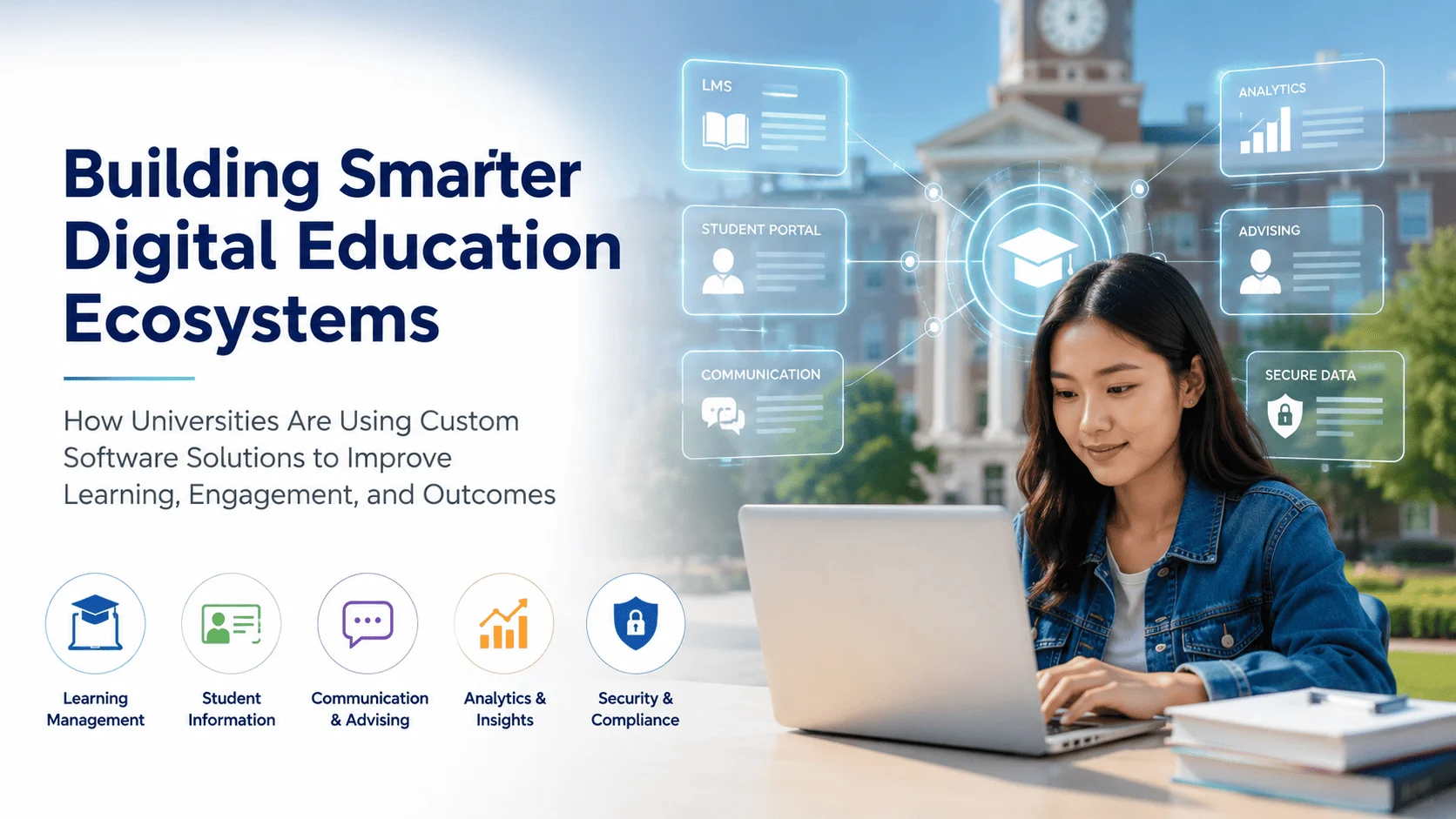
Today's students do more than just attend lectures and read textbooks—they learn online, submit assignments digitally, check their portals for financial aid updates, and reach out for advising support through various platforms. If these systems are disconnected, the student experience becomes frustrating. As universities adapt to the expectations of digital-native students, they are increasingly relying on custom software solutions to build smarter, interconnected digital education ecosystems.
Rather than adopting generic tools that only solve a single problem, many forward-thinking institutions are rethinking their entire digital infrastructure. An effective digital ecosystem brings everything together—learning management systems (LMS), administrative portals, advisory dashboards, and data analytics—into one seamless, secure environment.
The EdTech Market and Digital Transformation
The rapid evolution of educational technology is supported by substantial market trends. According to Grand View Research and Mordor Intelligence, the global EdTech and Learning Management System (LMS) markets are experiencing significant double-digit growth. This expansion highlights the fact that educational institutions are actively investing in digital transformation to improve learning outcomes and administrative efficiency.
Beyond the Basic LMS: What Makes a Smart Digital Ecosystem?
In the past, digitizing education often meant nothing more than moving classroom materials to a basic LMS. Today, a smart digital ecosystem goes much further. It connects every part of the student journey into a unified platform. From the moment you research universities and enroll, until graduation, all your academic and administrative needs are supported in one place.
Custom-built solutions allow universities to create tailored environments that meet their specific operational needs and the unique learning preferences of their students. This means fewer disconnected logins, more personalized support, and a more intuitive learning experience.
Adaptive Learning & Personalized Paths
What happens when you fall behind on one lesson and the class simply moves on without you? Every learner has a different pace. AI-powered education platforms can help here and they're expanding fast. Rather than relying on off-the-shelf adaptive tools that run on generic algorithms, universities can build custom platforms that match their actual course structure and grading patterns, offering more tailored recommendations.
Unified Dashboards and Personalized Portals
A smart ecosystem typically features a unified student portal. Instead of checking a separate website for financial aid, another for registration, and yet another for coursework, you can access everything through a single dashboard. Custom software enables universities to design portals that prioritize the information you need most, creating a streamlined, personalized digital experience.
Early-Alert and Advising Integration
Custom e-learning architectures often connect academic systems with advising networks to flag potential warning signs early. For instance, if a student's engagement drops or assignments are missed, an integrated system can automatically notify an academic advisor. This proactive approach ensures students receive the necessary support precisely when it can make a real difference in their educational journey.
Institutional Analytics and Retention Planning
Connected systems benefit universities as much as students. By studying patterns across student cohorts, universities can identify structural challenges—such as courses with high difficulty curves or programs with lower retention rates. This data-driven approach helps universities continuously improve their course offerings, direct advising resources effectively, and refine their overall educational strategy.
A custom-built ecosystem also streamlines IT management. Instead of juggling separate vendor contracts and disjointed integrations, universities manage a unified governance layer, gaining better control over upgrades and system accountability.
How Universities Protect Your Data and Privacy
To provide personalized experiences, universities must process significant amounts of student data, from academic progress to engagement patterns. Protecting this data is a critical responsibility. Security and privacy must be foundational components of any institutional software implementation.
Research from IBM indicates that data breaches in the education sector can cost institutions millions of dollars, with ransomware demands presenting severe financial risks. Globally, identifying and containing such breaches can take significant time, emphasizing the need for robust, proactive security measures.
FERPA and GDPR Compliance
In the United States, the Family Educational Rights and Privacy Act (FERPA) governs how education records are accessed and shared. For students connected to the European Union, the General Data Protection Regulation (GDPR) enforces strict rules regarding data consent and handling. Modern educational software must be explicitly designed to meet these stringent regulatory requirements and protect student privacy.
Role-Based Access Controls
A secure system relies on Role-Based Access Control (RBAC). This ensures that university personnel only access the specific information necessary for their roles. For example, a financial aid officer can access billing records but cannot view a student's academic transcript. This minimizes unnecessary exposure of sensitive data.
Ongoing Governance and Oversight
As universities integrate AI and advanced analytics, continuous governance—including regular security audits and clear data retention policies—is essential. Technology tools should be thoroughly vetted for privacy, accuracy, and security before being deployed across an institution.
When you compare universities, it is wise to review their published privacy policies and data-use statements. Institutions with transparent, robust security protocols are generally better prepared to protect your digital identity.
Evaluating a University's Digital Infrastructure
When researching where to study, a university’s digital infrastructure is an important factor. Here are key indicators that an institution has successfully modernized its technology:
Single Sign-On (SSO)
Check if you can access your primary portals—LMS, email, and the library—using a single login. Disconnected credentials often signal a fragmented digital ecosystem.
Streamlined Administrative Processes
Core tasks like course registration, fee payments, and accessing records should be seamless online experiences. A university committed to its digital infrastructure ensures these everyday processes are intuitive and efficient.
Mobile Accessibility
A modern, mobile-friendly portal is a reliable indicator of ongoing digital modernization. You should be able to navigate essential university resources smoothly from your smartphone without being forced to use a desktop computer.
System Reliability During Peak Demand
Ask current students or check forums to see how the university's systems handle peak periods, such as registration week or exam season. Frequent crashes, slow portals, or disconnected systems suggest underinvestment in the technology that students rely on daily.
Final Takeaway: The Digital Experience You Should Expect
Students today expect elevated, seamless digital learning experiences. Off-the-shelf software often falls short, prompting universities to invest in custom educational technology. This shift helps institutions build connected, secure, and intuitive learning environments.
By embracing digital transformation, universities create holistic ecosystems where various platforms function as a cohesive whole. As a result, students can spend less time navigating disconnected administrative hurdles and more time focusing on learning, growth, and academic success.

Samrat Biswas
Samrat Biswas is a distinguished VP of Operations, Engineering, and Growth at Unified Infotech, renowned for his deep expertise in scaling teams and refining processes. Samrat’s writings are informed by his wealth of experience, offering readers valuable insights into the intricacies of engineering leadership, operational efficiency, and driving transformational change within organizations.