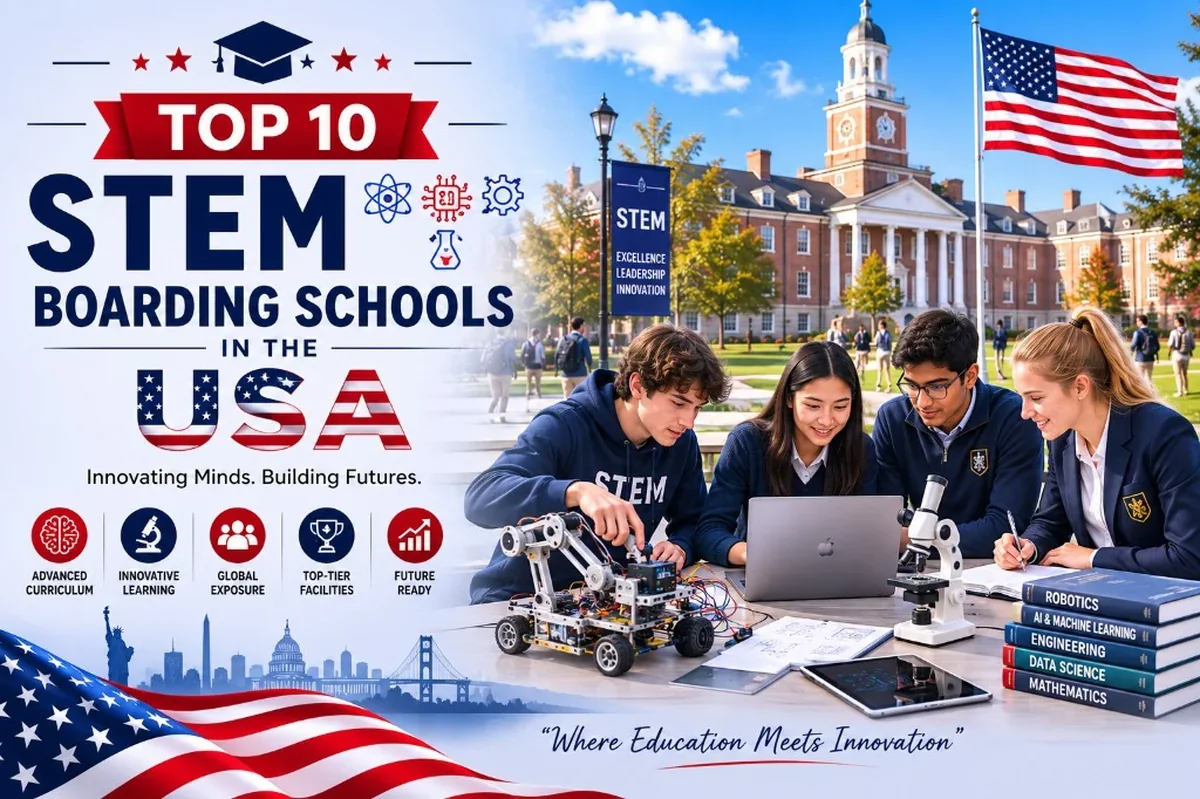
Overview: Most “best boarding school” lists rank by overall Niche score or general reputation. This guide takes a different angle: the top 10 STEM boarding schools in the USA, selected specifically for science research facilities, math competition depth (AMC/AIME/USAMO), robotics programs, and computer science course offerings. All ten are elite New England or California boarding schools with residential science research options — not day-only STEM academies.
Parents searching “best STEM boarding schools” often land on generic prep-school rankings that weigh sports, arts, and college matriculation equally with science and math. This list narrows the focus: which residential boarding schools give a serious STEM-track student the strongest labs, research mentorship, competitive math culture, and computer science depth before college?

How we selected these STEM boarding schools
- Dedicated science research programs: Schools offering independent or mentored research beyond the standard AP curriculum
- Math competition culture: Active participation in AMC, AIME, and (for top performers) USAMO, plus math team depth
- Computer science & robotics: Standalone CS departments, robotics teams, and hackathon/competition participation
- Facilities: Purpose-built science centers, maker spaces, and specialized labs
- Boarding format: All ten are traditional residential boarding schools, not day-only STEM magnet schools
Top 10 STEM boarding schools in USA (2026)
| # | School | Location | STEM strength |
|---|---|---|---|
| 1 | Phillips Exeter Academy | Exeter, NH | Harkness-method math curriculum, deep AMC/AIME participation, strong CS electives |
| 2 | Phillips Academy (Andover) | Andover, MA | Extensive science research electives, longstanding MS² STEM outreach program, strong math team |
| 3 | The Hotchkiss School | Lakeville, CT | Independent science research courses, environmental science field programs, robotics club |
| 4 | Choate Rosemary Hall | Wallingford, CT | Kohler Environmental Center — a residential environmental science immersion semester |
| 5 | The Lawrenceville School | Lawrenceville, NJ | Strong robotics and engineering electives, competitive math team, science research seminar |
| 6 | Deerfield Academy | Deerfield, MA | Modern science building, growing CS/data science course sequence, math competition team |
| 7 | Loomis Chaffee School | Windsor, CT | Dedicated CS department, robotics program, sustainability-focused science initiatives |
| 8 | Cate School | Carpinteria, CA | Small classes with high faculty access for independent science research projects |
| 9 | Milton Academy | Milton, MA | Strong AP science sequence, active math team, computer science electives through AI/data topics |
| 10 | St. Paul’s School (Concord) | Concord, NH | Advanced science labs, math team tradition, research-based capstone options |
All ten schools also appear on general “highly competitive boarding schools” lists — the ranking above reorders them specifically by STEM program depth, which is not always the same as overall Niche or reputation rank.

What makes a boarding school genuinely strong in STEM?
| Signal | What to look for when researching a school |
|---|---|
| Course catalog depth | Multiple CS courses beyond “Intro to Programming” (e.g. data structures, AI/ML, multivariable calc-based physics) |
| Independent research options | A formal research seminar, thesis, or mentored lab project track, not just AP Research |
| Math competition results | Ask for the school’s AMC/AIME participation numbers and any recent USAMO qualifiers |
| Facilities | Purpose-built or recently renovated science/engineering buildings with maker spaces |
| Faculty credentials | PhD-holding science faculty who actively mentor outside projects or competitions |
| Outside partnerships | Ties to nearby universities, national labs, or summer research programs |
Choate’s Kohler Environmental Center: a model STEM program
Choate Rosemary Hall’s Kohler Environmental Center (KEC) is one of the most distinctive STEM offerings among elite boarding schools: a residential, semester-long environmental science immersion where a small cohort of students lives and studies at an off-campus, sustainability-focused facility, combining fieldwork, data collection, and interdisciplinary coursework. Programs like this illustrate how STEM strength at the boarding-school level increasingly means hands-on, research-format learning — not just AP course counts.
Math competitions: a useful, verifiable STEM signal
Because private schools do not always publish detailed STEM outcome data, one of the more objective signals families can check is participation in the American Mathematics Competitions (AMC/AIME), run by the Mathematical Association of America (MAA). Schools with strong STEM cultures typically:
- Register large cohorts for AMC 10/12 each year, not just a handful of top students
- Produce multiple AIME qualifiers annually
- Occasionally produce USAMO qualifiers or Math Olympiad program invitees, an extremely high bar nationally
Ask an admissions office directly for recent competition results — official participation data is published by the MAA but is not always broken out publicly by individual school.
Boarding vs. day STEM programs: a quick comparison
| Factor | STEM-strong boarding schools (this list) | Specialized public STEM magnet day schools |
|---|---|---|
| Residential experience | Full boarding life, 24/7 community and structure | Typically day-only, students live at home |
| Curriculum breadth | Strong STEM plus full liberal arts, arts, and athletics requirements | Often deeply specialized in STEM with fewer non-STEM requirements |
| Cost | $65,000–$78,000+ per year (need-based aid available at many) | Often free or low-cost for eligible in-district or in-state students |
| Admissions pool | National and international | Usually regional or statewide only |
| College counseling network | Established relationships with elite college admissions offices built over decades | Varies widely by school and district |
Neither format is universally “better” for STEM outcomes — a specialized public magnet may offer deeper single-subject immersion at a much lower cost, while a boarding school offers a more rounded experience alongside strong STEM depth.
Cost of attendance at top STEM boarding schools
| Cost line | Typical boarding tuition range (2025–26) |
|---|---|
| Full boarding tuition, room & board | ~$65,000–$78,000 per year |
| Financial aid | Several schools on this list (Exeter, Andover) offer need-based aid, and Andover and Exeter both have committed to no-loan, full-need policies for admitted families |
| Additional STEM costs | Lab fees, competition travel, and summer research programs may carry extra costs — ask each school directly |
Summer research programs that complement these schools
Many students at STEM-strong boarding schools supplement their in-school curriculum with competitive external summer research programs. While these are not run by the boarding schools themselves, awareness of them helps illustrate what “serious STEM culture” typically leads toward:
| Program | Focus | Relevance to boarding school STEM students |
|---|---|---|
| Research Science Institute (RSI) | Interdisciplinary STEM research, hosted at MIT | Highly competitive; boarding school students with strong faculty research mentorship are well-positioned to apply |
| MIT PRIMES / other university-affiliated math-research programs | Advanced mathematics research for high schoolers | A natural next step for students from schools with deep math team cultures |
| Summer Science Program (SSP) | Astrophysics or biochemistry research | Popular among students seeking hands-on lab research outside the school year |
| USA Computing Olympiad (USACO) | Competitive programming | An objective, year-round benchmark for CS-focused students regardless of school |
Ask a school’s college counseling or STEM department how many students they typically support in applying to programs like these — it is a useful proxy for how seriously the school treats outside research opportunities.
How to evaluate STEM strength during your school search
- Request the science and CS course catalog, not just the general curriculum guide.
- Ask about independent research or thesis options and how many students complete one per year.
- Check math team participation numbers and recent AIME/USAMO results.
- Tour the science facilities in person or virtually — age and equipment quality vary widely even among elite schools.
- Ask about university partnerships or access to nearby research labs and summer programs.
For selectivity-focused comparisons of many of these same schools, see our companion guide to the hardest boarding schools to get into in the USA. Browse more profiles in our USA Schools category.
Frequently asked questions: top STEM boarding schools in USA
Which boarding school has the best STEM program in the USA?
There is no single official “STEM ranking” for boarding schools, but Phillips Exeter Academy, Phillips Academy (Andover), and Choate Rosemary Hall (via its Kohler Environmental Center) are consistently cited for the depth of their science, math, and research offerings among elite Northeastern boarding schools.
Do boarding schools offer real scientific research opportunities, or just AP classes?
The strongest STEM boarding schools go beyond AP coursework, offering independent research seminars, mentored lab projects, and in some cases residential immersion programs (like Choate’s Kohler Environmental Center). Always ask a specific school what percentage of students complete an independent research project.
Are these STEM boarding schools also academically selective overall?
Yes — all ten schools on this list are highly selective, elite boarding schools with competitive admissions across all subjects, not STEM-only admission tracks.
Do STEM-strong boarding schools have good computer science programs?
Most do, though depth varies. Schools like Loomis Chaffee and Deerfield have expanded dedicated CS departments and data science courses in recent years; ask for the current CS course sequence when researching, since offerings change year to year.
Is there a formal ranking of STEM boarding schools like there is for colleges?
No. Unlike U.S. News college rankings, there is no standardized, numerically ranked list of STEM boarding school programs. This guide is based on program depth, facilities, and competition participation rather than a single official methodology.
How much does it cost to attend a top STEM boarding school?
Full boarding tuition, room, and board typically runs $65,000–$78,000 per year at these schools. Several offer generous need-based financial aid, including no-loan policies at some institutions — confirm current figures directly with each admissions office.
Can international students study at these STEM boarding schools?
Yes, all ten schools enroll international boarding students, typically on an F-1 student visa. International admission is highly competitive and often need-aware for financial aid purposes — check each school’s international admissions page for specifics.
Should I choose a STEM boarding school over a specialized STEM day school?
It depends on priorities. Specialized STEM-only schools may offer deeper subject specialization, while these boarding schools combine strong STEM programs with broad liberal arts, athletics, and residential life — a better fit for students who want STEM depth without narrowing their whole high school experience to one subject area.
Do students at these schools go on to competitive summer research programs?
Many do. Programs like MIT’s Research Science Institute (RSI), MIT PRIMES, and the Summer Science Program are popular next steps for students who have already built a strong research or math foundation at schools like these — though admission to those external programs is separately competitive and not guaranteed by boarding school attendance.
How do I compare STEM facilities between two schools I'm considering?
Request a tour of the science and engineering buildings specifically, ask when they were last renovated, and ask how many independent research projects or theses were completed in the STEM departments in the past year. Facilities age and course catalogs both change over time, so always verify current details rather than relying on older published reviews.
Final overview
The top STEM boarding schools in the USA combine serious science and math infrastructure — research seminars, competition math culture, robotics, and specialized facilities like Choate’s Kohler Environmental Center — with the traditional boarding-school residential experience. Families should verify current course catalogs, research opportunities, and competition results directly with each admissions office, since program strength can shift as faculty and facilities change.
Disclaimer: Program offerings, facilities, and admissions policies change over time. This article summarizes publicly available program descriptions for planning purposes only. Confirm current STEM curriculum details and admissions requirements directly with each school before applying.

Saahil
Saahil is an education researcher and content creator specializing in university rankings, admissions strategies, and student guides. He is dedicated to helping students make informed academic decisions.
Continue your research
Top 10 Hardest Boarding Schools to Get Into in the USA (2026 Guide)
The top 10 hardest boarding schools to get into in the USA for 2026 by reported selectivity: Groton, Exeter, Andover, St. Paul's, Hotchkiss, Deerfield, Lawrenceville, Choate, Milton, and Cate.
Read the guide →
Top 15 Australian Boarding Schools (2026 Guide)
Top 15 Australian boarding schools for 2026: Geelong Grammar, Melbourne Grammar, King's School, Scotch College, and more, with state curriculum differences and FAQs.
Read the guide →
Top 20 Boarding Schools in the USA (2026 Niche Rankings Guide)
Top 20 boarding schools in the USA for 2026 using Niche rankings: Hotchkiss, Exeter, Choate, Andover, plus admissions tips and FAQs.
Read the guide →
Top 20 Canadian Boarding Schools (2026 Admissions Guide)
Top 20 Canadian boarding schools for 2026: Upper Canada College, Appleby, Branksome Hall, Bodwell, and more, with admissions, IB availability, and cost guidance.
Read the guide →