
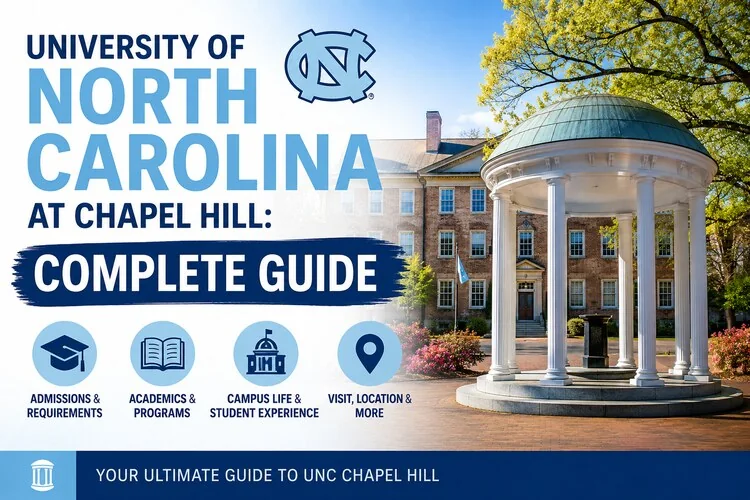
If you are looking for a university that offers Ivy-League level academics without the private school price tag, the University of North Carolina at Chapel Hill (UNC) is probably on your radar. Known widely as one of the original "Public Ivies," UNC offers more than 300 degree programs and handles a massive community of thinkers, creators, and athletes.
But what does it actually take to get in? What are the hidden catches for out-of-state students? In this complete guide, we will break down the real numbers for 2026—covering everything from the selective admissions process and top-tier majors to actual costs and daily campus life.
Chartered way back in 1789, UNC was the first public university in the US to actually open its doors and teach students. Cut to today, and it has grown into a bustling campus of over 32,000 students. The magic of Chapel Hill lies in its balance: it is large enough to pull in billions in research funding, yet structured enough that you won't feel like just another number in a crowded lecture hall.
Academic Programs and Specializations
Top Undergraduate Schools & Majors
UNC Chapel Hill keeps its student-to-faculty ratio at 14:1. This means you actually get to interact with your professors and build a network. Undergraduates choose from over 70 majors across several highly competitive schools:
-
College of Arts and Sciences: This is the academic core of the university. Whether you are into computer science, quantitative biology, history, or political science, this college handles the bulk of undergraduate programs.
-
UNC Kenan-Flagler Business School: A world-famous business school. If your goal is investment banking, management consulting, or launching a startup, their undergraduate business program is incredibly prestigious.
-
UNC School of Nursing: Consistently ranked among the top 5 nursing programs in the country, offering intense hands-on clinical training.
-
Hussman School of Journalism and Media: The go-to spot for future media executives, investigative journalists, and digital strategists.
A massive perk here is academic flexibility. Around 40% of Tar Heels end up double-majoring or pairing their degree with specialized minors to stand out in the job market.
Graduate and Professional Programs
UNC is just as dominant at the post-graduate level, running some of the most respected professional schools in the world:
-
UNC School of Medicine: Highly celebrated for its primary care tracks and life-saving biomedical research.
-
Gillings School of Global Public Health: Ranked as the #1 public school of public health in the United States.
-
UNC School of Law: A premier law school with exceptional tracks in environmental, constitutional, and corporate law.
Internships, Research, and Study Abroad
-
Undergraduate Research: You don't have to wait until grad school to work in a lab. Over 70% of seniors do original research here.
-
The Research Triangle Advantage: UNC sits right next to Research Triangle Park (RTP)—the biggest dedicated research park in the country. This means direct access to internship pipelines at major tech, healthcare, and biotech firms.
-
Global Learning: With 150+ study abroad programs across 50 countries, international exposure is easily accessible.
Admission Requirements and Process
The Residency Rule: In-State vs. Out-of-State
Before you write your essays, you need to understand how UNC admissions work. By North Carolina state law, at least 82% of the incoming first-year class must be from inside North Carolina.
Because out-of-state and international students compete for a tiny 18% slice of the pie, the acceptance rates look wildly different depending on where you live:
| Admissions Metric | In-State (NC Residents) | Out-of-State / International |
| Real Acceptance Rate | 38% – 43% | ~8% |
| Middle 50% SAT Range | 1360 – 1510 | 1400 – 1530 |
| Middle 50% ACT Range | 28 – 33 | 32 – 35 |
| High School Standing | Top 10% of class | Top 1%–5% of class |
The Reality Check: If you are applying from outside North Carolina, getting into UNC is mathematically just as difficult as getting into an Ivy League school like Cornell or UPenn.
Application Checklist
You will apply through the Common Application. To build a strong file, make sure you have:
-
A Rigorous Transcript: They want to see that you took the hardest classes available to you (AP, IB, or Honors).
-
Letters of Recommendation: One from a core subject teacher and one from your school counselor.
-
Standout Essays: Your main Common App essay plus UNC's short-answer questions. Use these to show your personality, not just your achievements.
-
Test Scores: Test-optional policies can change based on state board decisions, so check the live admissions portal. If you are applying from out-of-state, submitting a high score (SAT 1450+ / ACT 32+) is highly recommended.
Deadlines to Remember
-
Early Action: November 1 (Get your decision in January)
-
Regular Decision: January 15 (Get your decision in March)
Campus Life and Student Resources
The Student Community
Chapel Hill has an incredibly active campus culture. With roughly 19,000 undergrads and 13,000 graduate students, the campus feels alive but never overwhelming. Students come from all 50 states and over 100 countries. Plus, UNC does a phenomenal job supporting first-generation college students, who make up 22% of the student body.
Athletics and Campus Culture
School spirit here isn't optional—it's a lifestyle. As part of the NCAA Division I Atlantic Coast Conference (ACC), Tar Heel sports are legendary. The basketball rivalry with Duke University transforms the entire town into an electric, blue-tinted festival every single year. Beyond sports, there are over 800 student organizations, ranging from pre-professional consulting clubs to zero-waste environmental groups and creative writing circles.
Living and Career Placements
-
Housing: First-year students live on campus, which helps everyone mix, mingle, and find their friend groups early on.
-
Career Network: The University Career Services team doesn't just look at resumes; they connect you directly with employers. UNC boasts a massive 92% job or graduate school placement rate within six months of graduation.
Cost, Tuition, and Financial Aid
Estimated Cost of Attendance (2025–2026 Academic Year)
| Expense Item | In-State NC Residents | Out-of-State / International |
| Tuition & Required Fees | $8,994 | $41,203 |
| On-Campus Room & Board | $13,804 | $13,804 |
| Books & Supplies | $1,290 | $1,290 |
| Travel & Personal Expenses | $2,932 | $2,932 |
| Total Estimated Cost / Year | $27,020 | $59,229 |
Financial Aid Programs That Actually Help
Even though the out-of-state cost looks high, UNC is widely regarded as one of the most financially supportive public schools in America.
-
The Carolina Covenant: If you come from a low-income household and qualify for this program, UNC guarantees you will graduate 100% debt-free. They completely replace student loans with clean grants and work-study jobs.
-
The Morehead-Cain Scholarship: This is the oldest merit scholarship in the US. It covers your entire tuition, room, board, custom laptop, and four years of fully funded summer travel experiences around the globe.
Rankings and Reputation
UNC is a proud member of the elite Association of American Universities (AAU) and routinely sweeps national value charts:
-
U.S. News & World Report: Ranked as the #4 Top Public University in the United States.
-
#1 Best Value Public School: Held the top spot for over two decades because of how low its graduate debt rates are compared to the quality of education it delivers.
-
Research Power: Secures over $1.2 billion every year in research funding, putting it at the absolute forefront of medicine, pharmacy, and tech innovation.
Conclusion
The University of North Carolina at Chapel Hill is a unique beast. It gives you the prestige, networking power, and research funding of an elite private school while keeping its soul rooted in public accessibility.
If you are planning to apply, focus heavily on keeping your grades up, tackling rigorous courses, and writing an essay that shows who you are outside the classroom. Your path to Chapel Hill starts with a well-planned application strategy!
Key Takeaways
-
Out-of-State Cutoffs: Out-of-state applicants face an ultra-competitive ~8% acceptance rate due to strict state-enforced caps.
-
Flagship Majors: Kenan-Flagler Business, Nursing, and Global Public Health are highly regarded highlights.
-
Stellar Value: Signature initiatives like the Carolina Covenant mean top-tier education doesn't have to mean lifelong debt.
FAQs
1. What fields of study is UNC Chapel Hill most famous for?
UNC is an absolute powerhouse for pre-med tracks, public health initiatives, clinical nursing fields, journalism, and elite corporate undergraduate business placements via the Kenan-Flagler Business School.
2. Is it actually harder to get into UNC if I live outside North Carolina?
Yes, by a wide margin. Because state regulations mandate that 82% of the student body must be from North Carolina, out-of-state acceptance rates hover around 8%. Applicants need exceptional GPAs, high standardized test scores, and deep leadership resumes to stand out.
3. What is the true total cost for an out-of-state student?
The all-inclusive estimated cost of attendance for an out-of-state student sits at approximately $59,229 per academic year. This includes $41,203 for tuition and mandatory fees, along with roughly $13,804 for on-campus room and board.
4. Can international students get financial aid at UNC?
While federal need-based aid is restricted to U.S. citizens, international students are automatically considered for elite, highly competitive merit-based scholarships (such as the Morehead-Cain or Robertson Scholars programs) during the main admissions evaluation cycle.

Saahil
Saahil is an education researcher and content creator specializing in university rankings, admissions strategies, and student guides. He is dedicated to helping students make informed academic decisions.
Continue your research

North Dallas High School: Historic Urban Bulldog Campus
North Dallas High School (NDHS) is a historic public high school serving grades 9–12 in the Oak Lawn and Uptown area of Dallas, Texas, as part of the Dallas…
Read the guide →
What Is Northwestern University Known For? (The 2026 Insider Guide)
Northwestern University is often called the "Ivy of the Midwest," but that title barely scratches the surface.
Read the guide →
University Cost Comparison Checklist: Find the Real Total
A step-by-step worksheet for comparing tuition, living expenses, aid, deposits and hidden study costs across universities and countries.
Read the guide →
Brown University: Admissions Guide 2026 | Requirements & Majors
Everything you need to know about Brown University: admission requirements, SAT/ACT scores, tuition costs, popular majors, and campus life. Apply now!
Read the guide →