The 2026 Selective School Exam is the gateway to New South Wales’ most prestigious academic institutions. However, if you are preparing based on old 2023 or 2024 blogs, you might be following outdated advice.
From computer-based testing to a complete shift in scoring weightage, the 2026 cycle (for Year 7 entry in 2027) is a “Digital First” era. This guide covers the absolute latest requirements and strategies to ensure your child isn’t just a participant, but a top scorer.
1. What’s New in 2026? (The Game Changers)
Before diving into the subjects, you must understand the two major structural changes made by the NSW Department of Education:
- Equal Weighting (25% Rule): In previous years, ‘Thinking Skills’ carried more weight (35%) and ‘Writing’ was less significant (15%). From 2026, all four sections are worth exactly 25% each. You can no longer afford to neglect Writing.
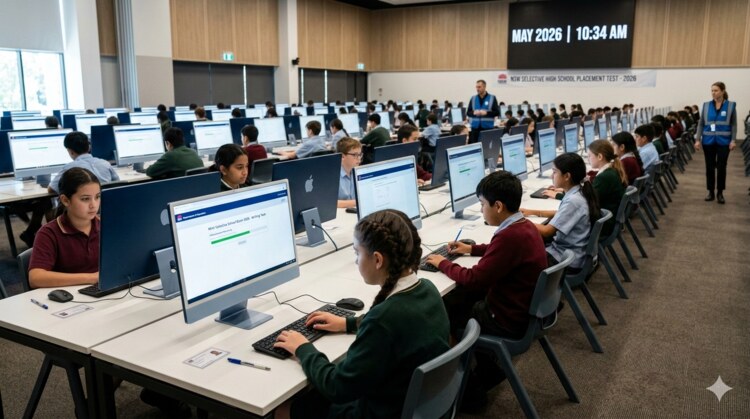
- Fully Computer-Based: The exam is no longer a paper-and-pencil test. It is held at external test centers on computers. Typing speed and digital literacy are now just as important as academic knowledge.
2. Key Dates for the 2026 Cycle
Keep these dates in your calendar to avoid missing the window:
- Applications Period: Opened 6 November 2025 – Closed 20 February 2026.
- Test Admission Tickets: Expected around 17 April 2026.
- Main Test Dates: 1–2 May 2026 (Students attend one allocated day).
- Make-up Test Date: 22 May 2026 (Only for approved illness/misadventure).
- Outcome Release: Late August 2026.
3. The 2026 Exam Structure: Section-by-Section
The exam consists of four distinct segments. Here is the updated breakdown for 2026:
I. Reading (45 Minutes | 17 Questions)
The 2026 Reading test has moved away from simple “fact-finding.” It now features 38 specific answers across 17 questions (some are multi-part).
- Focus: Inference, author’s intent, and comparative analysis of multiple texts.
- Tip: Students must practice reading long passages on a screen to build “digital stamina.”
II. Mathematical Reasoning (40 Minutes | 35 Questions)
This isn’t a school-level maths test; it is a reasoning test.
- Focus: Problem-solving, number sense, and logical application of concepts. Calculators are NOT permitted.
- Tip: Focus on word problems where the “maths” is hidden behind a story.
III. Thinking Skills (40 Minutes | 40 Questions)
This section has replaced the old ‘General Ability’ test.
- Focus: Logical deduction, argument analysis, and identifying flaws in reasoning.
- Tip: This is often the “tie-breaker” section. Practice non-verbal reasoning and syllogisms.
IV. Writing (30 Minutes | 1 Prompt)
Since it now carries 25% weight, Writing is often the difference between a “Reserve List” and a “Placement Offer.”
- Focus: Clarity of ideas, sophisticated vocabulary, and structure.
- The Typing Factor: Students are expected to type roughly 200–300 words in 30 minutes. If your child’s typing speed is below 25 WPM, they will struggle to finish.
4. How Competitive is it? (Latest Stats)
Competition in the Hills District and North-West Sydney is at an all-time high.
- Total Applicants: ~17,000 students across NSW.
- Top Schools: James Ruse, Baulkham Hills, and North Sydney Boys/Girls require performance in the top 5-8% of the state.
- The Ranking System: Students are ranked against their peers. A “Good Score” is relative, but aiming for Band 1 (Highest) in at least 3 sections is the goal for elite schools.
5. Strategic Preparation for 2026
To reach a 10/10 performance level, follow this 3-step strategy:
- Digital Mock Tests: Do not practice only on paper. Use online platforms that simulate the actual test interface (drag-and-drop, dropdown menus, and on-screen timers).
- Typing Drills: Dedicate 10 minutes a day to touch-typing. A student who types comfortably has more “brain power” left to focus on the actual content of their story.
- The “60-Second Rule”: In Mathematical Reasoning and Thinking Skills, students have roughly 60-70 seconds per question. Practice skipping “time-sink” questions to ensure they reach the end of the test.
6. What Happens After the Test?
Once the test is over on May 2nd, the wait begins.
- Outcome: You will receive an offer, a reserve list spot, or an unsuccessful notice in Late August.
- School Preferences: You can change your school choices until 5 June 2026. If your child felt the test was harder than expected, you might want to adjust your 2nd or 3rd preference accordingly.
FAQs
Q: Can we bring our own laptop? A: No. Test centers provide the computers.
Q: Is there still a “School Assessment Score” (SASS)? A: No. The placement is now 100% based on the placement test performance. School marks from your primary school are no longer part of the calculated score.
Q: Where can I find official practice tests? A: The NSW Department of Education website has several “Computer-Based Practice Tests” that show the exact layout your child will see on exam day.
Conclusion
The 2026 Selective School Exam is a marathon, not a sprint. With the shift to equal weighting and digital testing, the “winning” student is one who is technically proficient and academically balanced. Focus on Writing, master the keyboard, and stay updated with official announcements.Ready to start? Download the official 2026 Selective Test Sample Papers today and give your child the competitive edge they deserve!
For more info visit :- topschoolsrankings.com