
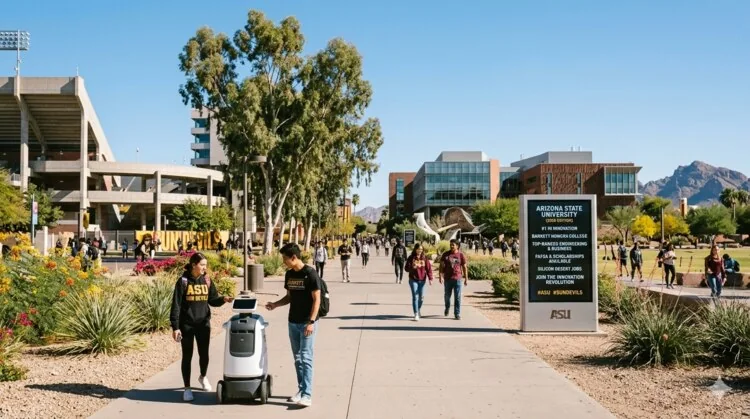
Arizona State University: The Complete 2026 Guide to Admissions, Costs & Campus Realities
Recognized consistently for institutional innovation and research scaling, Arizona State University (ASU) is one of the largest public research universities in the United States. With an expansive academic footprint spanning metropolitan Phoenix and globally distributed online programs, ASU serves over 140,000 undergraduate and graduate students.
However, navigating ASU’s decentralized campus system, understanding the true out-of-state cost of attendance, and evaluating competitive entry into specialized colleges like the Ira A. Fulton Schools of Engineering or Barrett, The Honors College requires granular analysis beyond promotional brochures.
This analytical guide provides verified tuition breakdowns, campus distribution distinctions, standardized testing policies, STEM OPT career pathways, and strategic admission steps.
ASU at a Glance: Key Institutional Metrics
| Metric / Parameter | Data / Specification |
|---|---|
| Institution Type | Public R1 High-Research Activity University |
| Undergraduate Acceptance Rate | ~88% (General Admission; Honors & Engineering are more competitive) |
| Metro Phoenix Campuses | Tempe (Historic/Main), Downtown Phoenix, Polytechnic (Mesa), West Valley (Glendale) |
| Student Body Size | 140,000+ (Total enrollment across physical campuses and ASU Online) |
| Standardized Testing Policy | Test-Optional (SAT/ACT not mandatory for general admission, but beneficial for scholarships) |
| Accreditation Body | Higher Learning Commission (HLC); ABET accredited for Engineering |
The Four-Campus Model: Where Will You Actually Study?
A common misconception among prospective applicants is assuming all academic life happens in Tempe. ASU operates a unified multi-campus ecosystem across the Phoenix metropolitan area where programs are tethered to specific campuses:
1. Tempe Campus (The Historic Core)
The flagship and densest campus, housing traditional collegiate architecture, massive student unions, NCAA athletic venues, and Sun Devil Stadium. It is home to the College of Liberal Arts and Sciences, the Ira A. Fulton Schools of Engineering (main programs), and the W. P. Carey School of Business.
2. Downtown Phoenix Campus
An urban campus embedded directly into the commercial and civic core of Phoenix. This location is designed for professional pre-career immersion, housing the Walter Cronkite School of Journalism and Mass Communication, the Watts College of Public Service & Community Solutions, and the Edson College of Nursing and Health Innovation.
3. Polytechnic Campus (Mesa)
Located in the East Valley, this campus functions as a hands-on, maker-centric laboratory environment. It is the hub for aviation flight programs, manufacturing engineering technology, user experience design, and robotics test beds.
4. West Valley Campus (Glendale)
A self-contained, liberal arts-style collegiate environment with Spanish courtyard architecture. It specializes in business forensics, cybersecurity, psychology, and interdisciplinary arts, offering smaller class sizes while retaining full university resource access.
2026 Cost of Attendance: Arizona Residents vs. Non-Residents
While Arizona residents benefit from subsidized public rates, out-of-state and international students encounter significantly higher financial commitments. The following table reflects realistic annual cost projections based on full-time undergraduate enrollment (30 credit hours per academic year):
| Expense Category | AZ Resident (Annual) | Non-Resident / International (Annual) | Strategic Notes |
|---|---|---|---|
| Base Tuition & Mandatory Fees | $12,500 – $14,000 | $34,500 – $38,500 | Program fees vary (e.g., Engineering & Business carry supplemental course fees). |
| On-Campus Housing & Meal Plan | $15,500 – $17,000 | $15,500 – $17,000 | Standard residential hall double room with mid-tier Sun Devil dining plan. |
| Books & Academic Supplies | $1,000 – $1,300 | $1,000 – $1,300 | Varies by STEM vs. Humanities major requirements. |
| Mandatory Health Insurance | N/A (Optional if covered) | $2,800 – $3,200 | Compulsory for all international F-1 and J-1 visa holders. |
| Personal & Transportation Costs | $2,500 – $3,500 | $3,500 – $4,500 | Valley Metro Light Rail between campuses is free for registered students. |
| Realistic Total Annual Commitment | $31,500 – $35,800 | $57,300 – $64,500 | Net total before institutional scholarships or financial aid. |
Undergraduate Admissions: Criteria & Competitive Programs
General Admission Assurance Benchmarks
ASU maintains assured admission criteria for undergraduate applicants who meet competency requirements. Applicants generally qualify if they fulfill at least one of the following thresholds:
- Top 25% graduating class rank in an accredited high school curriculum.
- Cumulative unweighted Grade Point Average (GPA) of 3.00 in core competency courses (based on a 4.00 scale).
- Minimum composite score of 1120 on the SAT (math and reading combined) or 22 on the ACT.
Barrett, The Honors College: Elite Cohort Pathway
Consistently recognized as one of the most prestigious public honors colleges in the United States, Barrett requires a distinct supplementary application beyond baseline ASU admission. Candidates must submit:
- Two specialized honors essay prompts focusing on critical inquiry and personal voice.
- Detailed resume/portfolio of extracurricular impact and research experience.
- Two academic letters of recommendation.
Barrett students pay an additional honors fee (approx. $1,000 per semester) but receive priority course registration, dedicated honors residential colleges, small seminar tracks, and individual faculty thesis advisors.
Scholarships & Financial Aid Mechanisms
Prospective students should actively explore merit-based discounting options:
- New American University (NAMU) Awards: Automatic merit-based scholarships awarded to high-achieving non-resident and international undergraduates based on cumulative incoming GPA and rigorous coursework. Awards range from $5,000 up to $15,500 annually and are renewable for four years maintaining a 3.0 college GPA.
- President’s & Provost’s Scholarships: Top-tier awards granted to the highest academic quartile of Arizona resident applicants, covering a significant portion of resident tuition.
- FAFSA Submissions: Domestic students should submit the Free Application for Federal Student Aid early to qualify for institutional grants, Federal Work-Study, and subsidized loan frameworks.
International Students: Visas, CPT & STEM OPT Extension
For international students holding an F-1 visa, ASU provides extensive career transition infrastructure:
- Curricular Practical Training (CPT): Students who have completed two consecutive full-time academic semesters can obtain off-campus internship authorization aligned with their major field of study.
- 36-Month STEM OPT Extension: Graduates from ASU’s extensive roster of ABET-accredited engineering, data analytics, software architecture, and biotechnology programs qualify for the 24-month STEM extension, granting up to 3 cumulative years of US work authorization without an immediate H-1B lottery petition.
- The Phoenix Silicon Desert Advantage: ASU’s strategic placement adjacent to semiconductor manufacturing expansions (TSMC, Intel) and logistics hubs provides localized post-graduate technical employment pipelines.
Frequently Asked Questions
Is ASU truly test-optional for out-of-state and international applicants?
Yes. ASU does not require SAT or ACT scores for general undergraduate admissions evaluation. However, submitting competitive standardized test scores is highly recommended for applicants seeking to strengthen their merit scholarship considerations (NAMU) or fulfill specific prerequisite requirements for Fulton Engineering.
How do students travel between the Tempe and Downtown Phoenix campuses?
ASU operates dedicated intercampus shuttle buses that run frequently seven days a week between Tempe, Downtown Phoenix, Polytechnic, and West Valley campuses. Additionally, the Valley Metro Light Rail directly connects Tempe with Downtown Phoenix.
Can an international student obtain a full-ride scholarship at ASU?
Full-ride scholarships covering 100% of tuition, housing, and living expenses are exceedingly rare for international undergraduates at public US state universities. While the New American University award significantly reduces tuition liability, families should be prepared to fund residual tuition, living costs, and mandatory medical insurance.
Editorial Standards & Verification: All tuition metrics, admission thresholds, and policy parameters in this guide are cross-verified against official published records from the Arizona Board of Regents (ABOR), ASU Financial Aid & Scholarship Services, and institutional admissions disclosures.

Saahil
Saahil is an education researcher and content creator specializing in university rankings, admissions strategies, and student guides. He is dedicated to helping students make informed academic decisions.
Continue your research
Algoma University for International Students: Admissions, Fees, Courses & Visa Guide
Choosing the right university in Canada is a crucial decision for international students.
Read the guide →
Appleby College Canada: Boarding School, Admissions, Fees & Student Life Guide for International Students
Appleby College is an independent boarding school in Canada.
Read the guide →
Bodwell High School Acceptance Rate 2026: Admissions Guide
Want to crack Bodwell High School admissions? Discover the real acceptance rate metrics, interview guide, and the preparation guide to stand out.
Read the guide →
Brown University: Admissions Guide 2026 | Requirements & Majors
Everything you need to know about Brown University: admission requirements, SAT/ACT scores, tuition costs, popular majors, and campus life. Apply now!
Read the guide →