
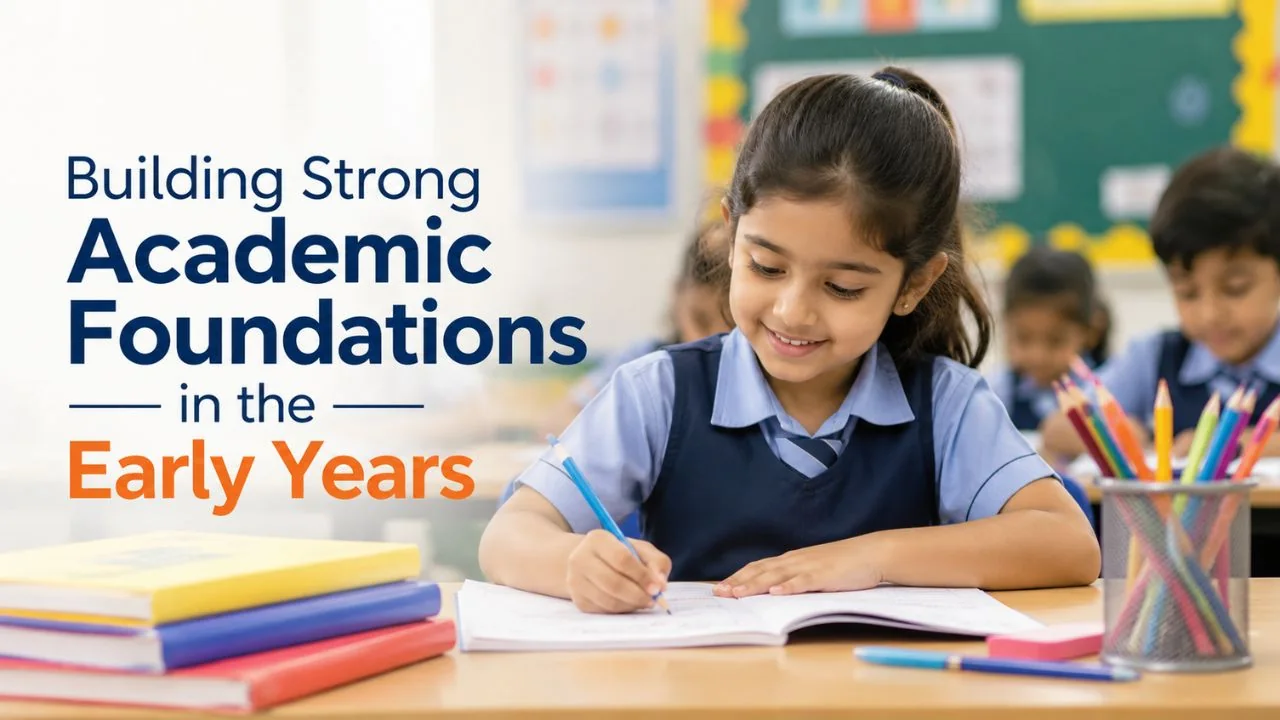
Most parents spend months picking the right school. But that is not what shapes your child's future.
What happens in the first few classrooms does.
Children who build strong reading and number skills between ages 3 and 8 do better throughout school. Not because they were pushed harder. Because something clicked at the right time, and that click stays.
What Does a Real Academic Foundation Look Like?
Reciting the alphabet or counting to 100 looks impressive at family functions. But that is not what actually matters.
What matters is language, mathematical thinking, curiosity, and creativity. Every subject your child will ever study grows from these four things.
Language runs through everything, not just English. And maths at this age is not about drilling tables. It is about spotting patterns and figuring things out. That kind of thinking, built early, stays with a child for life.
Why You Cannot Make Up for Lost Time Later
Harvard research puts it plainly. 90% of a child's core brain development is done before age five. Most parents do not act like that is true.
Children who start primary school with strong basics are three times more likely to complete secondary school, according to Brookings. Three times. And that gap rarely closes once the syllabus speeds up.
ASER 2023 showed exactly where India stands. Half of Class 5 children cannot read a Class 2 text. This did not happen overnight. It started quietly in Class 1.
NEP 2020 recognised this and launched NIPUN Bharat with one goal: every child reading and doing basic arithmetic by Grade 3. When something becomes a national mission, it usually means the problem was hiding in plain sight all along.
What You Can Do at Home Without Turning Your House into a Classroom
UNESCO's education reports consistently show that parental involvement in early learning is one of the strongest predictors of academic success. And it does not require you to run lessons at home every evening.
Here are three things that actually work:
-
Read with your child for just 15 minutes a day. Reading aloud builds vocabulary, comprehension, and a love for language that no school activity can fully replace. If you read in both English and your mother tongue, even better. Research shows children raised with two reading languages develop stronger memory and problem-solving skills.
-
Bring numbers into daily life naturally. Count vegetables while cooking. Ask your child to calculate change at the market. Let them measure something with a ruler. Children who see numbers as useful in real life build a much healthier relationship with maths than those who only meet numbers on a worksheet.
-
When your child asks why, do not always rush to answer. Try asking what you think first. That one small habit builds curiosity and independent thinking faster than most school programs can.
What a Good School Should Actually Be Doing
Not every school builds foundations well, even the ones with impressive buildings and long waiting lists. Here is what to look for when you visit or research a school:
-
In pre-primary years, play-based learning is not optional, it is essential. Children between ages 3 and 6 learn language, creativity, and problem-solving most effectively through structured play. A good pre-primary program has time built in for storytelling, free play, art, and movement. These are not fillers. They are the actual curriculum at this age.
-
The teacher to student ratio matters more in primary school than anywhere else. The Right to Education Act sets a 1:30 benchmark for primary classes. The best schools go lower. A teacher stretched across 40 children cannot give a struggling reader the attention they need in Class 1.
-
Ask how the school tracks reading and numeracy progress in Classes 1 and 2. A school that gives you specific feedback rather than a general grade at the end of term is one that actually knows where your child stands.
How School Selection Ties Into All of This
For families in Rajasthan, finding the best school in Jaipur for early years means going beyond the glossy brochure. It means asking how the school approaches foundational literacy, what the teaching philosophy is for primary grades, and whether the school actually balances structured learning with the play and creativity that young children need.
Talk to parents whose kids go to a good English medium CBSE school in Jaipur and you will hear the same things come up. Teachers who actually stay. A curriculum that makes sense. And honest updates on how their child is doing, not just a report card at the end of term. That consistency is what builds real reading and thinking habits, not just exam readiness.
When you are ready to start looking, most schools now have a school registration form online. Use that to do your homework before you visit. Start early, and trust what you see on a regular school day over anything you are told during an open house.
FAQs
Q1. When should a child start formal schooling?
Most experts say age 5 or 6. But learning that sticks actually starts earlier, around age 3, which is why pre-primary years matter more than most parents think.
Q2. Does the medium of instruction matter?
Yes. Children learn best in a language they already understand. Good schools find a way to balance mother tongue comfort with early English exposure.
Q3. What is NIPUN Bharat?
India's national mission to ensure every child can read and do basic math by Grade 3. If your child's school hasn't heard of it, that tells you something.
Q4. How do I know if my child's school is building a real foundation?
Ask how they track reading and numeracy in Classes 1 and 2. A good school gives you specifics, not just a grade at the end of term.
Q5. How important are extracurricular activities in a child's development?
Very important. Sports, music, arts, debates, and clubs help children build confidence, teamwork, creativity, leadership, and problem-solving skills alongside academics.
Q6. Should I choose a school based only on board exam results?
No. Strong board results matter, but they don't tell the whole story. Look at teaching quality, student engagement, life skills, and how well the school supports every child's overall growth.
Q7. How much homework is appropriate for primary school students?
Homework should reinforce learning, not overwhelm children. In the early years, short, meaningful activities that encourage reading, observation, and practice are more effective than long worksheets.
Q8. What should I ask during a school visit?
Ask about the teacher-student ratio, classroom teaching methods, safety measures, extracurricular opportunities, and how the school supports children who learn at different paces. A transparent school will answer confidently with real examples.

Saahil
Saahil is an education researcher and content creator specializing in university rankings, admissions strategies, and student guides. He is dedicated to helping students make informed academic decisions.
Continue your research

How to Verify University Accreditation Before You Apply
A practical country-by-country checklist for checking whether a university and programme are officially recognized before paying an application fee.
Read the guide →
How to Compare Universities Beyond Rankings: A 2026 Framework
Compare course fit, cost, outcomes, support and learning experience with official data instead of relying on one league-table position.
Read the guide →
University Cost Comparison Checklist: Find the Real Total
A step-by-step worksheet for comparing tuition, living expenses, aid, deposits and hidden study costs across universities and countries.
Read the guide →
How to Choose a UK University Course: Evidence Checklist
Compare UK university courses using modules, assessment, entry requirements, official outcomes and student-support evidence.
Read the guide →