James Ruse and Baulkham Hills are the two names that dominate selective-school conversations in Sydney's north-west — and unusually for a comparison like this, getting into either one runs through exactly the same door. Both are fully selective NSW government high schools. Both are co-educational. Both fill their Year 7 classes from a single test, the Selective High School Placement Test, on test performance alone. What separates them shows up later: in the 2025 HSC, 70.43 per cent of James Ruse course results achieved the top band, against 51.53 per cent at Baulkham Hills — a gap of almost 19 points between two schools that sit just suburbs apart. One of them also makes every student study Agriculture for four years. This page compares the two on the figures and rules that are published and checkable: HSC results, the entry process, enrolments, the later-entry routes and the real cost of attending.
Every number below comes from NESA's published 2025 HSC data (the basis of our Top 50 Schools in Sydney ranking), the NSW Department of Education's selective-schools pages, or the schools' own annual reports — checked on 13 November 2026 and listed in full at the end. For the school-by-school detail, start with the two entry guides: James Ruse entry guide and Baulkham Hills entry guide.
A closer look at both schools
James Ruse Agricultural High School — Carlingford, NSW
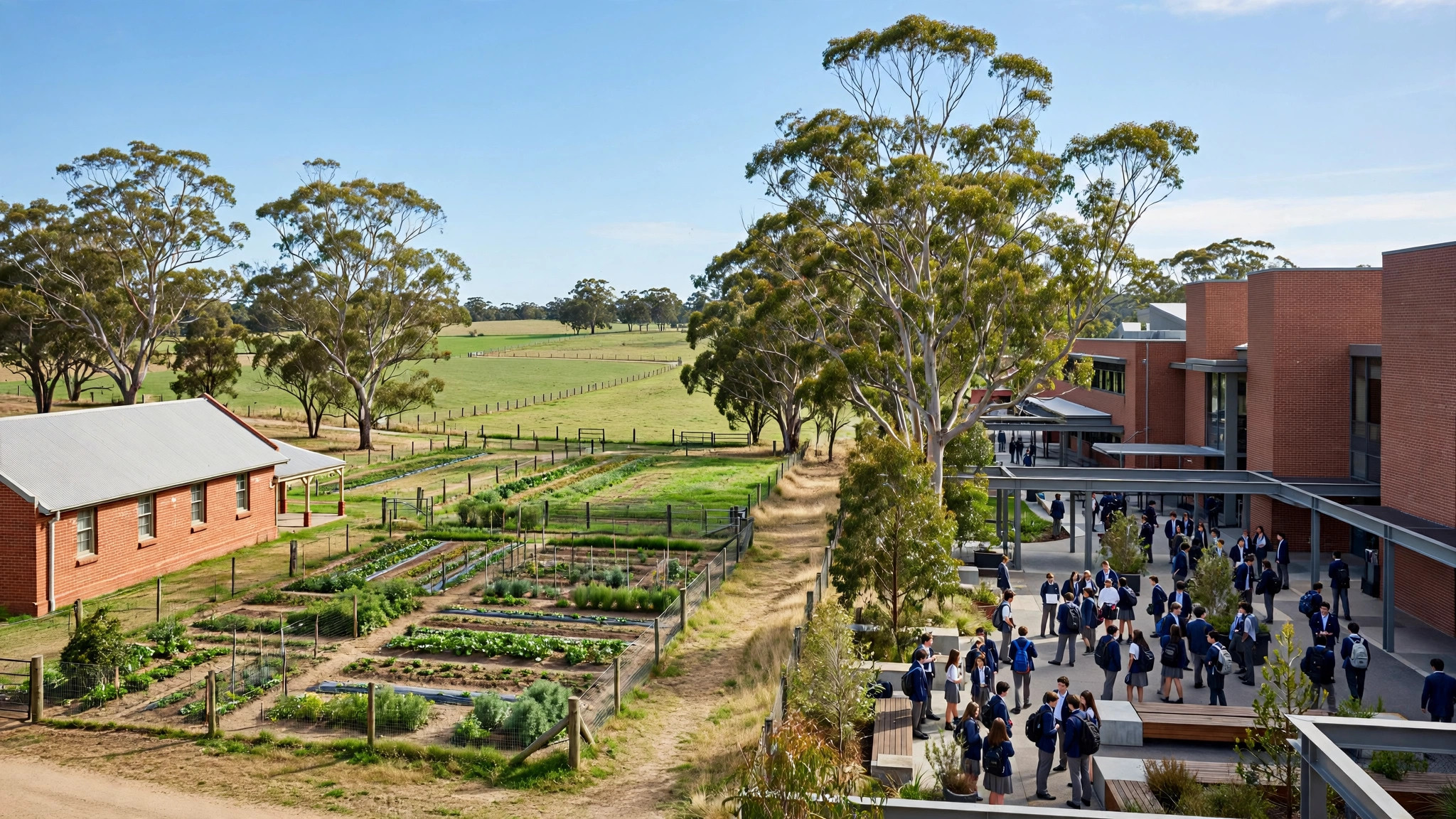
James Ruse sits on Felton Road in Carlingford, and the "Agricultural" in its name is not decorative: Agriculture is a compulsory subject for every student in Years 7 to 10 (it sits on the school's mandatory course lists for both Stage 4 and Stage 5), students begin accelerating it from Year 10, and it becomes an elective only in Years 11 and 12. It is a mid-sized selective school — 857 students in its 2024 annual report, "around 860" in the school's own current description — with a cohort that year after year produces the strongest HSC results in the state: second in NSW in 2025 on the success-rate measure, and in December 2020 the Department of Education described it as the most successful school overall in that year's HSC First in Course list. A James Ruse place is, by any measure, the hardest-won seat in NSW public education.
Baulkham Hills High School — Baulkham Hills, NSW
Baulkham Hills High, on Windsor Road in the suburb of the same name, is the bigger school by a wide margin: 1,222 students in its 2025 annual report (723 boys and 499 girls). It is also a more varied institution than its selective label suggests — alongside the selective cohort it runs a Support Unit for around 60 students, and its senior students accelerate aggressively: roughly 147 students completed accelerated subjects in the 2025 HSC. Its 51.53 per cent success rate put it seventh in NSW in 2025 — inside the state's top ten, ahead of every other school in the Hills district, and the natural first choice for thousands of north-west families whose children sit the same test as James Ruse applicants.
One test, one application: how entry actually works
There is no separate application, interview or portfolio for either school at Year 7. Families apply through the NSW selective schools application in late Year 5 or early Year 6, the child sits the Selective High School Placement Test in mid-May of Year 6, and outcomes arrive in August. You may list up to three selective schools, in preference order. Offers are made solely on test performance, taking your preference order into account, and each child receives one offer — the highest of their choices that their score reaches. Home address plays no part in placement: there is no catchment for these schools, and the only residency rule is that the student must be living in NSW by the start of the entry year. For the current cycle (Year 7 in 2028), applications run from 5 November 2026 to 15 February 2027, and the test is held on 13 and 14 May 2027.
From application to offer, step by step
- Apply online while your child is in late Year 5 or early Year 6 — for 2028 entry, between 5 November 2026 and 15 February 2027.
- List up to three selective schools in true preference order. Listing James Ruse first and Baulkham Hills second costs nothing: a score that misses the first is automatically considered for the next.
- Sit the Selective High School Placement Test in May of Year 6 (13–14 May 2027 for the current cycle).
- Receive one offer in August — the highest-listed school the score qualifies for.
- Accept, and your child starts Year 7 the following January. There is no second round of interviews at either school.
The practical consequence: this comparison is not about which application to write, but about the order of three preferences and about which school your child would genuinely thrive in if the score lands in the overlap zone. Preparation strategy for the test itself is covered in our NSW selective exam guide.
The results gap, read properly
The success rate used here is the share of a school's HSC course results that achieved the top band (Band 6, or E4 in extension courses) in the 2025 HSC, calculated from NESA's published data. On that measure James Ruse's 70.43 per cent means roughly seven in ten results its students produced were top-band results; Baulkham Hills' 51.53 per cent means about one in two — itself an extraordinary figure that placed the school seventh in the state. Two honest qualifications belong beside those numbers. First, a success rate reflects the cohort as much as the teaching: a school that selects the highest-scoring entrants in the state will post the highest-scoring outcomes, and the test-score difference at entry explains a large part of the gap at exit. Second, both schools are so far ahead of the typical NSW school on this measure that the choice between them should rarely turn on results alone — the differences that will shape your child's six years are the ones in the next section.
Where the schools genuinely differ
Agriculture. Only at James Ruse: four compulsory years of it, on a working school farm, whether or not your child has any interest in the subject. Some students love it and accelerate it into the HSC; for others it is four years of periods they would rather spend elsewhere. Baulkham Hills has no equivalent compulsory signature subject. This is the single most concrete curriculum difference between the two schools, and the one most often underestimated at preference time.
Size and shape. At roughly 860 students, James Ruse is one of the smaller selective schools; at 1,222, Baulkham Hills is more than 40 per cent larger. That shows up in team and ensemble depth, in the number of parallel classes, and in how many students compete for each leadership or representative place. Baulkham Hills also educates its Support Unit students inside the same school community, which gives the place a broader mix than a purely selective cohort.
Senior flexibility. Baulkham Hills leans into subject acceleration — about 147 of its students completed accelerated subjects in the 2025 HSC, effectively finishing some courses early. James Ruse accelerates its compulsory Agriculture from Year 10 as a matter of design. Both schools, in other words, compress the junior years, but toward different ends.
The commute. Carlingford and Baulkham Hills are neighbouring parts of the north-west, but the daily reality differs street by street: both schools draw from the whole of Sydney because there is no catchment, so the honest test is the actual door-to-door trip from your home at 7:30 in the morning, twice over, for six years. Run it before you finalise the preference order.
Missed Year 7? The Years 8 to 11 routes
Entry after Year 7 works completely differently, and families should go in with clear eyes: it is vacancy-only, run by each school separately, and places appear only when a student leaves — some years there may be none. You apply to each school individually (a maximum of three schools, in the same preference order as your applications), and schools assess applicants with their own tests and/or a review of school reports. In Baulkham Hills' most recent round (for 2027 entry), applications ran from 17 June to 24 July 2026, testing was an EduTest on Saturday 15 August 2026, the combined application and test fee was $180, and the school warned plainly that a very small number of places was available. James Ruse assesses later-entry applicants through a submission of achievements, a test and an interview. One structural change is coming: from 2028 entry there are no direct Year 8 applications to individual schools — Year 8 places are filled from the placement test reserve list instead.
What the schools cost
Both are NSW government schools, and NSW law is direct about what that means: instruction in a government school is free — there is no tuition charge at either school. What families may be asked for is a voluntary school contribution, capped by the Department at $110 for secondary schools in 2026 — and "voluntary" is real: payment is at the family's discretion and a child's access to instruction never depends on it. Subject-specific elective contributions and the ordinary costs of uniforms, devices and excursions sit on top at both schools. Set against Sydney's private school fees, the arithmetic of the selective system is stark: the most academically successful schools in the state charge no tuition at all, which is precisely why one May morning of testing carries so much weight.
James Ruse vs Baulkham Hills at a glance
| James Ruse | Baulkham Hills | |
|---|---|---|
| Location | Felton Road, Carlingford | 419A Windsor Road, Baulkham Hills |
| Type | Government, fully selective, co-educational | Government, fully selective, co-educational |
| Enrolment | 857 (2024 annual report) | 1,222 (2025 annual report) |
| HSC success rate, 2025 | 70.43% | 51.53% |
| NSW rank on that measure, 2025 | 2nd | 7th |
| Year 7 entry | Selective High School Placement Test only | Selective High School Placement Test only |
| Applications | One application, up to 3 school choices; offers on test performance alone; no catchment | |
| Tuition | None — NSW government schools do not charge tuition; voluntary contribution capped at $110 (2026) | |
| Signature feature | Agriculture compulsory Years 7–10 | Support Unit within the school; strong subject acceleration |
| Years 8–11 entry | Achievements submission, test and interview; vacancy-only | EduTest-based round (2027 entry: $180 fee, very few places); vacancy-only |
| School character | Smaller cohort, state's top outcomes | Larger, broader community, top-ten outcomes |
Every figure in this table comes from NESA data, the NSW Department of Education or the schools' own annual reports — see Sources at the end of this page.
Use a decision framework, not a winner label
Because both schools are chosen on one preference list, the decision is really four questions. First, agriculture: is four compulsory years of it a bonus or a burden for this particular child — answer that one honestly and the order often settles itself. Second, intensity: a 70-per-cent success-rate cohort is an inspiring and a demanding peer group; some children rise in it and some are happier being near the top of a still-exceptional cohort rather than the middle of the state's strongest. Third, the commute, tested at real school-run hours, not on a quiet Sunday. Fourth, size: a smaller school where every teacher knows your child, or a larger one with deeper teams, more parallel classes and a wider community. Neither school is the "winner" of this comparison — they are two different six-year experiences that happen to share an entrance test.
Frequently Asked Questions
Can my child apply to both James Ruse and Baulkham Hills?
Yes — in fact, that is how the system is designed. One application and one Selective High School Placement Test covers all selective schools, and you may list up to three schools in preference order. Your child receives a single offer: the highest-listed school their test performance qualifies them for. Listing James Ruse first and Baulkham Hills second never disadvantages the Baulkham Hills offer.
Which school gets better HSC results?
James Ruse, by a clear margin on the standard measure: in the 2025 HSC, 70.43 per cent of its course results achieved the top band (Band 6/E4), ranking it 2nd in NSW, against 51.53 per cent and 7th place for Baulkham Hills (NESA data). Both figures are exceptional — Baulkham Hills still outperformed every other school in its district. Remember that outcomes partly reflect entry scores: the school selecting the state's highest-scoring intake starts with a built-in advantage.
Is Agriculture compulsory at James Ruse?
Yes. Agriculture is a mandatory subject for all James Ruse students in Years 7 to 10 — it appears on the school's compulsory course lists for both Stage 4 and Stage 5, and students begin accelerating it from Year 10. In Years 11 and 12 it becomes an elective, so no student has to take Agriculture into the HSC itself. Baulkham Hills has no compulsory Agriculture.
How much does it cost to attend either school?
Neither school charges tuition: both are NSW government schools, and instruction in NSW government schools is free under the Education Act. Schools may request a voluntary contribution, capped at $110 for secondary schools in 2026, and paying it is genuinely optional. Families still budget for uniforms, devices, excursions and any elective-subject contributions at both schools.
Can students join in Years 8 to 11 instead?
Sometimes, but never count on it. Later entry is vacancy-only and run by each school separately — places exist only when a student leaves, and some years there are none. Baulkham Hills' round for 2027 entry charged a $180 combined application and test fee (EduTest, 15 August 2026) and warned of a very small number of places; James Ruse assesses a submission of achievements, a test and an interview. From 2028 entry, Year 8 places are filled from the placement test reserve list rather than by direct school application.
Sources, Updates and Corrections
Every figure on this page comes from NESA data, the NSW Department of Education or the schools' own publications, checked on 13 November 2026. HSC figures: NESA 2025 HSC data as ranked in our Top 50 Schools in Sydney (success rate = share of course results in the top band, Band 6/E4). Entry process: NSW Department of Education — selective high schools application process and selective high schools, Year 7. Years 8–11 entry: NSW Department of Education — Years 8 to 11 applications and Baulkham Hills High School — enrol. School facts: James Ruse Agricultural High School Annual Report 2024; James Ruse — overview of academic curriculum; Baulkham Hills High School Annual Report 2025; NSW Department of Education news, December 2020. Costs: NSW Department of Education — voluntary school contributions. If you spot an error, email topschoolsrankings@gmail.com and we will correct it.
Saahil
Saahil is an education researcher and content creator specializing in university rankings, admissions strategies, and student guides. He is dedicated to helping students make informed academic decisions.
Continue your research
James Ruse Agricultural High School Entry Guide 2026 – HSC Results, Cutoff & How to Get In
James Ruse Agricultural High School is widely regarded as the most competitive selective high school in NSW and Australia.
Read the guide →
Baulkham Hills High School Entry Requirements: 2026 Comprehensive Guide
Choosing a school for your child is a pivotal decision, and in Sydney’s Hills District, Baulkham Hills High School (BHHS) —affectionately known as "Baulko"—is…
Read the guide →
Top 50 Schools in Sydney
The 2026 ranking of Sydney’s top 50 schools on verified 2025 HSC success-rate data — where both of these schools sit near the very top.
Read the guide →
2026 Selective School Exam: The Comprehensive Guide for NSW Parents
The 2026 Selective School Exam is the gateway to New South Wales' highly competitive academic institutions.
Read the guide →