
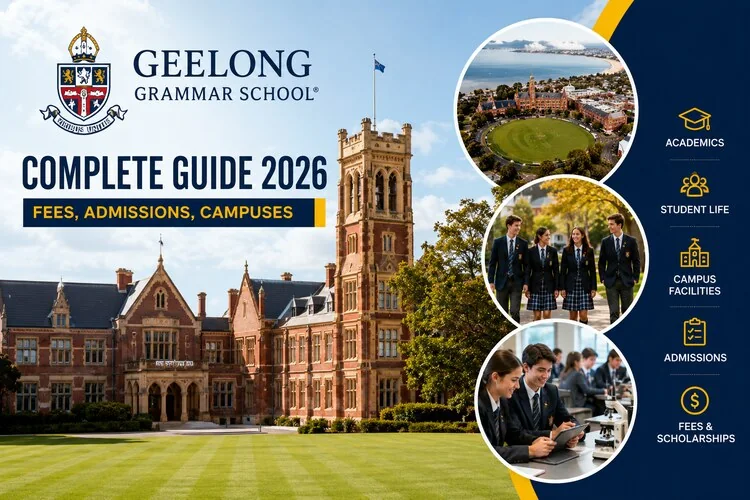
Are you considering Geelong Grammar School for your child's education but feeling overwhelmed by the information available? You're not alone. Many parents in Australia, the UK, Canada, and the USA struggle to find comprehensive, accurate details about this prestigious institution.
This complete guide delivers everything you need to know about Geelong Grammar School – from its 165-year history to current fees, campus options, academic programs, and the admissions process. You'll discover why this school is known as "Australia's Eton" and how it prepares students for success at leading universities worldwide.
By reading this article, you'll gain clear insights into whether Geelong Grammar School aligns with your child's educational needs and your family's values. Let's explore what makes this institution exceptional.
History & Heritage of Geelong Grammar School
Foundation and Early Years (1855-1914)
Geelong Grammar School opened on 1 October 1855 as a private venture under the Church of England's auspices. The school began with just 14 pupils in two semi-detached houses in Villamanta Street, Geelong, Victoria.
Five clergymen, including first headmaster George Vance, founded the school to provide quality secondary education for sons of Geelong's growing middle class. By 1858, the school moved into grand neo-Gothic buildings in central Geelong.
The school gained recognition as "Australia's Eton" by 1907, even adopting the same shade of blue (Eton blue) for its school colour. During this period, students came from all around Australia, particularly Victoria's Western District.
Relocation to Corio Campus (1914)
By 1911, the school had outgrown its inner-city location. Inspired by English public schools like Eton, the Council sought open space with playing fields to promote "a healthy mind in a healthy body."
The school settled on land at Corio (north of Geelong city) with beautiful views over Limeburners Bay. Students moved into new red brick buildings in 1914.
Over subsequent decades, the chapel, dining hall, additional boarding houses, and Junior School were completed. Enrolments grew significantly under headmaster Sir James Darling (1930–1961).
Major Milestones
|
Year |
Milestone |
|
1855 |
School founded with 14 pupils |
|
1858 |
Moved to neo-Gothic buildings in central Geelong |
|
1907 |
Golden jubilee celebrated; regarded as "Australia's Eton" |
|
1914 |
Relocated to current Corio site |
|
1933 |
Acquired Geelong Grammar Preparatory School (Bostock House) |
|
1947 |
Acquired Glamorgan Preparatory School (Toorak) |
|
1953 |
Timbertop campus opened in Victorian Alps |
|
1972 |
Introduced co-education (first girls in Fifth & Sixth Forms) |
|
1976 |
Two girls' schools amalgamated with Geelong Grammar |
|
2014 |
Celebrated 100 years at Corio |
|
2020 |
Marked 165 years since foundation |
Four Unique Campuses Explained
Geelong Grammar School is Australia's largest co-educational boarding school, caring for over 1,600 students across four unique campuses from ELC (Early Learning Centre) to Year 12.
1. Corio Campus (Main Campus)
Location:
50 Biddlecombe Avenue, Corio 3214, Victoria, Australia
Age Range:
ELC to Year 12 Features:
-
Red brick buildings dating back to 1912
-
Overlooks Corio Bay and Limeburners Bay
-
SPACE (School for Performing Arts and Creative Education) - completed 2015
-
Chapel and dining hall
-
Multiple boarding houses for senior boys and girls
-
Junior School (moved from Bostock House in 2026)
The Corio Campus is the heart of the school, offering comprehensive day and boarding options with highly regarded facilities for performing arts, science, and sports.
2. Toorak Campus
Location:
Toorak, Melbourne, Victoria
Age Range:
ELC to Year 6
History:
Founded in 1887 as Glamorgan Preparatory School by Miss Annie McComas
Key Facts:
-
Acquired by Geelong Grammar in 1947
-
Became co-educational in 1973
-
Renamed Toorak Campus in 2008
-
Former Prime Minister Stanley Melbourne Bruce attended (1891–1895)
Toorak provides exceptional early learning and primary education in Melbourne's prestigious Toorak suburb.
3. Bostock House (Closed 2026)
Historical Note: Bostock House closed at the conclusion of Term 1, 2026. Students and staff relocated to the newly built Junior School at Corio Campus, marking the next chapter in the school's history.
4. Timbertop Campus
Location:
Mt Timbertop, Victorian Alps near Mansfield
Age Range:
Year 9 only
Established:
1953
Philosophy: Outdoor education inspired by the Outward Bound movement
Timbertop provides an unique "off-grid" wilderness learning experience for Grade 9 students. The campus features:
-
Timber "units" (residential buildings) constructed by students in 1952
-
Chapel of St John the Baptist (opened 1958)
-
Dedicated outdoor education program (established 1955)
-
Focus on developing stamina, courage, adaptability, and persistence
Sir James Darling visioned Timbertop to help students "learn to look after themselves, to find their own occupation, and develop their own capacities."
Academic Programs: IB Diploma & VCE
Senior School Pathways (Years 11-12)
Geelong Grammar School offers multiple learning pathways for students entering Years 11 and 12, preparing them for university success worldwide.
|
Program |
Description |
Recognition |
|
IB Diploma |
Two-year curriculum emphasizing academic breadth, depth, and international understanding |
Recognised by most leading universities worldwide |
|
VCE |
Victorian Certificate of Education – broad subject range across disciplines |
Australian university entry (ATAR pathway) |
|
VCE with Vocational Focus |
VCE + VET qualifications for apprenticeships/traineeships |
Industry certification + VCE |
The IB Diploma Programme
The IB Diploma provides:
-
Academic breadth and depth of knowledge
-
International understanding
-
Consistent work over Years 11–12
-
Qualification recognised by leading universities globally
Victorian Certificate of Education (VCE)
VCE offers:
-
Broad range of subjects across multiple disciplines
-
No compulsory subjects except English
-
Specialisation options or general study
-
Open tertiary pathways
Year 10 Curriculum
Year 10 students enjoy an innovative and creative curriculum designed to prepare them for IB and VCE programmes, with:
-
Balanced subjects across major academic disciplines
-
Strong foundations of learning
-
Exploration opportunities in areas of interest
-
Encouragement to maintain breadth in elective subjects
Timbertop Academic Programme
The academic programme at Timbertop is full and comprehensive, focusing on:
-
Preparing students for Senior School academic rigour
-
Building subject-specific knowledge
-
Embedding critical, analytical, and creative thinking skills
Boarding & Day School Options
Australia's Largest Co-educational Boarding School
Geelong Grammar School cares for approximately 1,500 pupils, including 800 boarders from Years 5 to 12.
Boarding Options
|
Campuses |
Year Levels |
Type |
|
Corio |
Years 5–12 |
Full boarding residential |
|
Timbertop |
Year 9 only |
Wilderness outdoor education |
Boarding Houses at Corio
Senior Boys' Boarding Houses:
-
Perry House (founded 1914)
-
Manifold House (founded 1914)
-
Cuthbertson House (founded 1914)
-
Francis Brown House (founded 1934)
Senior Girls' Boarding Houses:
-
The Hermitage House (named after amalgamated school)
-
Clyde House (named after amalgamated school)
-
Garnett House (named after co-education principal)
-
Elisabeth Murdoch House (founded 2009)
Co-educational Day Boarding Houses:
-
Allen House
-
Fraser House
Middle School Houses (2021 amalgamation):
-
Kunuwarra (girls' house – meaning "black swan")
-
Parrwang (boys' house – meaning "magpie")
-
Otway (co-educational day)
-
Highton (co-educational day)
Day School Options
Day students are welcomed across all campuses from ELC to Year 12, with non-selective enrolment policy catering to approximately 1,500 students.
Fees & Costs (2026)
Annual School Fees 2026
Fees vary significantly based on year level and boarding vs. day options. Here's the comprehensive breakdown:
Tuition Only (Day School)
|
Year Level |
Annual Fee (AUD) |
|
F–Tuition Only |
From $45,740 |
|
Year 7 |
$45,740 |
|
Year 12 |
$55,380 |
|
Primary (Grade 1) |
$30,560 |
|
Primary (Grade 6) |
$37,580 |
Boarding Only
|
Year Level |
Annual Fee (AUD) |
|
Year 7 |
$89,280 |
|
Year 12 |
$93,840 |
|
Range (2026) |
$54,200–$66,300 |
Total Costs (Day + Boarding)
|
Category |
Annual Fee Range (AUD) |
|
Day School (F–Year 12) |
$19,500–$61,000 |
|
Full Boarding (Year 7–12) |
$89,280–$93,840 |
Currency Conversion (Approximate 2026)
|
AUD |
USD |
GBP |
CAD |
|
$50,000 |
~$32,500 |
~£25,000 |
~$67,500 |
|
$90,000 |
~$58,500 |
~£45,000 |
~$121,500 |
Sibling Discount
-
3rd and subsequent children boarding at the same time: 20% discount
-
Discount applies to youngest sibling
Important Notes
-
Fees are subject to annual review
-
Payment schedules and terms available in Fee Schedules
-
Download full fee schedules from the school's official website
Admissions Process & Enrolment
Application Timeline
Geelong Grammar School welcome applications for enrolment into all year levels at any time of the year from the birth of a child.
Steps to Enrolment
-
Complete online application – Take the first step by submitting an application online
-
Contact Admissions team – For specific campus enquiries
-
Assessment/interview – Depending on year level
-
Offer of enrolment – If suitable
-
Acceptance and payment – Complete enrolment process
Admissions Contact Information
|
Campus |
Phone |
|
|
Corio Campus, Timbertop |
+61 3 5273 9307 |
admissions@ggs.vic.edu.au |
|
Toorak Campus |
+61 3 9829 1406 |
toorakadmissions@ggs.vic.edu.au |
Enrolment Policy
-
Non-selective enrolment policy
-
Caters for approximately 1,500 students from Pre-school to Year 12
-
Open to domestic and international students
Notable Alumni & School Achievements
"100 Exceptional Stories"
In 2014, celebrating 100 years at Corio, the school produced "100 Exceptional Stories" profiling past students who achieved in diverse fields.
Famous Alumni
|
Name |
Achievement |
Year |
|
Rupert Murdoch |
Media mogul (Fox Corporation, News Corp) |
Modern |
|
Malcolm Fraser |
Former Prime Minister of Australia |
1975–1983 |
|
Stanley Melbourne Bruce |
Prime Minister of Australia |
1923–1929 |
|
John Fairfax |
Media mogul |
Historical |
|
Kerry Packer |
Media mogul |
Modern |
|
Missy Higgins |
Singer-songwriter |
Cl'01 |
|
Peter Carey |
Novelist |
FB'60 |
|
John Landy |
Olympic athlete |
M'48 |
School Achievements
-
Institute of Positive Education: Pioneering research at the intersection of learning science and teaching art
-
165+ years of educational excellence
-
Australia's largest co-educational boarding school
-
Spears 500 Schools Index member
Key Takeaways
165+ years of history – Founded in 1855, one of Australia's longest-established independent schools
Four campuses – Corio (main), Toorak (Melbourne), Timbertop (wilderness), formerly Bostock House
1,500+ students – ELC to Year 12, including 800 boarders from Years 5–12
Multiple pathways – IB Diploma, VCE, and VCE with Vocational Focus
Co-educational since 1972 – Full co-education across all campuses
Unique Timbertop experience – Year 9 only, off-grid wilderness learning
Notable alumni – Rupert Murdoch, Malcolm Fraser, Stanley Melbourne Bruce
Fees 2026 – Day: $19,500–$61,000 AUD; Boarding: $89,280–$93,840 AUD
Sibling discount – 20% for 3rd+ children boarding simultaneously
Non-selective enrolment – Applications accepted anytime from birth
Conclusion
Geelong Grammar School stands as one of Australia's highly competitive independent schools, combining 165 years of heritage with innovative educational approaches like Positive Education and unique wilderness learning at Timbertop.
With four campuses, over 1,600 students, multiple academic pathways (IB and VCE), and exceptional boarding facilities, Geelong Grammar offers a comprehensive education that prepares students for leading universities worldwide.
While fees range from $19,500 AUD (day school) to $93,840 AUD (full boarding), the school's non-selective enrolment policy, sibling discounts, and highly regarded facilities make it accessible to families seeking exceptional education.
What are your thoughts on Geelong Grammar School?
Share your questions in the comments below, subscribe for more Australian school guides, and share this article with fellow parents considering independent education!
FAQs
1. What is Geelong Grammar School known for?
Geelong Grammar School is known for being Australia's largest co-educational boarding school with 165+ years of history. It's recognised as "Australia's Eton," pioneering Positive Education, offering IB Diploma and VCE programs, and providing unique wilderness learning at its Timbertop campus for Year 9 students.
2. How much does Geelong Grammar School cost in 2026?
In 2026, Geelong Grammar School fees range from $19,500 AUD to $61,000 AUD for day school (ELC–Year 12), and $89,280 AUD to $93,840 AUD for full boarding (Years 7–12). Primary day school starts around $30,560 AUD, with a 20% sibling discount for 3rd+ children.
3. Is Geelong Grammar School selective?
No, Geelong Grammar School has a non-selective enrolment policy. The school welcomes applications for all year levels at any time from the birth of a child, catering to approximately 1,500 students without entrance test requirements for enrolment.
4. What campuses does Geelong Grammar School have?
Geelong Grammar School operates four campuses: Corio (main campus in Geelong, ELC–Year 12), Toorak (Melbourne, ELC–Year 6), Timbertop (Victorian Alps, Year 9 only), and formerly Bostock House (closed 2026, relocated to Corio).
5. Does Geelong Grammar School offer boarding?
Yes, Geelong Grammar School offers full boarding from Years 5–12 at Corio Campus, with 800 boarders currently. Timbertop provides unique outdoor education boarding for Year 9 only. The school is Australia's largest co-educational boarding school.
6. What academic programs are available at Geelong Grammar?
Geelong Grammar School offers three pathways for Years 11–12: IB Diploma (international recognition), VCE (Victorian Certificate of Education), and VCE with Vocational Focus (VET qualifications). Year 10 prepares students for both IB and VCE programmes.
Saahil
Saahil is an education researcher and content creator specializing in university rankings, admissions strategies, and student guides. He is dedicated to helping students make informed academic decisions.
Continue your research
Melbourne Grammar School: A Complete Overview
Melbourne Grammar School is a leading Anglican independent day and boarding school in Melbourne, known for its strong academic outcomes, holistic education…
Read the guide →
Brown University: Admissions Guide 2026 | Requirements & Majors
Everything you need to know about Brown University: admission requirements, SAT/ACT scores, tuition costs, popular majors, and campus life. Apply now!
Read the guide →
Duke University: Complete Guide 2026 – Admissions, Fees & Rankings
Discover everything about Duke University in 2026. Learn about admissions requirements, tuition fees ($70,265), rankings (#6 US News), acceptance rate (4.8%).
Read the guide →
Hills Grammar School Sydney: 2026 Admissions, Fees & HSC Guide
Hills Grammar School admissions for 2026 — Kenthurst fees, waitlists, HSC results, international student rules, and how it fits Sydney's Hills District.
Read the guide →