
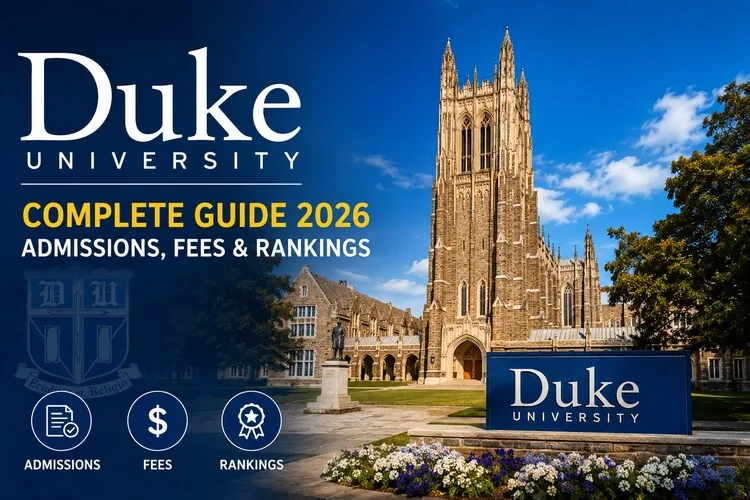
Are you dreaming of attending one of the world's highly competitive universities but struggling to find reliable information about Duke University? You're not alone. Thousands of international students from the UK, Australia, Canada, and around the globe search for accurate details about Duke's admissions, fees, and programs every year.
This comprehensive guide gives you 100% factual, up-to-date information about Duke University for 2026. Whether you're interested in undergraduate or graduate programs, you'll discover everything needed: acceptance rates, tuition costs (£52,500 GBP / $88,000 AUD / $94,000 CAD), top majors, financial aid options, and campus life.
In this blog, we'll cover Duke University's world rankings, admission requirements for international students, detailed fee breakdowns, scholarship opportunities, popular majors, student life in Durham (North Carolina), and answer your most-asked FAQs. Let's explore why Duke is often called the "Ivy Plus of the South" and how you can join this elite institution.
Duke University Overview: History & Prestige
When Was Duke University Founded?
Duke University traces its roots to 1838 but was officially established in its current form in 1924 in Durham, North Carolina. The university was renamed in recognition of philanthropist James B. Duke's enormous endowment.
Unlike older Ivy League institutions, Duke is comparatively young but has rapidly become one of the most renowned American universities. Despite not being an official Ivy League member, Duke is frequently labeled as "Ivy Plus" or "Southern Ivy" due to its academic excellence and prestige.
Duke University Location & Campus
Duke sits in Durham, North Carolina, within the famous Research Triangle (Durham-Chapel Hill-Raleigh) with 1.3+ million residents. The campus spans 8,693 acres with 254 buildings, featuring stunning Neo-Gothic architecture.
Key campus features:
-
East Campus: First-year students live here ("Bricks")
-
West Campus: Upperclassmen residences ("Stone")
-
Undergraduate enrollment: 6,488 students (fall 2023)
-
10 schools (9 schools + 1 college)
-
53 majors, 52 minors, 23 certificates
Why Choose Duke University?
Duke offers a haven for intellectual curiosity with collaboration-focused learning. Students benefit from:
-
R1 research university status (highest research activity)
-
Division I sports program (Duke Blue Devils)
-
Thriving network with global impact
-
50% of undergraduates receive financial aid
-
No separate merit scholarship application (automatic consideration)
Duke University Rankings 2026: Global & National
Global Rankings
Duke University maintains strong positions in international rankings:
| Ranking System | 2026 Position | Change |
|---|---|---|
| QS World University Rankings | #61-62 | ↓ from #57 (2024) |
| Times Higher Education (THE) | #26 | ↓ from #25 (2023) |
| US News Global Universities | #27 | ↓ from previous |
National Rankings (USA)
In the United States, Duke ranks among the top 10 national universities:
-
US News National Universities 2025: #6 out of 436 universities
-
US News National Universities 2024: #7
-
Considered among America's Best Colleges consistently
Program-Specific Rankings
Duke's graduate schools hold high esteem, particularly:
-
Business (Fuqua School of Business)
-
Law (Duke Law School)
-
Medicine (Duke School of Medicine)
-
Engineering (Pratt School of Engineering)
The university's academic excellence rivals Ivy League institutions, making it a "Southern Ivy".
Duke University Admissions Requirements 2026
Acceptance Rate: How Competitive Is Duke?
Duke is extremely selective with an acceptance rate below 7%:
| Class Year | Acceptance Rate |
|---|---|
| Class of 2029 (Fall 2025) | 4.8% |
| Class of 2027 | 6% |
| Class of 2026 | 4.6% |
| Class of 2025 | 4.3% |
Regular Decision acceptance rate: 4.8% (all-time low territory)
This means only ~5 out of 100 applicants get admitted. Duke competes directly with Ivy League schools in selectivity.
Undergraduate Admission Requirements
For International Students, you must meet:
Educational Requirements:
-
Completed high school education or equivalent
-
Strong academic credentials with high GPA (admitted students: 3.7+)
-
No minimum GPA required, but 3.7+ is typical
Standardized Test Scores (2026-2027: Test-Optional):
Important: Duke University will be test-optional for first-year and transfer applicants in 2026-2027, including international students.
However, if you submit scores:
| Test | Required Score Range |
|---|---|
| SAT | 1510-1560 |
| ACT | 34-35 |
| Half of admitted students: SAT 1520-1570 or ACT 34-35 |
English Proficiency (International Students):
-
TOEFL: 100
-
IELTS: 7.0
Application Materials:
-
Apply through Coalition or Common Application
-
Application fee: $85-$95 (£65-£75 GBP / $130-$145 AUD / $115-$130 CAD)
-
Official transcripts from all schools
-
Letters of recommendation (very important)
-
Personal statement + one-page personal essay
-
Short-answer questions specific to Duke
-
Copy of passport
-
Standardized test scores (if submitting)
-
English proficiency test scores
Graduate Admission Requirements
For graduate studies, apply through the Graduation Portal:
-
GMAT: 670+ (for business programs)
-
GRE: Required for most programs
-
TOEFL: 90+
-
IELTS: 7.0+
-
Official transcripts
-
Letters of recommendation
-
Personal statement
-
Portfolio (if applicable)
What Duke Admissions Looks For
Duke evaluates applications holistically. Important factors:
-
GPA (very important academic factor)
-
High school class rank (important)
-
Letters of recommendation (very important)
-
Personal essay quality
-
Extracurricular activities
-
Leadership experience
-
Community service
Admissions officials consider personal essays and short-answer questions specifically.
Duke University Tuition Fees & Cost 2025-2026
Undergraduate Tuition Fees
For 2025-2026, Duke's undergraduate costs are:
| Cost Component | Amount (USD) | Amount (GBP) | Amount (AUD) | Amount (CAD) |
|---|---|---|---|---|
| Tuition (annual) | $70,265 | ~£52,500 | ~$105,000 | ~$94,000 |
| Tuition (per semester) | $35,132.50 | ~£26,250 | ~$52,500 | ~$47,000 |
| Fees (annual) | ~$1,450 | ~£1,100 | ~$2,200 | ~$2,000 |
| Room & Board | Included in total | Included | Included | Included |
| Total Cost of Attendance | $92,042 | ~£69,000 | ~$138,000 | ~$123,000 |
2025 tuition & fees: $68,758
Estimated 2026 tuition: $71,844
Graduate Tuition Fees (2025-2026)
Graduate school tuition varies by program:
| Program | Per Semester | Per Year |
|---|---|---|
| Master's (full-time) | $33,862 | $67,724 |
| Master's (summer) | $16,930 | - |
| Master of Fine Arts | $27,012 | $54,024 |
| Master of Arts Teaching | $17,493 | $34,986 |
| Master of Arts Liberal Studies | $13,383 | $26,766 |
| PhD (years 1-3) | $33,862 | $67,724 |
| PhD (years 4+) | $4,680 | $9,360 |
2025 graduate tuition & fees: $66,523
Estimated 2026 graduate tuition: $69,162
Additional Costs
Beyond tuition, consider:
-
Books & supplies: $1,000-$1,500 annually
-
Personal expenses: $2,000-$3,000
-
Transportation: $1,000-$2,000 (varies by location)
-
Health insurance: $3,000-$4,000
Total annual cost: ~$95,000-$100,000 USD (£71,000 GBP / $142,000 AUD / $127,000 CAD)
Duke University Financial Aid & Scholarships
Financial Aid Overview
Duke is committed to accessibility:
-
50% of undergraduate students receive financial aid
-
Duke provides merit scholarships automatically (no separate application)
-
Need-based aid available through FAFSA
Merit Scholarships
All students are automatically considered for merit scholarships as admitted students. Exceptions requiring separate application:
-
Robertson Scholarship
-
Nakayama Scholarship
Named merit scholarships include:
| Scholarship | Criteria | Coverage |
|---|---|---|
| Alumni Endowed Scholarship | Duke alumni children/grandchildren + financial need | Partial tuition |
| Angier B. Duke Scholarship | Intellectual accomplishment + academic leadership potential | Full/partial tuition |
| Benjamin N. Duke Scholarship | NC/SC students + academic achievement + leadership + community service | Full tuition, room, board, fees (8 semesters) + summer stipends |
| Karsh International Scholarship | International students + academic/global impact potential | Full/partial |
| Trinity Scholarships | NC/SC students + academic achievement | Partial |
| University Scholarship | Interdisciplinary research + collaborative thinking + innovative scholarship | Partial |
Need-Based Aid
-
Available through FAFSA (Federal Application)
-
50% of undergraduates receive some financial aid
-
Covers tuition, room, board, fees based on need
graduate Financial Aid
Graduate students may receive:
-
Program-specific scholarships
-
Research assistantships
-
Teaching assistantships
-
Need-based grants
Nursing School scholarships: $5,000/semester for 6-9 semesters
Duke University Majors & Academic Programs
Most Popular Undergraduate Majors
Duke offers 53 majors across its schools. The top majors by graduates:
| Major | Annual Graduates | Category |
|---|---|---|
| Economics | 190 | Social Sciences |
| Public Policy Analysis | High | Social Sciences |
| Biology/Biological Sciences | High | Life Sciences |
| Political Science | 132 | Social Sciences |
| Anthropology | 79 | Social Sciences |
| Sociology | 44 | Social Sciences |
All Available Majors by Category
Social Sciences:
-
Economics
-
Political Science and Government
-
Anthropology
-
Sociology
Arts & Humanities:
-
Art History, Criticism and Conservation (16 graduates)
-
Drama and Dramatics/Theatre Arts (9 graduates)
-
Design and Visual Communications (30 graduates)
Engineering (Pratt School):
-
Computer Science
-
Electrical Engineering
-
Mechanical Engineering
-
Bioengineering
Business (Fuqua School):
-
Finance
-
Accounting
-
Business Administration
-
Economics
Graduate & Professional Programs
Duke offers 124+ graduate programs:
-
Business: Fuqua School of Business
-
Law: Duke Law School
-
Medicine: Duke School of Medicine
-
Engineering: Pratt School of Engineering
-
Nursing: Duke School of Nursing
-
Public Health: Gillings School
-
Education: University School of Education
52 minors and 23 certificates available for customization.
Interdisciplinary Majors
Duke encourages cross-disciplinary learning:
-
Computational Media (IDM + minor)
-
Double majors common
-
Certificate programs supplement majors
Duke University Student Life & Campus Culture
Campus Living Requirements
Unique Duke tradition: All undergraduates must live on campus for first three years.
East Campus ("Bricks"):
-
First-year students only
-
Separate from main campus
-
Fosters friendships with entire class
-
More sheltered from party atmosphere
West Campus ("Stone"):
-
Upperclassmen (years 2-4)
-
Variety of living options
-
Residential quads
-
Near academic buildings
Duke Traditions
"Bricks to Stone" tradition: Symbolizes transition from East Campus ("Bricks") to West Campus ("Stone"), when students officially join their residential quad.
Duke Blue Devils pride:
-
Division I sports (ACC member)
-
Basketball legendary (men's team national championships)
-
Game-day wins celebrated
-
Strong school spirit
Campus Facilities
-
254 buildings on 8,693 acres
-
** highly regarded libraries** with cutting-edge spaces
-
Research laboratories
-
Athletic facilities
-
Student centers
-
Dining halls
Student Diversity
Duke attracts diverse community from worldwide:
-
International students from UK, Australia, Canada, Asia, Europe
-
Culturally diverse campus
-
Global impact focus
-
Karsh International Scholarship for international students
Location Benefits: Durham, North Carolina
Durham offers:
-
Research Triangle access (tech, research jobs)
-
1.3+ million population region
-
Moderate climate
-
Lower cost of living than NYC/SF
-
Growing tech hub
-
Access to Raleigh (state capital) and Chapel Hill (UNC)
Conclusion
Duke University stands as one of the world's highly competitive institutions, ranking #6 nationally (US News 2025) and #61-62 globally (QS 2026). With an acceptance rate of just 4.8%, Duke competes directly with Ivy League schools in selectivity and academic excellence.
For 2025-2026, undergraduate tuition is $70,265 annually ($92,042 total cost of attendance), but 50% of students receive financial aid. Duke's automatic merit scholarship consideration makes it accessible to talented students worldwide.
FAQs: Duke University Questions Answered
1. What is Duke University's acceptance rate in 2026?
Duke University has an acceptance rate of 4.8% for the Class of 2029 (Fall 2025), making it extremely selective. This is one of the lowest rates in Duke's history, competing directly with Ivy League schools in competitiveness.
2. Is Duke University harder to get into than Ivy League schools?
Duke's 4.8% acceptance rate is comparable to Ivy League schools. While not officially Ivy League, Duke is called "Ivy Plus" or "Southern Ivy" due to similar academic excellence. It ranks #6 nationally, higher than Cornell, Dartmouth, and Brown.
3. What SAT score do I need for Duke University?
If submitting scores, Duke admits students with SAT 1510-1560 (middle 50%: 1520-1570). However, Duke is test-optional for 2026-2027, so SAT is not required for admission.
4. How much does Duke University cost per year for international students?
Total cost of attendance is $92,042 annually ($70,265 tuition + fees + room/board). For international students from UK/Australia/Canada: ~£69,000 GBP / $138,000 AUD / $123,000 CAD. However, 50% receive financial aid.
5. Does Duke University offer scholarships for international students?
Yes! Duke offers the Karsh International Scholarship for outstanding international students with academic and global impact potential. All students are automatically considered for merit scholarships (no separate application).
6. What are the English proficiency requirements for Duke?
International students need TOEFL 100 or IELTS 7.0 for undergraduate admission. For graduate programs: TOEFL 90+ or IELTS 7.0+.

Saahil
Saahil is an education researcher and content creator specializing in university rankings, admissions strategies, and student guides. He is dedicated to helping students make informed academic decisions.
Continue your research

Johns Hopkins University: Rankings, Admissions, Tuition & Programs Guide
Discover everything about Johns Hopkins University — rankings (#7 US, #24 global), tuition ($68,670), admission requirements (6.4% acceptance), programs.
Read the guide →
University of New South Wales: Complete Guide 2026 – Rankings, Courses, Fees & Admissions
Discover everything about the University of New South Wales (UNSW Sydney) – global rankings, courses, tuition fees, scholarships, admission requirements.
Read the guide →
Brown University: Admissions Guide 2026 | Requirements & Majors
Everything you need to know about Brown University: admission requirements, SAT/ACT scores, tuition costs, popular majors, and campus life. Apply now!
Read the guide →
Geelong Grammar School: Complete Guide 2026 | Fees, Admissions, Campuses
Discover everything about Geelong Grammar School – fees, 4 campuses, IB & VCE programs, boarding options, admissions process, and notable alumni. Apply today!
Read the guide →