
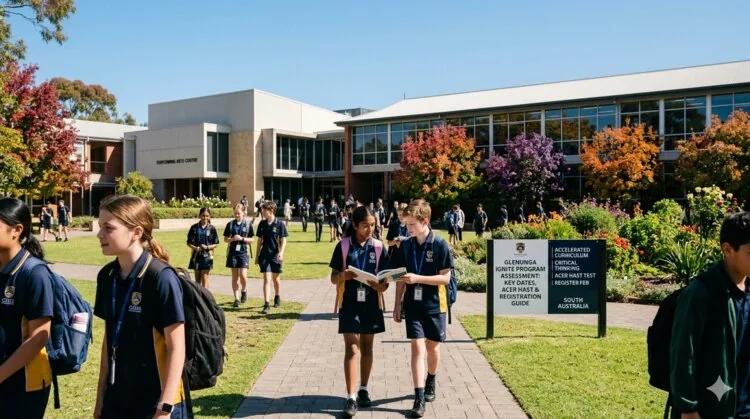
Glenunga International High School runs one of South Australia's best-known selective pathways for gifted learners: IGNITE, a special interest program funded by the South Australian Department for Education for identified gifted and talented students, running since 1997. Only three Adelaide public high schools offer it: Glenunga, The Heights School and Aberfoyle Park High School. For Year 7 entry in 2028, the ACER Ignite Assessment will be held on Saturday 20 February 2027 for Year 6 students. Registrations through the ACER Portal are open now and close on Sunday 7 February 2027, the fee is $170, and 100 students are selected per yearly intake.
This guide covers what IGNITE is, the four parts of the assessment, the key dates, who can apply, the fee and refund rules, and what happens after the test. Every date and figure was checked against Glenunga's own IGNITE page (updated 2 November 2026), the South Australian Government's program description and ACER's test pages on 14 November 2026. Where the school publishes no figure — the offers date, the test venue and per-part timings — this guide says so instead of guessing. One naming note: Glenunga's page never calls the test "HAST" — the school calls it the ACER Ignite Assessment, and so does this guide.
The ACER Ignite Assessment for Year 7 2028 entry is on Saturday 20 February 2027. Registrations through the ACER Portal close on Sunday 7 February 2027 — no late applications. The fee is $170. Four parts — Reading Comprehension, Mathematical Reasoning, Abstract Reasoning, Written Expression — take about three hours with a break. Year 6 students apply; Year 5 students can apply with a principal's letter of recommendation.
What is the Glenunga IGNITE Program?
IGNITE is a special interest program funded by the Department for Education, designed to support the learning needs of identified gifted and talented students. Glenunga is one of only three public high schools in Adelaide that offer it, alongside The Heights School and Aberfoyle Park High School, and the program has been functioning since 1997. Glenunga puts it plainly: giftedness shows itself in many different ways, no two students are alike, and the aim is great learners and first-class people, not just high marks.
The learning is deliberately faster and deeper than the standard curriculum. The South Australian Government describes IGNITE as fast-paced, with less review and repetition than the normal curriculum: students can accelerate to complete Years 8, 9 and 10 in two years, or move faster through subjects or expand on them.
The program is not only academic: IGNITE students work on socio-emotional maturity and five capabilities the school names — Creative and Critical Thinking, Collaboration, Communication, Citizenship and Character. Since 2024, every Year 7 IGNITE student starts with a common Year 7 curriculum, and at the end of Year 7 the school finalises each student's personalised pathway for Year 8 — from student data, Student Insight Responses and Parent Insight Responses, with two pathways available. Students stay in a consistent mentor group from Years 7 to 9 for the LEAP PB curriculum, attending different IGNITE classes by pathway.
A Closer Look: The Four Parts of the ACER Ignite Assessment (2027)
The assessment is the single gateway into IGNITE at Glenunga. Glenunga calls it the ACER Ignite Assessment: four parts over about three hours with a break, the papers sent to ACER in Melbourne for marking. The portal is run by ACER, whose HAST team handles technical questions — HAST is ACER's Higher Ability Selection Test, and its primary level, for entry into Years 5 and 6, has the same four components. It is four reasoning tests, not a curriculum exam: ACER describes it as measuring skills and aptitude, not retrieved knowledge.
1. Reading Comprehension
Students read passages and answer questions testing understanding, inference and interpretation — not whether they have met a text before. Wide reading above the child's school year is the best preparation, building the vocabulary and stamina the questions assume.
2. Mathematical Reasoning
This part tests mathematical thinking, not memorised procedures: logical problem-solving, pattern recognition and unfamiliar quantitative situations. A child fast at times tables but unused to reasoning about new problems will find it harder than one used to puzzles and logic problems.
3. Abstract Reasoning
A non-verbal test: students identify patterns, sequences and relationships in abstract shapes and diagrams. It measures fluid reasoning — spotting the rule behind a set of figures and applying it to the next one — so familiarity helps, and a child who has seen this style of question will not lose time working out what is asked.
4. Written Expression
A written response to a prompt, assessed by qualified human markers — ACER states this explicitly, while the multiple-choice parts are machine scored. Structure, vocabulary, creativity and a coherent argument under time pressure all count, so a child who writes regularly and plans quickly has a real advantage.
Two things the school does not publish, and this guide will not invent: per-part timings and question counts. ACER publishes indicative timings in its generic HAST bulletin, but Glenunga's page gives only the overall figure of about three hours with a break. No calculator rule, question count or pass mark is published on the school's IGNITE page either.
Key Dates for Year 7 2028 Entry
The cycle is already running. Registrations are open now — the two dates to put in the calendar first are the closing date and the test day, because the school accepts no late applications.
| Event | Date | What to know |
|---|---|---|
| IGNITE Information Evening | Tuesday 1 December 2026 | For families with Year 5 students seeking Year 7 2028 entry. Bookings essential. |
| Registrations open | Open now | Apply through the ACER Portal. Read the ACER Parent Guide first. |
| Registrations close | Sunday 7 February 2027 | No late applications will be accepted. |
| ACER Ignite Assessment | Saturday 20 February 2027 | Four parts over about three hours, with a break. For Year 6 students entering Year 7 in 2028. |
| Year 7 entry | 2028 school year | Selected students start Year 7 at Glenunga. |
One date is deliberately missing: when offers are made. Glenunga's IGNITE page states no offers or results date for this cycle, so no month is quoted here — older guides putting offers in May or June repeat an earlier cycle's pattern, not a published date. Watch for contact from the school after the assessment.
The school does not name a test venue on its IGNITE page. What it states is the sitting rule: students must register and sit at their first-preference IGNITE school, and students in rural or interstate locations may sit at their primary school with their principal's approval. For a family whose first preference is Glenunga, the assessment is sat at Glenunga — but no room or address is published, and none is given here.
How to Register: Step by Step
Registration is through the ACER Portal, not the school's enrolment form. Follow the steps in order — the common mistakes are skipping the parent guide, uploading the wrong NAPLAN report, or missing the Year 5 recommendation letter.
Step 1: Read the instructions and the ACER Parent Guide first
Glenunga's page says it is vital to read the instructions, including the ACER Parent Guide, before starting. The guide to online registrations is linked from the school's IGNITE page — read it first, because the portal asks for documents during the application.
Step 2: Register through the ACER Portal
Applications are made via the ACER Portal at higherability.acer.org. Registrations are open now and close on Sunday 7 February 2027; no late applications are accepted, so do not leave it to the closing weekend.
Step 3: Upload the NAPLAN report
Year 6 applicants upload their Year 5 NAPLAN report; Year 5 applicants, their Year 4 report instead. If the upload fails, email the Ignite Team at dl.0927.ignite@schools.sa.edu.au.
Step 4: Year 5 applicants — include the principal's letter of recommendation
A Year 5 student can apply only if recommended by their principal, documented in a letter submitted during registration — a condition of applying from Year 5, not a bonus in the ranking. Have the letter ready before starting.
Step 5: Pay the $170 registration fee
The fee is $170, paid as part of registration. School Card holders should provide their School Card details when registering — see the fees section for the exact figures. Keep the payment receipt and confirmation together.
Step 6: Check the refund rules before you commit
Withdrawing before the closing date gives a full refund; after it, a partial refund of $145 of the $170 fee. School Card holders get a $145 refund after the closing date, in both Year 5 and Year 6.
Step 7: Sit the assessment once, at your first-preference school
A student can sit the Ignite assessment only once, at their first-preference school — sitting at one school bars re-sitting at another. Rural or interstate students may sit at their primary school with their principal's approval.
Two contacts cover the two kinds of problem families hit: for technical issues with the online application system, the ACER HAST team at hast@acer.org or 03 9007 2037; for questions about the application, the Ignite Team at dl.0927.ignite@schools.sa.edu.au — or 08 8379 5629 for extenuating circumstances around taking the assessment.
Who Can Apply: Eligibility
Eligibility is set out on the school's IGNITE page; the main intake is for Year 6 students entering Year 7 in 2028.
Year 6 students may register, as may all Australian citizens and permanent residents. Year 5 students can apply if recommended by their principal, documented in a letter of recommendation submitted in the registration process. International students on a 500 visa, or on any other visa type, who are currently living and studying in South Australia may register if they are currently in Year 6. Students who are currently in Year 7 at an IGNITE school cannot sit the Ignite Assessment again. All applicants will be offered a placement on a strict merit basis regardless of their permanent residence.
Two rules catch families out. First, the assessment can be sat only once, and cannot be re-sat at another school even if the preferred school changes. Second, the principal-recommendation rule is real but narrow — it opens the door for Year 5 applicants only. The old version of this guide said recommendations "don't matter" at all; that was wrong for Year 5 applicants, and is corrected here.
Fees and Refunds
The fee is $170, stated in the school's eligibility information with the refund rules below.
| Situation | Refund |
|---|---|
| Withdraw before the registration closing date (Sunday 7 February 2027) | Full refund of the registration fee |
| Withdraw after the registration closing date | Partial refund of $145 of the $170 fee |
| School Card holders (Year 5 and Year 6 applicants) | Refund of $145 after the closing date; provide School Card details when registering |
The $145 partial refund means $25 of the fee is retained. No other fee is stated on the school's IGNITE page, and no fee figure from another school's page applies to Glenunga — a $150 figure in some third-party guides belongs to another school, not this one.
What Happens After the Assessment
Selection is based on the student's ACER results — the school's own statement of how places are decided. Under its Capacity Management Plan it selects 100 students per yearly intake, on a strict merit basis regardless of permanent residence. Glenunga publishes no pass mark, so none is quoted here: with a fixed number of places, the effective standard moves with each year's cohort — treat the assessment as a ranking exercise, not an exam with a published pass line. No acceptance rate or applicant count is published either.
Once in, the structure is as described above: a common Year 7 curriculum, then a personalised Year 8 pathway finalised at the end of Year 7 on student data and Insight Responses, with a consistent mentor group from Years 7 to 9. That end-of-Year-7 decision is a second decision point — not a second entrance test, but a pathway decision made with evidence about the student.
How to Prepare for the Assessment
The best preparation follows from what the test is. ACER describes it as measuring skills and aptitude rather than retrieved knowledge, so rote tutoring and memorised content are poor preparation, and no booklet, tutor or coaching program can guarantee a place. What helps is familiarity with the four kinds of reasoning, timed practice, and reading that stretches vocabulary and stamina.
- Attend the Information Evening: Tuesday 1 December 2026, for families with Year 5 students seeking Year 7 2028 entry. Bookings are essential.
- Read the ACER Parent Guide: Glenunga says it is vital to read the instructions and the parent guide before starting — it explains the process and the assessment better than any third-party summary.
- Practise reasoning, not recall: Work on the four parts as skills — demanding passages, mathematical puzzles, non-verbal patterns and short timed writing — so test day is spent answering, not working out what is asked.
- Keep reading widely: For Reading Comprehension and Written Expression, there is no shortcut around vocabulary and sentence sense — regular reading above school level does more over months than any last-minute workbook.
Finally, prepare the paperwork early: the NAPLAN report and, for Year 5 applicants, the principal's letter are needed during registration, not after it. Families who gather those before 7 February 2027 avoid the most common failure — an application that cannot be submitted because a document is missing.
Frequently Asked Questions
When is the Glenunga IGNITE assessment for Year 7 2028 entry?
The ACER Ignite Assessment is on Saturday 20 February 2027, for Year 6 students entering Year 7 in 2028. It comprises four parts — Reading Comprehension, Mathematical Reasoning, Abstract Reasoning and Written Expression — over about three hours with a break. The papers are sent to ACER in Melbourne for marking.
When do registrations close, and how much is the fee?
Registrations through the ACER Portal close on Sunday 7 February 2027; no late applications are accepted. The fee is $170. Withdrawing before the closing date gives a full refund; after it, a partial refund of $145 of the $170 fee.
Can a Year 5 student apply for the IGNITE assessment?
Yes. Students currently in Year 5 can apply if recommended by their principal, documented in a letter submitted during registration. Year 5 applicants also need to provide their Year 4 NAPLAN report, uploaded during online registration. School Card holders in Year 5 get the same $145 refund after the closing date as Year 6 applicants.
Is there a pass mark, and how many places are there?
Glenunga does not publish a pass mark. Selection is based on the student's ACER results, on a strict merit basis regardless of permanent residence. Under the school's Capacity Management Plan, 100 students are selected per yearly intake.
Can my child sit the assessment more than once, or at a different IGNITE school?
No. A student can sit the Ignite assessment only once, at their first-preference IGNITE school. A student who has sat it at one school cannot re-sit it at another, and students currently in Year 7 at an IGNITE school cannot sit it again. The exception is for rural or interstate students, who may sit at their primary school with their principal's approval.
Sources, Updates and Corrections
Every figure below was checked on 14 November 2026. The school's IGNITE page is the primary source for dates, the fee, eligibility and selection; the South Australian Government page corroborates the program and the three schools; ACER's pages describe the test itself.
- Glenunga International High School: IGNITE Program — assessment date, closing date, fee and refunds, eligibility, one-sitting rule, selection and 100-student intake (updated 2 November 2026; tabs read 14 November 2026).
- Government of South Australia: student support programs — the three IGNITE schools and the program's accelerated structure.
- ACER: Higher Ability Selection Test (HAST) — the test's four components, skills-based design and human marking of Written Expression.
- ACER Higher Ability registration portal — the Ignite registration site for all three schools, per The Heights School's official Ignite Parent Guide to Online Registration.
Corrections are welcomed: if a date, fee or rule here differs from the school's current published information, report it via our contact page and we will check it against the official source. This guide is independent research — no school paid for it — and the charts are illustrative graphics drawn from the verified figures above, not school-published material. Dates, fees and eligibility are time-sensitive: confirm them on the school's IGNITE page and in the ACER Portal before you apply.

Saahil
Saahil is an education researcher and content creator specializing in university rankings, admissions strategies, and student guides. He is dedicated to helping students make informed academic decisions.
Continue your research
Top 50 Schools in Sydney: 2026 Rankings by HSC Results
Sydney's top 50 schools ranked by 2025 HSC results — success rates, sectors and what the numbers mean for parents choosing a school.
Read the guide →
Top 50 Schools in Victoria: 2025 VCE Rankings
Victoria's top 50 schools ranked on 2025 VCE results — the share of study scores of 40 and above, checked against VCAA data.
Read the guide →
Top 50 Schools in Queensland: 2025 ATAR Rankings
Queensland's top 50 schools ranked on school-published median ATAR for the Class of 2025 — with the disclosure on how the ranking was built.
Read the guide →
James Ruse Agricultural High School Entry Guide 2026
Entry requirements, HSC results and the cut-off for NSW's most competitive selective school — how to get in, and what to expect.
Read the guide →