
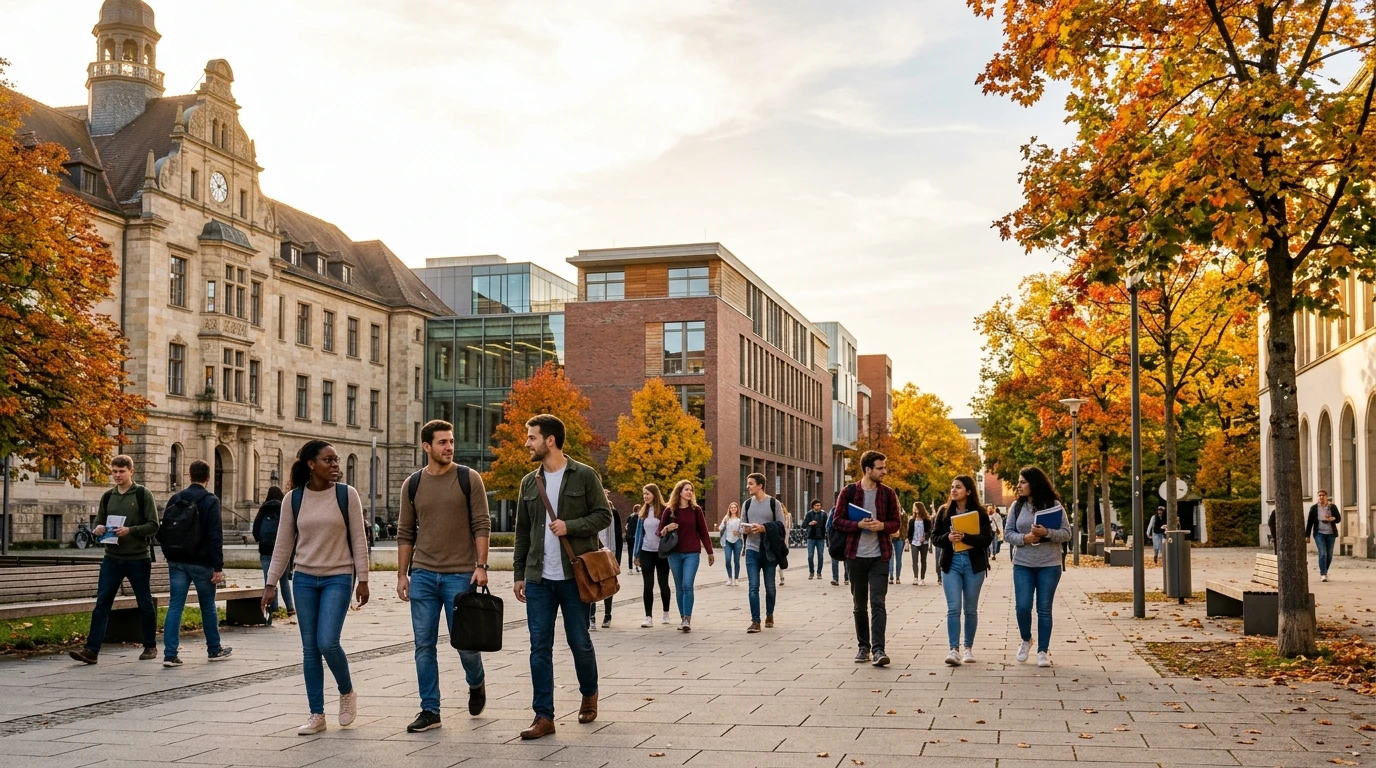
The landscape of European higher education is undergoing a decisive shift, with Germany standing as the leading continental destination for international graduate students. Driven by national economic demand for advanced STEM research and global management talent, German state universities are rapidly transitioning their master's degree catalogs to 100% English-language coursework.
For international applicants, this framework provides an unparalleled proposition: tuition-free or low-cost higher education at institutions globally respected for technical rigor. However, navigating German university admissions requires meticulous preparation—from understanding state-level tuition policies to securing mandatory APS certificate verifications and meeting strict blocked account statutory thresholds.
To contextualize these institutions globally, we recommend reviewing our comprehensive analysis of the Top 100 Universities in Europe, which examines how German TU9 institutes compare with elite institutions in the UK, Netherlands, and Switzerland on QS and THE world metrics.
Strategic Highlights & Public Tuition Reality
- Zero-Tuition Policy Across 15 States: In 15 out of 16 German federal states, public universities levy €0 base tuition for consecutive master's degrees for all students regardless of citizenship.
- Baden-Württemberg Exception: Public universities in the state of Baden-Württemberg (including KIT Karlsruhe, University of Stuttgart, Heidelberg University, and University of Freiburg) charge non-EU international entrants a statutory tuition fee of €1,500 per semester (€3,000 annually).
- Semesterbeitrag (Administrative Contribution): While tuition is zero in most states, every enrolled student pays a mandatory administrative semester fee (Semesterbeitrag) ranging from €150 to €380 per semester. This fee covers campus student unions, social administration, and the regional Semesterticket granting unlimited local and regional public transit.
- Post-Study Career Transition: International graduates of German public universities receive a legal entitlement to an 18-Month Jobseeker Visa (18-Monate-Suchvisum), enabling unrestricted employment while searching for a role commensurate with their degree.
Master 50-Program Comparison Table (2026 Rankings)
This master comparison table profiles the top 50 English-taught master's programs across premier German public institutions, categorized by discipline, state fee framework, language prerequisites, and APS requirements:
| Rank | University | Program / Specialization | City / State | Semester Contribution | English Req | APS Required? |
|---|---|---|---|---|---|---|
| 1 | Technical University of Munich (TUM) | M.Sc. Data Engineering and Analytics | Munich, Bavaria | ~€152 | 6.5+ | Yes |
| 2 | LMU Munich | M.Sc. Data Science | Munich, Bavaria | ~€152 | 7.0 | Yes |
| 3 | Heidelberg University | M.Sc. Scientific Computing | Heidelberg, Baden-Württemberg | €1,500 (Non-EU) | 6.5+ | Yes |
| 4 | RWTH Aachen University | M.Sc. Computer Aided Conception & Production | Aachen, NRW | ~€320 | 6.5+ | Yes |
| 5 | TU Berlin | M.Sc. Computer Science | Berlin | ~€315 | 6.5+ | Yes |
| 6 | KIT Karlsruhe | M.Sc. Electrical Engineering & IT | Karlsruhe, Baden-Württemberg | €1,500 (Non-EU) | 6.5+ | Yes |
| 7 | University of Stuttgart | M.Sc. Information Technology (INFOTECH) | Stuttgart, Baden-Württemberg | €1,500 (Non-EU) | 6.5+ | Yes |
| 8 | TU Darmstadt | M.Sc. Aerospace Engineering | Darmstadt, Hesse | ~€270 | 6.5+ | Yes |
| 9 | FAU Erlangen-Nürnberg | M.Sc. Artificial Intelligence | Erlangen, Bavaria | ~€140 | 6.5+ | Yes |
| 10 | University of Bonn | M.Sc. Computer Science | Bonn, NRW | ~€320 | 6.5+ | Yes |
| 11 | Technical University of Munich (TUM) | M.Sc. Informatics | Munich, Bavaria | ~€152 | 6.5+ | Yes |
| 12 | RWTH Aachen University | M.Sc. Robotic Systems Engineering | Aachen, NRW | ~€320 | 6.5+ | Yes |
| 13 | TU Dresden | M.Sc. Computational Modeling and Simulation | Dresden, Saxony | ~€290 | 6.5+ | Yes |
| 14 | University of Freiburg | M.Sc. Embedded Systems Engineering | Freiburg, Baden-Württemberg | €1,500 (Non-EU) | 7.0 | Yes |
| 15 | TU Berlin | M.Sc. Global Production Engineering | Berlin | ~€315 | 6.5+ | Yes |
| 16 | University of Hamburg | M.Sc. Intelligent Adaptive Systems | Hamburg | ~€340 | 6.5+ | Yes |
| 17 | University of Göttingen | M.Sc. Applied Data Science | Göttingen, Lower Saxony | ~€380 | 6.5+ | Yes |
| 18 | Saarland University | M.Sc. Computer Science | Saarbrücken, Saarland | ~€300 | 6.5+ | Yes |
| 19 | University of Mannheim | M.Sc. Data Science | Mannheim, Baden-Württemberg | €1,500 (Non-EU) | 6.5+ | Yes |
| 20 | TU Braunschweig | M.Sc. Automotive Engineering | Braunschweig, Lower Saxony | ~€380 | 6.5+ | Yes |
| 21 | Technical University of Munich (TUM) | M.Sc. Management & Technology (TUM-BWL) | Munich, Bavaria | ~€152 | 6.5+ | Yes |
| 22 | University of Cologne | M.Sc. International Management (CEMS) | Cologne, NRW | ~€310 | 7.0 | Yes |
| 23 | RWTH Aachen University | M.Sc. Sustainable Management - Energy | Aachen, NRW | ~€320 | 6.5+ | Yes |
| 24 | TU Dortmund University | M.Sc. Automation and Robotics | Dortmund, NRW | ~€325 | 6.5+ | Yes |
| 25 | University of Bremen | M.Sc. Control, Microsystems, Microelectronics | Bremen | ~€380 | 6.5+ | Yes |
| 26 | University of Stuttgart | M.Sc. Computational Mechanics (COMMAS) | Stuttgart, Baden-Württemberg | €1,500 (Non-EU) | 6.5+ | Yes |
| 27 | TU Dresden | M.Sc. Distributed Systems Engineering | Dresden, Saxony | ~€290 | 6.5+ | Yes |
| 28 | Leibniz University Hannover | M.Sc. Mechatronics and Robotics | Hannover, Lower Saxony | ~€390 | 6.5+ | Yes |
| 29 | University of Tübingen | M.Sc. Machine Learning | Tübingen, Baden-Württemberg | €1,500 (Non-EU) | 7.0 | Yes |
| 30 | University of Kiel (CAU) | M.Sc. Materials Science and Engineering | Kiel, Schleswig-Holstein | ~€280 | 6.5+ | Yes |
| 31 | Technical University of Munich (TUM) | M.Sc. Aerospace | Munich, Bavaria | ~€152 | 6.5+ | Yes |
| 32 | FAU Erlangen-Nürnberg | M.Sc. Advanced Materials and Processes | Erlangen, Bavaria | ~€140 | 6.5+ | Yes |
| 33 | Ruhr University Bochum | M.Sc. Computational Engineering | Bochum, NRW | ~€330 | 6.5+ | Yes |
| 34 | University of Potsdam | M.Sc. Data Science | Potsdam, Brandenburg | ~€310 | 6.5+ | Yes |
| 35 | TU Ilmenau | M.Sc. Communications & Signal Processing | Ilmenau, Thuringia | ~€160 | 6.5+ | Yes |
| 36 | TU Bergakademie Freiberg | M.Sc. Sustainable Mining Management | Freiberg, Saxony | ~€100 | 6.0+ | Yes |
| 37 | University of Duisburg-Essen | M.Sc. Mechanical Engineering (ISE) | Duisburg, NRW | ~€330 | 6.5+ | Yes |
| 38 | University of Passau | M.Sc. Computer Science | Passau, Bavaria | ~€90 | 6.5+ | Yes |
| 39 | TU Chemnitz | M.Sc. Embedded Systems | Chemnitz, Saxony | ~€270 | 6.0+ | Yes |
| 40 | University of Magdeburg (OVGU) | M.Sc. Medical Systems Engineering | Magdeburg, Saxony-Anhalt | ~€140 | 6.5+ | Yes |
| 41 | Humboldt University of Berlin | M.Sc. Economics and Management (MEMS) | Berlin | ~€315 | 7.0 | Yes |
| 42 | University of Münster | M.Sc. Geoinformatics | Münster, NRW | ~€310 | 6.5+ | Yes |
| 43 | University of Bayreuth | M.Sc. Biotechnology | Bayreuth, Bavaria | ~€150 | 6.5+ | Yes |
| 44 | University of Würzburg | M.Sc. Artificial Intelligence | Würzburg, Bavaria | ~€145 | 6.5+ | Yes |
| 45 | TU Darmstadt | M.Sc. Autonomous Systems | Darmstadt, Hesse | ~€270 | 6.5+ | Yes |
| 46 | Brandenburg Tech (BTU Cottbus) | M.Sc. Power Engineering | Cottbus, Brandenburg | ~€320 | 6.5+ | Yes |
| 47 | University of Rostock | M.Sc. Computational Science | Rostock, Mecklenburg-Vorpommern | ~€260 | 6.5+ | Yes |
| 48 | Frankfurt University of Applied Sciences | M.Sc. High Integrity Systems | Frankfurt, Hesse | ~€370 | 6.5+ | Yes |
| 49 | Hochschule Darmstadt (h_da) | M.Sc. Electrical Engineering & IT | Darmstadt, Hesse | ~€280 | 6.5+ | Yes |
| 50 | University of Siegen | M.Sc. Mechatronics | Siegen, NRW | ~€290 | 6.0+ | Yes |
Core Editorial Pillars
Pillar 1: TU9 Alliance & Advanced Engineering Standards
The TU9 is the consortium of Germany's nine premier Technical Universities (including TUM, RWTH Aachen, TU Berlin, KIT Karlsruhe, and TU Darmstadt). Admissions committees at these institutions place immense weight on undergraduate credit parity (ECTS compatibility). Applicants must demonstrate sufficient credit hours in theoretical mathematics, thermodynamics, and algorithms to pass primary qualification rounds. For high-demand programs, submitting a GRE score with a Quantitative percentile above 80% is either compulsory or heavily recommended.
Pillar 2: English-Taught Data Science, Management & Sustainability
In addition to traditional mechanical and electrical engineering, German universities are rapidly expanding English-language master's offerings in Data Science, Applied AI, and Sustainable Resource Management. Programs at LMU Munich, University of Mannheim, and University of Cologne offer close integration with European enterprise hubs (SAP, BMW, Siemens, Allianz), facilitating required thesis research in industrial settings.
Pillar 3: The APS (Akademische Prüfstelle) Verification Workflow
For applicants holding undergraduate degrees from India, China, or Vietnam, obtaining an APS certificate from the German embassy is a mandatory prerequisite before any student visa application can be lodged. This system validates the authenticity of academic transcripts and degree certificates to prevent fraudulent submissions.
- Phase 1: Register on the official national APS online portal and submit processing fees.
- Phase 2: Dispatch notarized physical copies of degree certificates, semester transcripts, and official language test results.
- Phase 3: Academic verification is conducted directly with your home university. Due to seasonal application surges, processing timelines can take between 6 to 12 weeks; candidates must initiate verification well ahead of university deadlines. Also reference our guide on verifying university accreditation before finalizing applications.
Pillar 4: Blocked Account (Sperrkonto) & Proof of Living Funds
To obtain a national student visa, non-EU candidates must demonstrate sufficient financial resources to sustain themselves for their first year of study. German immigration law requires depositing funds into a legally certified Blocked Account (Sperrkonto). For the 2026 cycle, the statutory benchmark requires approximately €11,208 per year (equivalent to roughly €934 to €992 per month). Leading government-approved blocked account providers include Expatrio, Coracle, and Fintiba, which bundle statutory public health insurance (TK, Barmer, or AOK) with the escrow account.
Pillar 5: Post-Graduation Career Pathways & 18-Month Jobseeker Visa
Upon graduation, international students can extend their residency permit by up to 18 months under the 18-Monate-Suchvisum. During this period, graduates can work full-time in any industry to support themselves while interviewing for qualified professional positions. Securing a qualifying contract meeting standard salary thresholds enables a seamless transition to the EU Blue Card, with permanent residency (Niederlassungserlaubnis) attainable after just 21 to 27 months of German pension contributions.
Frequently Asked Questions (FAQ)
Can I get an IELTS waiver for English-taught master's programs in Germany?
Yes. Many German public universities accept a formal Medium of Instruction (MOI) letter confirming that your previous bachelor's degree was conducted 100% in English. However, competitive TU9 programs (such as TUM and RWTH Aachen) generally maintain strict requirements for recent academic IELTS (minimum 6.5) or TOEFL iBT (minimum 88-92) scores.
Do I need to speak German to live and study in Germany?
While coursework for these 50 master's degrees is conducted entirely in English, basic German language proficiency (A2 to B1 level) is vital for integrating into local communities, interacting with local administrative bodies (Ausländerbehörde), and accessing internship opportunities with German-speaking companies.
What are the legal part-time work limits for international students in Germany?
Under current immigration guidelines, non-EU international students on a full-time student visa are legally permitted to work up to 140 full days or 280 half days per calendar year. Student academic assistant roles (HiWi) within universities typically enjoy additional exemptions.
What are the primary application deadlines for German universities?
For the Winter Semester (starting October), non-EU international deadlines generally run between April 15 and July 15. For the Summer Semester (starting April), deadlines typically close between October 15 and January 15. Many universities utilize the centralized uni-assist portal for preliminary document evaluation.
How does tuition in Germany compare to the UK and USA?
While master's tuition in the United States and the United Kingdom frequently exceeds $35,000 to $60,000 per year, public universities in 15 German states charge €0 in base tuition, requiring only modest semester contributions (€300–€700 annually), representing substantial cost savings for international scholars.
Sources, Updates and Corrections
- DAAD (German Academic Exchange Service) Official International Programs Database — verified 2026.
- TU9 German Universities of Technology Official Consortium — checked 2026.
- Akademische Prüfstelle (APS) Official Guidelines — verified 2026.
- Make it in Germany (Federal Government Portal for International Professionals) — verified 2026.
Admissions criteria, semester fee schedules, and visa regulations change periodically. Prospective applicants are encouraged to verify program-specific details directly through respective university faculty portals.

Saahil
Saahil is an education researcher and content creator specializing in university rankings, admissions strategies, and student guides. He is dedicated to helping students make informed academic decisions.
Continue your research
Top 100 Universities in Europe for International Students: 2026 Rankings & Tuition Guide
A complete comparative guide to the 100 leading European higher education institutions for global candidates. Breakdown of English coursework, non-EU fee structures, and post-study employment avenues.
Read the guide →
Top 100 Finance Schools in the US: 2026 Rankings & Placement Guide
Compare 100 leading US finance universities and business schools by Wall Street recruitment pipelines, quantitative curriculum, target status, and STEM accreditation.
Read the guide →
How to Verify an Australian Course on CRICOS
Check an Australian provider, course code, location and duration in the official CRICOS register before applying as an international student.
Read the guide →