
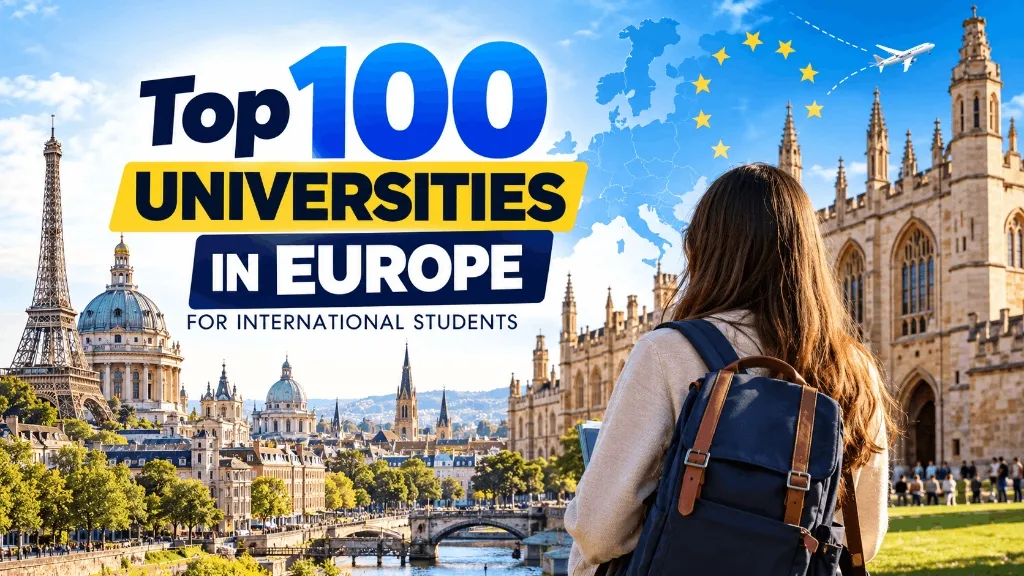
Europe is where a strong degree and a manageable bill can still go together. The QS World University Rankings: Europe 2026 puts Oxford first, ETH Zurich second, Imperial College London and UCL tied third, and Cambridge fifth — and behind those five, this guide ranks 100 universities across the continent, from the UK and Ireland to Germany, France, the Netherlands, Switzerland and the Nordics.
This guide is written for international students. It covers the ranking itself, where English-taught degrees actually exist, what non-EU students pay in each country, and how long graduates can stay to look for work. The order below is our own editorial ranking, built with the weights in the methodology section; QS Europe 2026 and Times Higher Education's Europe table are the outside checks we measured it against. Tuition figures are projected ranges for non-EU students — confirm the exact fee on the university's own fees page before you apply, because fees change every year.
Best Universities in Europe at a Glance
- Low-cost strongholds: Public universities in most German states still charge no tuition — only a small semester contribution. Baden-Württemberg is the exception at €1,500 a semester for non-EU students, and TUM charges €2,000 to €6,000 a semester depending on the programme.
- The Swiss change: ETH Zurich and EPFL tripled fees for most international students from autumn 2025 — CHF 2,190 a semester (CHF 4,380 a year). Even so, that is far below leading UK fees.
- UK fees are the outlier: Oxford's overseas undergraduate fees for 2026–27 run £37,380 to £62,820 a year, depending on the course. Continental Europe mostly sits between €0 and about €21,000 a year.
- English where it counts: Master's degrees across Western Europe are mostly taught in English. Bachelor's degrees are a different story — the Netherlands, Ireland and the Nordics offer the widest choice in English; Germany, France and Switzerland keep most bachelor's teaching in the local language.
- Staying on after graduation: Germany gives graduates up to 18 months to look for work; the Netherlands gives 12 months with no work-permit requirement; Ireland gives 12 months after a bachelor's and up to 24 after a master's; Finland gives up to two years.
A Closer Look: Top 5 Universities in Europe (2026 Overview)
These five lead both our table and the QS Europe 2026 ranking — Oxford first, ETH Zurich second, Imperial and UCL tied third, Cambridge fifth. Each one is different in what it offers an international student, so read them for fit, not just for rank.
1. University of Oxford — Oxford, England
Oxford tops the QS Europe 2026 ranking with a perfect score of 100. It is a federation of 36 colleges, three societies and four permanent private halls — 43 colleges and halls in all — and its Bodleian Library opened in 1602. Teaching is built around small-group tutorials in the colleges. Overseas undergraduate fees for 2026–27 run £37,380 to £62,820 a year depending on the course, with clinical medicine higher. University of Oxford profile
2. University of Cambridge — Cambridge, England
Cambridge sits fifth in QS Europe 2026 and second in our table. Its 31 self-governing colleges run the university's famous supervisions — regular small-group teaching with a college academic — across six Schools covering the arts, sciences, medicine and technology. The Fitzwilliam Museum, founded in 1816, holds more than half a million artworks and antiquities. University of Cambridge profile
3. Imperial College London — London, England
Imperial is tied third in QS Europe 2026. Chartered in 1907, it teaches only science, engineering, medicine and business — no humanities departments at all — from its South Kensington campus, with a second major campus at White City. That narrow focus is the point: every department sits inside those four fields. Imperial College London profile
4. ETH Zurich — Zurich, Switzerland
ETH Zurich is second in QS Europe 2026 and the highest-ranked university in continental Europe. It is Switzerland's federal institute of technology, and its strength is engineering and the natural sciences. Since autumn 2025 most international students pay CHF 2,190 a semester (CHF 4,380 a year) — three times the old fee, and still far below UK levels.
5. University College London (UCL) — London, England
UCL is tied third in QS Europe 2026. Founded in 1826, it was the first university in England to admit students regardless of religion, and the first to admit women, in 1878. Its main campus sits on Gower Street in central London, and it teaches across eleven faculties — the broadest range of any university in this top five. University College London profile
How We Ranked the Top 100 Universities in Europe
This table is our own editorial ranking. It scores each university on the five practical measures below, not on reputation surveys alone. QS Europe 2026 and Times Higher Education's Europe table are the outside checks we used to test the order — which is why the top five here (Oxford, Cambridge, Imperial, ETH Zurich, UCL) match the QS Europe 2026 top five, even though the order inside it differs: QS puts ETH second and Cambridge fifth, while our weights put Cambridge second.
| Evaluation Metric | Weight | Key Assessment Points |
|---|---|---|
| Scholarly Rigor & Output | 30% | Departmental citation strength, laboratory infrastructure, and faculty-to-candidate ratios. |
| English Curricular Scope | 25% | The documented volume of fully English-medium bachelor's and master's tracks. |
| International Candidate Support | 20% | Institutional onboarding, housing guidance networks, and legal visa assistance. |
| Post-Graduate Economic Integration | 15% | Regional industrial integration, employment search authorization, and blue-card eligibility. |
| Net Financial Return | 10% | Anticipated total qualification cost relative to prevailing sector entry remuneration. |
Top 100 Universities in Europe: Full Ranking Table (2026)
Tuition figures below are projected annual ranges for non-EU students, in the currency each university charges. They are a starting point for comparison, not a quote — confirm the exact fee for your course on the university's own fees page. Oxford's 2026–27 overseas undergraduate fees (£37,380–£62,820, excluding clinical medicine) and ETH Zurich's CHF 4,380 a year for most international students were checked against the universities' own fee pages on 18 November 2026.
| Rank | Institution | Country | Key Discipline Concentrations | English Medium Availability | Projected Annual Tuition (Non-EU) |
|---|---|---|---|---|---|
| 1 | University of Oxford | United Kingdom | Classical Disciplines, Experimental Sciences, Medicine | Fully English | £37,380 – £62,820 |
| 2 | University of Cambridge | United Kingdom | Theoretical Physics, Pure Mathematics, Engineering | Fully English | £25,000 – £45,000 |
| 3 | Imperial College London | United Kingdom | Applied Computing, Clinical Sciences, Engineering | Fully English | £36,000 – £42,000 |
| 4 | ETH Zurich | Switzerland | Systems Architecture, Algorithmic Robotics, Physics | Extensive at Graduate Level | CHF 4,380 / year |
| 5 | University College London (UCL) | United Kingdom | Spatial Planning, Global Health, Econometrics | Fully English | £26,000 – £38,000 |
| 6 | Technical University of Munich (TUM) | Germany | Machine Intelligence, Power Engineering, Informatics | Broad Master's Catalogue | €4,000 – €12,000 / year |
| 7 | University of Edinburgh | United Kingdom | Cognitive Science, Evolutionary Biology, Philosophy | Fully English | £24,000 – £35,000 |
| 8 | LMU Munich | Germany | Oncology, Molecular Physics, Macroeconomics | High Master's Availability | €0 (Approx €150 admin contribution) |
| 9 | EPFL | Switzerland | Nano-electronics, Applied Mechanics, Data Systems | Strong Graduate Catalogue | CHF 4,380 / year |
| 10 | King's College London | United Kingdom | Jurisprudence, Geopolitics, Psychiatric Medicine | Fully English | £25,000 – £36,000 |
| 11 | KU Leuven | Belgium | Semi-conductors, Moral Philosophy, Bio-processing | Widespread Master's Selection | €1,500 – €7,000 |
| 12 | Université PSL | France | Abstract Mathematics, Quantitative Finance, Physics | Graduate Focus | €3,000 – €10,000 |
| 13 | Heidelberg University | Germany | Biomedical Research, Classical Philology, Mathematics | Focused Master's Tracks | €3,000 / year |
| 14 | London School of Economics (LSE) | United Kingdom | Financial Markets, Public Policy, Social Theory | Fully English | £26,000 – £34,000 |
| 15 | Karolinska Institute | Sweden | Clinical Research, Global Toxicology, Epidemiology | Advanced English Master's | SEK 180,000 – 200,000 |
| 16 | University of Manchester | United Kingdom | Advanced Materials, Particle Research, Accounting | Fully English | £24,000 – £34,000 |
| 17 | TU Delft | Netherlands | Maritime Structures, Aeronautical Design, Urbanism | Very High Across All Tiers | €16,000 – €21,000 |
| 18 | University of Amsterdam (UvA) | Netherlands | Behavioral Sciences, Mass Media, Computational Logic | Extensive Undergraduate & Graduate | €10,000 – €16,000 |
| 19 | Wageningen University & Research | Netherlands | Agritech, Global Food Systems, Eco-hydrology | Exclusively English at Master's | €16,000 – €19,500 |
| 20 | Institut Polytechnique de Paris | France | Quantitative Modeling, Applied Dynamics, Cybersecurity | Dedicated Graduate English Tracks | €6,000 – €15,000 |
| 21 | Université Paris-Saclay | France | Quantum Mechanics, Astrophysics, Pure Geometry | Substantial Graduate Scope | €4,000 – €8,000 |
| 22 | Leiden University | Netherlands | International Tribunal Law, Sinology, Governance | Broad Multilingual Catalog | €12,000 – €18,000 |
| 23 | Sorbonne University | France | Marine Biology, European History, Physical Sciences | Curated Master's Selection | €3,000 – €6,000 |
| 24 | University of Bristol | United Kingdom | Composite Materials, Synthetic Biology, Engineering | Fully English | £23,000 – £32,000 |
| 25 | University of Groningen | Netherlands | Molecular Genetics, Commercial Law, Economics | Substantial English Depth | €10,000 – €16,000 |
| 26 | University of Glasgow | United Kingdom | Precision Medicine, Civil Engineering, Comparative Arts | Fully English | £23,000 – £33,000 |
| 27 | Humboldt University of Berlin | Germany | Theoretical Sociology, Econometrics, Legal Philosophy | Diverse Master's Tracks | €0 (Nominal semester charge) |
| 28 | University of Copenhagen | Denmark | Biopharmaceuticals, Ecology, Animal Pathology | Dominant at Master's Level | €10,000 – €17,000 |
| 29 | Charité - Universitätsmedizin Berlin | Germany | Experimental Neuroscience, Infectious Pathogens | Targeted English Research Tracks | €0 (Nominal semester charge) |
| 30 | RWTH Aachen University | Germany | Production Engineering, Vehicle Technology, Metallurgy | High-Density STEM Master's | €0 (Nominal semester charge) |
| 31 | University of Bonn | Germany | Microeconomic Theory, Agricultural Logistics, Math | Tailored Graduate Streams | €0 (Nominal semester charge) |
| 32 | Lund University | Sweden | Wireless Tech, Global Human Rights, Biotechnology | Comprehensive Master's Scope | SEK 120,000 – 170,000 |
| 33 | University of Vienna | Austria | Astro-physics, Molecular Cytology, Humanities | Targeted Graduate Portfolios | €1,500 / year |
| 34 | KTH Royal Institute of Technology | Sweden | High-Voltage Systems, Urban Infrastructure, Telecom | Comprehensive Master's Tracks | SEK 155,000 – 170,000 |
| 35 | University of Birmingham | United Kingdom | Structural Metallurgy, Applied Physics, Commerce | Fully English | £22,000 – £30,000 |
| 36 | University of Tübingen | Germany | Neural Information Processing, Paleontology, Chem | Diverse Master's Catalog | €3,000 / year |
| 37 | Aarhus University | Denmark | Biosystems Engineering, Analytical Linguistics, IT | Robust English Master's Scope | €8,500 – €15,500 |
| 38 | University of Helsinki | Finland | Atmospheric Physics, Global Governance, Forest Sciences | Expansive English Graduate Division | €13,000 – €18,000 |
| 39 | Erasmus University Rotterdam | Netherlands | Health Economics, Trade Law, Enterprise Strategy | High Density Across Levels | €10,000 – €17,000 |
| 40 | University of Bern | Switzerland | Atmospheric Dynamics, Planetary Exploration, Medicine | Select English Graduate Portfolios | CHF 1,800 – 3,200 |
| 41 | University of Sheffield | United Kingdom | Heavy Metallurgy, Urban Architecture, Media Studies | Fully English | £22,000 – £31,000 |
| 42 | Free University of Berlin | Germany | Transnational Relations, Regional Studies, Philosophy | Extensive Master's Selection | €0 (Nominal semester charge) |
| 43 | University of Oslo | Norway | Renewable Power Law, Data Modeling, Geosciences | English Graduate Specializations | NOK 130,000 – 200,000 |
| 44 | Ghent University | Belgium | Industrial Fermentation, Marine Ecology, Crop Science | Strong Master's Offering | €2,000 – €6,000 |
| 45 | University of Leeds | United Kingdom | Urban Logistics, Textile Science, Environmental Law | Fully English | £23,000 – £31,000 |
| 46 | University of Basel | Switzerland | Molecular Pathology, Quantum Coherence, Pharmacology | Advanced Research Streams | CHF 1,700 – 2,500 |
| 47 | Technical University of Denmark (DTU) | Denmark | Off-Shore Wind Engineering, Enzyme Kinetics | Structured English Master's | €15,000 / year |
| 48 | University of Göttingen | Germany | Terrestrial Ecology, Agricultural Policy, Solid State | Diverse English Master's | €0 (Nominal semester charge) |
| 49 | University of Warwick | United Kingdom | Manufacturing Engineering (WMG), Financial Economics | Fully English | £24,000 – £33,000 |
| 50 | University of Hamburg | Germany | Maritime Law, Climate Modeling, High-Energy Physics | Focused Master's Catalog | €0 (Nominal semester charge) |
| 51 | Trinity College Dublin | Ireland | Immunology Research, Digital Humanities, CS | Fully English | €18,000 – €26,000 |
| 52 | University of Southampton | United Kingdom | Acoustic Engineering, Hydrodynamics, Microelectronics | Fully English | £22,000 – £29,500 |
| 53 | Karlsruhe Institute of Technology (KIT) | Germany | Electronic Propulsion, Cybernetics, Optics | Extensive STEM Master's Catalog | €3,000 / year |
| 54 | University of Freiburg | Germany | Solar Energy Systems, Forest Ecology, History | Curated Master's Selection | €3,000 / year |
| 55 | Stockholm University | Sweden | International Commercial Arbitration, Cryology | Extensive Master's Streams | SEK 100,000 – 140,000 |
| 56 | University of Nottingham | United Kingdom | Sustainable Agronomy, Pharmacy, Chemical Systems | Fully English | £21,000 – £28,000 |
| 57 | Uppsala University | Sweden | Structural Genomics, Geopolitics, Applied Physics | Broad English Master's Coverage | SEK 110,000 – 150,000 |
| 58 | Utrecht University | Netherlands | Hydro-geology, Comparative Veterinary Medicine | Substantial English Breadth | €12,000 – €19,000 |
| 59 | University of Zurich | Switzerland | Quantitative Finance, Primatology, Bio-ethics | Select English Master's | CHF 1,500 – 2,800 |
| 60 | University College Dublin (UCD) | Ireland | Agricultural Biotechnology, Financial Analytics | Fully English | €19,000 – €27,000 |
| 61 | Politecnico di Milano | Italy | Industrial Architecture, Space Vehicles, Civil Design | Comprehensive Graduate Catalog | €3,500 – €4,000 |
| 62 | Technical University of Berlin | Germany | Renewable Energy Systems, Urban Planning, Transport | Focused Technical Master's | €0 (Nominal semester charge) |
| 63 | Queen Mary University of London | United Kingdom | Intellectual Property Law, Dentistry, Data Systems | Fully English | £22,000 – £29,000 |
| 64 | University of Exeter | United Kingdom | Mineral Extraction, Oceanography, Environmental Policy | Fully English | £21,000 – £28,500 |
| 65 | University of Lausanne | Switzerland | Legal Criminology, Sports Governance, Earth Sciences | Select English Streams | CHF 1,200 – 2,000 |
| 66 | University of York | United Kingdom | Post-War Reconstruction, Bio-archaeology, Electronics | Fully English | £20,500 – £28,000 |
| 67 | Eindhoven University of Technology | Netherlands | Lithography Mechanics, Embedded Systems, Photonics | Fully English at Master's Tier | €14,000 – €18,000 |
| 68 | Chalmers University of Technology | Sweden | Naval Architecture, Autonomous Systems, Physics | Fully English Master's Tracks | SEK 140,000 – 160,000 |
| 69 | University of Bologna | Italy | Historical Jurisprudence, Agri-environmental Studies | Expanding International Portfolio | €2,000 – €3,500 |
| 70 | Lancaster University | United Kingdom | Operational Research, Climatology, Strategic Management | Fully English | £20,000 – £27,000 |
| 71 | Aalto University | Finland | Design Engineering, Interactive Systems, Business | Fully English Master's Tracks | €12,000 – €15,000 |
| 72 | University of Newcastle | United Kingdom | Marine Technology, Gerontology, Infrastructure | Fully English | £20,000 – £27,000 |
| 73 | University of Barcelona | Spain | Pharmacology, Regional Economics, Marine Ecology | Select English-Taught Master's | €3,000 – €5,000 |
| 74 | University of Cologne | Germany | Health Economics, Empirical Sociology, Genetics | Broad Master's Offerings | €0 (Nominal semester charge) |
| 75 | University of Antwerp | Belgium | International Port Management, Immunology, Design | Select Master's Programs | €1,800 – €5,800 |
| 76 | Radboud University | Netherlands | Cognitive Neuroscience, Software Safety, Law | High Density English Coverage | €10,000 – €15,500 |
| 77 | University of Bath | United Kingdom | Automotive Engineering, Applied Economics, Sports | Fully English | £22,000 – £29,000 |
| 78 | University of Liverpool | United Kingdom | Zoonotic Diseases, Heritage Architecture, Analytics | Fully English | £20,000 – £28,000 |
| 79 | TU Dresden | Germany | Microelectronic Engineering, Polymeric Chemistry | Substantial STEM Graduate Base | €0 (Nominal semester charge) |
| 80 | University of Stuttgart | Germany | Automotive Dynamics, Computational Construction | Dedicated Technical Master's | €3,000 / year |
| 81 | Maastricht University | Netherlands | Forensic Psychology, European Legal Integration | Predominantly English Medium | €10,000 – €16,000 |
| 82 | Sapienza University of Rome | Italy | Classical Archaeology, Aerospace Structures, Data | Growing English Degree Catalog | €1,500 – €3,000 |
| 83 | University of St Andrews | United Kingdom | Strategic Counter-Terrorism, Marine Ecology | Fully English | £24,000 – £31,000 |
| 84 | University of Twente | Netherlands | Sensor Systems, Interaction Design, Biomedical | Fully English Master's Division | €12,500 – €16,500 |
| 85 | University of Bergen | Norway | Deep-Sea Ecology, Arctic Climatology, Petroleum | Targeted English Master's Tracks | NOK 130,000 – 190,000 |
| 86 | Vrije Universiteit Amsterdam | Netherlands | Human Movement Dynamics, Digital Law, Computing | Extensive English Portfolio | €11,000 – €16,000 |
| 87 | FAU Erlangen-Nürnberg | Germany | Medical Implants, Optical Technologies, Materials | Focused STEM Master's | €0 (Nominal semester charge) |
| 88 | Autonomous University of Barcelona | Spain | Translational Biotech, Veterinary Medicine, Media | Select Master's Programs | €2,800 – €4,500 |
| 89 | University of Aberdeen | United Kingdom | Hydrocarbon Engineering, Legal Systems, Marine Bio | Fully English | £19,000 – £26,000 |
| 90 | Charles University | Czechia | Clinical Medicine, Central European Studies, Physics | English Divisions in Selected Fields | €4,000 – €14,000 |
| 91 | Queen's University Belfast | United Kingdom | Network Encryption, Cancer Therapeutics, Aerospace | Fully English | £19,000 – £25,000 |
| 92 | University of Innsbruck | Austria | High-Altitude Meteorology, Cryogenics, Sports Science | Select English Graduate Tracks | €1,500 / year |
| 93 | Cardiff University | United Kingdom | Investigative Journalism, Catalytic Chemistry, Design | Fully English | £19,500 – £27,000 |
| 94 | University of Tartu | Estonia | Cyber Defense, Synthetic Biology, Software Systems | Comprehensive English Catalog | €4,000 – €6,000 |
| 95 | University of Padua | Italy | Observational Astrophysics, Human Rights Law | Expanding English Offerings | €2,600 – €3,200 |
| 96 | University of Strathclyde | United Kingdom | Wind Turbine Dynamics, Maritime Architecture | Fully English | £18,000 – £25,000 |
| 97 | Vrije Universiteit Brussel | Belgium | Micro-photonics, Multilingual Governance, Law | Strong English Graduate Catalog | €2,500 – €5,000 |
| 98 | University of Münster | Germany | Nanoscale Chemistry, Distribution Logistics, Law | Selective Master's Streams | €0 (Nominal semester charge) |
| 99 | Linköping University | Sweden | Aviation Avionics, Medical Imaging, Electronics | Broad English Master's Tracks | SEK 110,000 – 140,000 |
| 100 | University of Warsaw | Poland | Quantum Cryptography, Prehistoric Archeology, Econ | Full English Subject Streams | €3,000 – €5,500 |
English-Taught Degrees in Europe: Where to Look
The first question is not which university, but which language your degree is taught in — and the honest answer depends on the level. At master's level, English is the norm across Western Europe: Germany, France, Switzerland and the Netherlands all run large English-taught master's catalogues. At bachelor's level the choice narrows sharply. The Netherlands, Ireland and the Nordic countries offer the widest range of English-taught bachelor's degrees. In Germany, France and Switzerland, most bachelor's programmes still teach in the local language, with English options concentrated in a smaller set of programmes.
Check before you shortlist. Germany's DAAD international programmes database lists English-taught degrees programme by programme, and the Study in NL register does the same for the Netherlands — both are linked in the Sources section below. Two things to verify on the programme page itself: that the whole degree is taught in English (some bachelor's programmes switch to the local language in later years), and what English test score the programme asks for — most ask for IELTS 6.5 to 7.0 or TOEFL iBT 90 to 100, with higher bands for competitive faculties.
Non-EU Tuition by Country (2026–27)
The cheapest degree in Europe and the most expensive one can sit in the same ranking table. The difference is the country, not the university's quality — so compare by country first, then by university.
| Country | Non-EU tuition, 2026–27 | What to know |
|---|---|---|
| Germany | €0 at public universities in most states; €1,500 a semester in Baden-Württemberg; TUM €2,000–€6,000 a semester | A small semester contribution still applies everywhere. |
| France | €2,902 a year (licence); €3,950 a year (master's) at public universities | Differentiated fees for non-EU students; exemptions now limited, so budget for the full fee. Plus the €105 CVEC student-life contribution. |
| Switzerland | ETH Zurich and EPFL: CHF 2,190 a semester (CHF 4,380 a year) for most international students | Tripled from autumn 2025. Other Swiss public universities charge less per semester. |
| Netherlands | Set by each university — roughly €10,000–€21,000 a year in our table | Institutional fees, so the exact figure is on the university's own fees page. |
| Sweden, Denmark, Finland | Non-EU students pay tuition — roughly €8,500–€18,000 a year in our table | Fees vary by university and subject; check the programme page. |
| Ireland | Roughly €18,000–€27,000 a year in our table (Trinity, UCD) | All teaching in English; fees set by each university. |
| United Kingdom | Oxford overseas undergraduate fees £37,380–£62,820 a year (2026–27) | The most expensive destination in this guide; clinical medicine costs more. |
Living costs are separate and often decide the budget: Germany asks visa applicants to show €11,904 for a year in a blocked account (see the Sperrkonto section below), and Zurich and Lausanne run roughly CHF 1,800 to CHF 2,500 a month. Always budget tuition and living costs together — a €0-tuition degree in an expensive city can cost more than a mid-fee degree in a cheaper one.
Post-Study Visas: How Long You Can Stay After Graduating
A degree is only half the decision. The other half is how long the country lets you stay and look for work once you graduate — and the answer ranges from 12 months to two years.
| Country | Permit | How long |
|---|---|---|
| Germany | Residence permit to seek qualified employment | Up to 18 months |
| Netherlands | Orientation year (zoekjaar) | 12 months |
| Ireland | Third Level Graduate Programme (Stamp 1G) | 12 months after a bachelor's; up to 24 months after a master's or PhD |
| France | Job-search / business-creation card (APS / RECE) | 12 months (master's graduates) |
| Sweden | Residence permit to seek work | Up to 12 months (up to 18 months for doctoral graduates) |
| Finland | Residence permit to look for work or start a business | Up to 2 years |
1. Germany: Technical Focus & 18-Month Jobseeker Status
Germany remains the strongest option for engineering and science graduates who want to stay. Apart from TUM's fees and Baden-Württemberg's €1,500-a-semester charge, public universities charge no tuition. Graduates can claim an 18-month residence permit to look for qualified work, and may take any job — even outside their field — while they search. A qualifying job then leads to a skilled-worker permit or an EU Blue Card.
2. The Netherlands: Multilingual Integration & Orientation Year
With the widest choice of English-taught bachelor's degrees in Europe, the Netherlands pairs that with the simplest post-study route: the zoekjaar, or orientation year. It is a 12-month permit for graduates of Dutch institutions (apply within three years of graduating) that gives free access to the Dutch labour market — no work permit, no sponsor and no salary threshold during the year. After it, the Highly Skilled Migrant permit applies at a reduced salary threshold.
3. Switzerland: Elite Training Against Living Costs
Both ETH Zurich and EPFL provide advanced computational and physical laboratories at tuition that is still modest by UK standards — CHF 2,190 a semester for most international students since autumn 2025. The real cost is living: budget roughly CHF 1,800 to CHF 2,500 a month in Zurich and Lausanne. Switzerland is not in the EU, so its post-study permit is a separate Swiss route — check the current rules with the university's international office before planning around staying on.
4. Ireland: 12 Months After a Bachelor's, Up to 24 After a Master's
Ireland's Third Level Graduate Programme (Stamp 1G) is the most generous route in this guide for master's graduates: 12 months after an honours bachelor's degree, and up to 24 months — granted as two 12-month blocks — after a master's or PhD. During that time graduates can work full-time, 40 hours a week, with no employment permit. You must apply within six months of your results and hold a valid student permission (Stamp 2) when you apply.
5. Nordic Region: Specialized Research & Career Visas
Sweden, Denmark and Finland all charge tuition to non-EU students, but they compensate with long post-study windows. Sweden grants up to 12 months to look for work after a bachelor's or master's (up to 18 months for doctoral graduates). Finland goes further: up to two years to look for work or start a business. Both require proof that you can support yourself for the permit period, so budget for it before you apply.
Applying as a Non-EU Student: Deadlines, Funds and Work Rules
Applications from outside the EU run on earlier deadlines than domestic ones, because visa processing and document checks take months. Most universities open applications between November and December and close international applications between mid-January and April for autumn entry — but the exact dates are set by each university, so treat the programme page as the only deadline that counts.
ECTS Framework and Global Equivalence
Higher education across the Continent is standardized through the European Credit Transfer and Accumulation System (ECTS). Academic programs calibrate workloads objectively: standard bachelor's curriculums encompass 180 to 240 credits over three or four years, whereas master's frameworks require 60 to 120 credits. International credentials organizations (including WES) routinely endorse these units as completely equivalent to four-year North American undergraduate degrees or two-year graduate programs.
Financial Escrow Requirements (Sperrkonto)
Immigration processing demands concrete proof of subsistence funding. In Germany, this requires prospective students to deposit mandatory annual allowances into a dedicated Blocked Account (currently calibrated at roughly €11,904). Corresponding legal guarantees or direct bank deposits apply when lodging entry permits in France, Sweden, and the Netherlands.
Working While You Study
Two countries, two sets of rules. In Germany, non-EU students may work up to 140 full days or 280 half days a year; jobs as student assistants at the university do not count against that limit. In the Netherlands, non-EU students may work up to 16 hours a week during term, or full-time in June, July and August — and the employer, not the student, must hold the work permit (TWV). In both countries, breaking the work rules can put your residence permit at risk, so confirm the conditions printed on your own permit before you start a job.
Local Language Importance for Internships
Even if your formal coursework is delivered entirely in English, navigating local corporate environments, securing off-campus industrial working-student contracts, and managing regional administration necessitates achieving practical conversational proficiency (CEFR B1/B2 level) before completing your studies.
Frequently Asked Questions (FAQ)
Which countries in Continental Europe charge no tuition fees to international students?
Germany is the clearest case: public universities in most German states charge no tuition at all — only a small semester contribution — though Baden-Württemberg charges non-EU students €1,500 a semester and TUM charges €2,000 to €6,000 a semester. In Czechia, programmes taught in Czech are tuition-free at public universities, including for international students. In Austria, non-EU students pay a set fee of about €1,500 a year at public universities. English-taught degrees in all three countries carry fees of their own, so the language of instruction decides the price as much as the country does.
What caused tuition updates at German universities like TUM?
Federal state policies determine academic fees in Germany. The regional legislature in Bavaria permitted institutions to enact selective non-EU fee schedules to improve educational infrastructure, leading the Technical University of Munich (TUM) to introduce fees between €2,000 and €6,000 per term. The state of Baden-Württemberg operates a separate statutory requirement charging non-EU applicants €1,500 per semester. Most other German states still charge no tuition at public universities.
What is the purpose of the Dutch Orientation Year (Zoekjaar)?
The Zoekjaar is a one-year residency permit granted by the Dutch Immigration and Naturalisation Service (IND) to international alumni of recognized Dutch institutions. The holder can work without restrictive employer authorizations or minimum salary caps, providing sufficient runway to transition into an employment contract under the Highly Skilled Migrant scheme.
Are bachelor's degrees across Europe widely taught in English?
Availability depends significantly on destination. The Netherlands, Ireland, and Nordic nations provide a wide array of accredited, English-conducted undergraduate degrees. Conversely, institutions in Germany, France, and Switzerland focus their primary English catalogs on master's and doctoral degrees, maintaining local language entrance requirements for the majority of bachelor's tracks.
How does tuition compare between Continental Europe and the UK?
Tuition across Continental Europe is far lower than in the UK. Leading UK universities charge overseas students roughly £20,000 to £60,000 or more a year — Oxford's overseas undergraduate fees for 2026–27 run £37,380 to £62,820 depending on the course. Most Continental universities charge between €0 and about €21,000 a year: Germany's public universities charge no tuition in most states, France charges non-EU students €2,902 a year for a bachelor's in 2026–27, and ETH Zurich charges most international students CHF 2,190 a semester (CHF 4,380 a year) since autumn 2025.
Sources, Updates and Corrections
- QS World University Rankings: Europe 2026 Edition — checked 18 November 2026.
- Times Higher Education Best Universities in Europe 2026 — checked 18 November 2026.
- DAAD (German Academic Exchange Service) International Programs Database — verified 2026.
- Study in NL (Nuffic) Official Higher Education Register — verified 2026.
- ETH Zurich — Tuition fees (Student Portal) — checked 18 November 2026.
- Make it in Germany — Studying in Germany (work rules, 18-month post-study permit, blocked account) — checked 18 November 2026.
- Trinity College Dublin — Staying in Ireland after your studies (Third Level Graduate Programme) — checked 18 November 2026.
- Swedish Migration Agency — Application for a residence permit to seek work after completing studies — checked 18 November 2026.
Academic regulations, consular financial benchmarks, and university admissions criteria evolve across academic cycles. Readers and institutions are encouraged to communicate updates or procedural adjustments alongside primary documentation links to maintain the factual accuracy of this reference guide.
Corrections in this update (18 November 2026): the Article schema, breadcrumb and page lede previously carried text from other guides and have been corrected; ETH Zurich and EPFL fees updated to CHF 2,190 a semester for most international students (from autumn 2025); Oxford's overseas fees updated to the published 2026–27 range; the FAQ on tuition-free countries corrected for Austria. TUM's fees, the Dutch orientation year, Ireland's Stamp 1G, Sweden's 12-month permit, Finland's two-year permit and France's 2026–27 differentiated fees were checked against the sources above; the 100-row table's other tuition figures remain projected ranges — confirm the exact fee on each university's own fees page.

Saahil
Saahil is an education researcher and content creator specializing in university rankings, admissions strategies, and student guides. He is dedicated to helping students make informed academic decisions.
Continue your research

Top 50 English-Taught Master's Programs in Germany: 2026 Rankings, Public University Fees & APS Visa Guide
Discover the top 50 English-taught Master's programs in Germany for 2026. Explore public university fees, the APS visa process, and step-by-step admissions workflows.
Read the guide →
Top 100 International Schools Worldwide
Compare 100 leading international schools worldwide by country, city, curriculum and boarding option, with a transparent method, expert guidance and FAQs now.
Read the guide →
Best Finance Schools in the US: Top 100 Rankings, Fees & Placement Guide (2026)
The best finance schools in the US, ranked top 100 for 2026, with tuition, Wall Street placement and starting salaries, verified from official sources.
Read the guide →
Top 50 Universities in USA (2026 Rankings Guide)
2026 guide to the top 50 US universities — verified U.S. News ranks, international student tips, costs, and school-by-school guides.
Read the guide →