
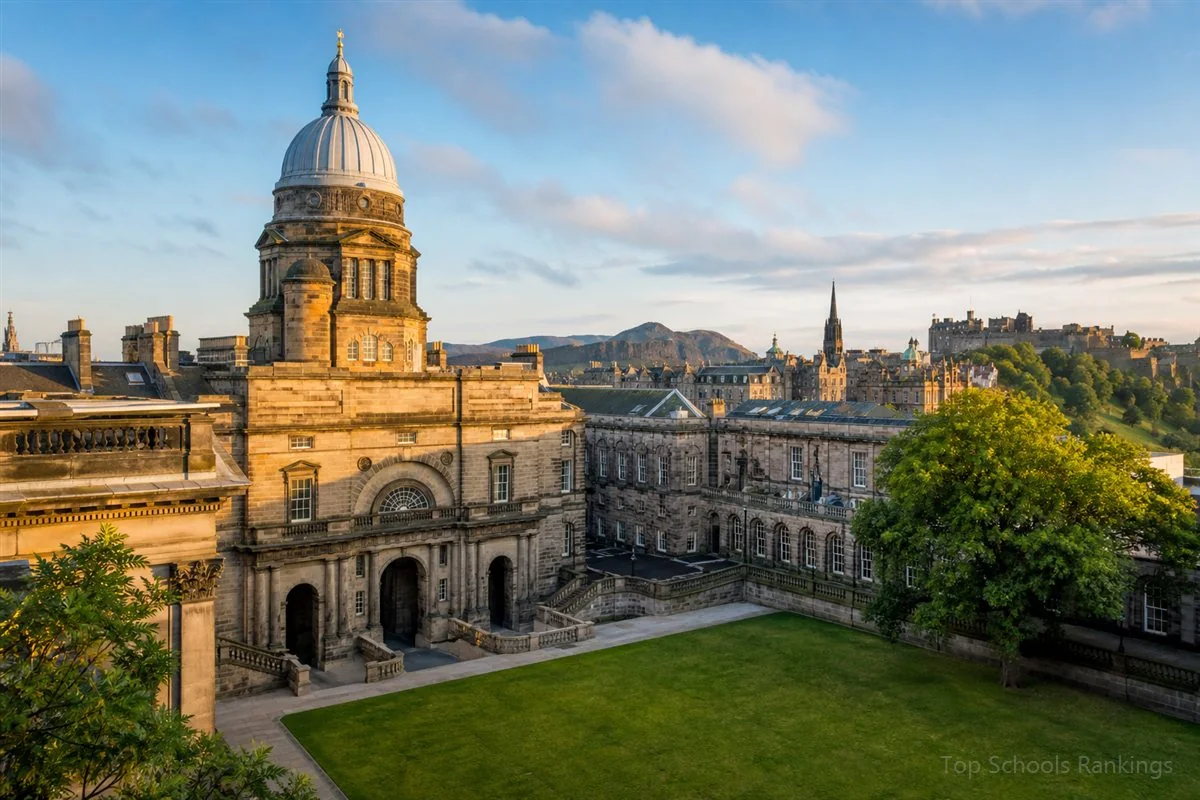
University of Edinburgh admissions attract thousands of international applicants each year to one of Scotland’s most research-intensive universities. Founded in 1583 and a member of the Russell Group, Edinburgh offers hundreds of undergraduate degrees across arts, sciences, medicine, and informatics—with a campus life shaped by a historic capital city rather than London’s pace. This guide explains how international students apply through UCAS, what fees to expect, key deadlines, and how to plan a competitive application using official university sources.
University of Edinburgh admissions at a glance
Edinburgh is a public research university in Scotland’s capital. It is often ranked among the world’s leading institutions—for example, 27th in the QS World University Rankings 2025—though rankings change yearly and should support research, not replace it. For University of Edinburgh admissions, most international undergraduates apply via the UK’s central system, UCAS, selecting up to five courses (with rules on medicine and related subjects).
| Factor | Key detail |
|---|---|
| Location | Edinburgh, Scotland, United Kingdom |
| University type | Public research university; Russell Group member |
| Founded | 1583 (civic university; one of Scotland’s ancient universities) |
| Typical undergrad application | UCAS (up to five choices on one application) |
| International tuition model | Fixed annual fee for the duration of your programme (start-year rate) |
| Strong subject areas | Informatics, medicine, veterinary medicine, law, humanities, sciences |
Why international students choose University of Edinburgh admissions
Students target Edinburgh for academic depth, global reputation, and a distinctive Scottish student experience. Unlike many London-centric guides, Edinburgh combines a compact, walkable city with festival culture, strong student societies, and access to research-led teaching. International graduates often value Edinburgh’s visibility in Europe and North America, especially in informatics, life sciences, and social sciences.
If you are comparing countries, Edinburgh sits in the same conversation as other globally known campuses. Many families review international admissions guides for Canada and the US before committing to the UK—useful for understanding how UCAS differs from Common App or direct university portals.
How University of Edinburgh admissions work through UCAS
International applicants usually apply through UCAS, the UK’s official undergraduate application service. You submit one personal statement (shared across up to five course choices), an academic reference, and qualification details. Edinburgh may request supplementary materials through its Applicant Portal after UCAS submission—such as portfolios for some art and design routes, or interview attendance for medicine, veterinary medicine, nursing, and certain professional programmes.
Edinburgh recommends that international students meet competitive programme deadlines early. For most degrees, the January UCAS equal consideration deadline is a practical target because popular courses can close or become selective soon after. Medicine, dentistry, and veterinary medicine use earlier UCAS deadlines (typically 15 October). Always confirm the exact date for your entry year on UCAS and Edinburgh’s degree finder.
Entry requirements for University of Edinburgh admissions
Requirements vary by degree. Edinburgh publishes specific entry standards on its degree finder for each programme—A-Level grades, IB points, or country-specific equivalents for international qualifications.
| Applicant background | What Edinburgh typically reviews |
|---|---|
| UK A-Levels | Grade requirements by programme (e.g., AAA–AAB ranges for competitive courses) |
| International Baccalaureate | Total points and higher-level subject requirements |
| Other national systems | Country-specific equivalency tables on Edinburgh’s international pages |
| English language | IELTS, TOEFL, or accepted alternatives if schooling was not in English |
| Personal statement | Academic motivation, subject fit, reflection—not a second CV |
| Reference | Academic referee who knows your recent work |
Conditional offers are common: you receive an offer if you achieve stated exam results. Edinburgh may also issue unconditional offers in specific circumstances. If you are still completing school when you apply, that is normal for international timelines.
University of Edinburgh tuition fees for international students
International undergraduates at Edinburgh generally pay the international fee rate with a fixed annual tuition fee locked for the standard duration of the programme—giving predictable year-on-year costs. Exact fees depend on your chosen degree and are listed on Edinburgh’s degree finder and registry services pages.
Edinburgh’s undergraduate guide cites indicative 2025 international fee levels (verify current rates before budgeting):
| Programme band (indicative) | Example annual international fee | Notes |
|---|---|---|
| Classroom-based degrees | From ~£28,000 / year | Many humanities and social science routes |
| Laboratory / studio-based degrees | ~£36,800 / year | Science, engineering, and studio subjects |
| Veterinary medicine | ~£39,700 / year | Professional programme; longer duration |
| Medicine (MBChB) | ~£51,961 / year (incl. ACT levy) | Includes NHS teaching levy; university may subsidise portion |
Source: University of Edinburgh undergraduate planning materials and registry fee pages. Fees for new entry years are confirmed on official sites—do not rely on third-party blogs alone.
Living in Edinburgh as an international student
Budget beyond tuition for accommodation, food, transport, insurance, and personal costs. Edinburgh’s living costs are generally lower than central London, but student districts fill quickly. Many first-year undergraduates live in university residences; others rent privately in areas such as Marchmont, Newington, or Leith. Plan £1,200–£1,800+ per month as a broad planning band depending on housing choice and lifestyle—then refine using Edinburgh’s published living cost guidance.
Scotland’s capital offers strong student societies, museums, and cultural events (including the Edinburgh Festival Fringe). Informatics and AI-related programmes benefit from the city’s growing tech presence, while life-science students access research hospitals and institutes nearby.
Step-by-step: University of Edinburgh admissions checklist
- Shortlist programmes on Edinburgh’s degree finder and note entry grades + English requirements
- Draft your UCAS personal statement early—one statement for up to five UK choices
- Register on UCAS and enter Edinburgh course codes carefully
- Submit before competitive deadlines (January for most courses; October

Saahil
Saahil is an education researcher and content creator specializing in university rankings, admissions strategies, and student guides. He is dedicated to helping students make informed academic decisions.
Continue your research
Algoma University for International Students: Admissions, Fees, Courses & Visa Guide
Choosing the right university in Canada is a crucial decision for international students.
Read the guide →Frequently Asked Questions About the University of Edinburgh
How long is a degree at Edinburgh compared to English universities?
Scotland has a different educational system than England. An undergraduate Honours degree at the University of Edinburgh typically takes four years to complete, whereas an Honours degree in England (like at Oxford or UCL) takes three years. This extra year allows Scottish students to study a wider variety of subjects before specializing.
Is guaranteed accommodation provided for international students?
Yes, the University of Edinburgh guarantees an offer of university-owned accommodation to all new, single undergraduate international students in their first year, provided they apply by the required deadline and hold an unconditional firm offer.
What is the 'Fringe' and how does it affect students?
The Edinburgh Festival Fringe is the world's largest arts festival, taking over the city every August. While the festival brings incredible energy, comedy, and culture, it also causes a massive spike in short-term rent prices. Students arriving early in August must secure housing well in advance to avoid exorbitant costs.
Appleby College Canada: Boarding School, Admissions, Fees & Student Life Guide for International Students
Appleby College is an independent boarding school in Canada.
Read the guide →Frequently Asked Questions About the University of Edinburgh
How long is a degree at Edinburgh compared to English universities?
Scotland has a different educational system than England. An undergraduate Honours degree at the University of Edinburgh typically takes four years to complete, whereas an Honours degree in England (like at Oxford or UCL) takes three years. This extra year allows Scottish students to study a wider variety of subjects before specializing.
Is guaranteed accommodation provided for international students?
Yes, the University of Edinburgh guarantees an offer of university-owned accommodation to all new, single undergraduate international students in their first year, provided they apply by the required deadline and hold an unconditional firm offer.
What is the 'Fringe' and how does it affect students?
The Edinburgh Festival Fringe is the world's largest arts festival, taking over the city every August. While the festival brings incredible energy, comedy, and culture, it also causes a massive spike in short-term rent prices. Students arriving early in August must secure housing well in advance to avoid exorbitant costs.

Douglas College Canada: Admissions, Fees, Courses & University Transfer Guide for International Students
For international students looking for an affordable and career-focused education in Canada, Douglas College is one of the most popular choices in British…
Read the guide →Frequently Asked Questions About the University of Edinburgh
How long is a degree at Edinburgh compared to English universities?
Scotland has a different educational system than England. An undergraduate Honours degree at the University of Edinburgh typically takes four years to complete, whereas an Honours degree in England (like at Oxford or UCL) takes three years. This extra year allows Scottish students to study a wider variety of subjects before specializing.
Is guaranteed accommodation provided for international students?
Yes, the University of Edinburgh guarantees an offer of university-owned accommodation to all new, single undergraduate international students in their first year, provided they apply by the required deadline and hold an unconditional firm offer.
What is the 'Fringe' and how does it affect students?
The Edinburgh Festival Fringe is the world's largest arts festival, taking over the city every August. While the festival brings incredible energy, comedy, and culture, it also causes a massive spike in short-term rent prices. Students arriving early in August must secure housing well in advance to avoid exorbitant costs.
Harvard University Admissions 2026: Rates, Deadlines, Costs & International Student Guide
Harvard University admissions: official admit data, deadlines, SAT/ACT rules, costs, international tips, tables, and FAQs for parents and students.
Read the guide →Frequently Asked Questions About the University of Edinburgh
How long is a degree at Edinburgh compared to English universities?
Scotland has a different educational system than England. An undergraduate Honours degree at the University of Edinburgh typically takes four years to complete, whereas an Honours degree in England (like at Oxford or UCL) takes three years. This extra year allows Scottish students to study a wider variety of subjects before specializing.
Is guaranteed accommodation provided for international students?
Yes, the University of Edinburgh guarantees an offer of university-owned accommodation to all new, single undergraduate international students in their first year, provided they apply by the required deadline and hold an unconditional firm offer.
What is the 'Fringe' and how does it affect students?
The Edinburgh Festival Fringe is the world's largest arts festival, taking over the city every August. While the festival brings incredible energy, comedy, and culture, it also causes a massive spike in short-term rent prices. Students arriving early in August must secure housing well in advance to avoid exorbitant costs.
Frequently Asked Questions About the University of Edinburgh
How long is a degree at Edinburgh compared to English universities?
Scotland has a different educational system than England. An undergraduate Honours degree at the University of Edinburgh typically takes four years to complete, whereas an Honours degree in England (like at Oxford or UCL) takes three years. This extra year allows Scottish students to study a wider variety of subjects before specializing.
Is guaranteed accommodation provided for international students?
Yes, the University of Edinburgh guarantees an offer of university-owned accommodation to all new, single undergraduate international students in their first year, provided they apply by the required deadline and hold an unconditional firm offer.
What is the 'Fringe' and how does it affect students?
The Edinburgh Festival Fringe is the world's largest arts festival, taking over the city every August. While the festival brings incredible energy, comedy, and culture, it also causes a massive spike in short-term rent prices. Students arriving early in August must secure housing well in advance to avoid exorbitant costs.