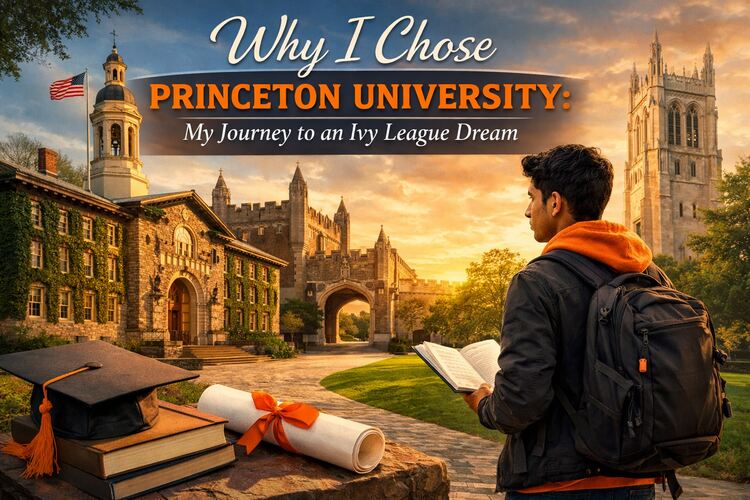
Choosing a university is one of the most defining decisions a student can make. For me, that decision didn’t come after months of scrolling through brochures in senior year. It came surprisingly early. At just thirteen years old, I confidently told my parents that I was going to attend Princeton University.
At the time, it was a major pivot from my childhood dream of moving to New York to become a professional ballerina. My parents were likely relieved when my goals shifted from the stage to one of the most prestigious Ivy League institutions in the world. Looking back, my journey toward Princeton was fueled by a simple, relentless curiosity about books, human stories, and the power of the written word.
A Lifelong Love for Learning and Writing
Even as a child, I genuinely loved the classroom environment. While many students tried to act indifferent to appear “cool,” I was the one volunteering for extra credit assignments. For me, learning wasn’t a chore; it was an exploration.
Weekends were dedicated to the local library. I would lose myself in novels, and soon, books became the lens through which I viewed the world. This passion naturally flowed into my own writing. What started as private diary entries slowly evolved into creative stories inspired by the authors I admired.
By the time I hit high school, it was clear: I didn’t just want a degree; I wanted an environment that treated writing as a rigorous intellectual discipline. That realization led me to my first serious Google search: “Best undergraduate colleges for writing in the US.”
Discovering the Princeton Difference
When Princeton University appeared at the top of those search results, I began to dig deeper. I discovered that Princeton isn’t just about prestige; it’s about a unique commitment to undergraduate teaching. Unlike many other research universities where professors focus primarily on graduate students, Princeton places its undergraduates at the center of the solar system.
I was particularly drawn to:
- The Princeton Writing Program: A dedicated department that ensures every student, regardless of their major, masters the art of academic inquiry.
- Small Class Sizes: The famous “Preceptorial” system, where large lectures are broken down into small groups of 10-12 students for deep discussion.
- Distinguished Faculty: The chance to learn from literary giants and world-class researchers.
From that moment on, my goal was set. It wasn’t just about the name; it was about the “fit.”
Preparing for the Ivy League: High School Strategy
Once Princeton became the target, my high school years became a focused preparation phase. I knew that getting into an Ivy League school—especially one with an acceptance rate consistently below 5%—required more than just good grades.
Academic Rigor and AP Courses
I pushed myself to take the most challenging curriculum available. I enrolled in multiple Advanced Placement (AP) courses, focusing heavily on English Literature, History, and the Social Sciences. I understood that Princeton admissions officers look for “intellectual bravery”—the willingness to dive into difficult subjects and succeed.
Crafting the Narrative
When the essay prompts were released, I didn’t just write; I reflected. I realized that Princeton values authenticity over “perfection.” My essays focused on my genuine love for storytelling and how I hoped to contribute to the diverse campus community.
The High-Stakes Application: Single-Choice Early Action
One of the most critical parts of my journey was the application strategy. I decided to apply through Single-Choice Early Action (SCEA).
Pro-Tip for Applicants: Princeton does not offer “Early Decision” (which is binding). Instead, they use SCEA. This means if you apply early to Princeton, you cannot apply early to any other private US university. However, you are not legally forced to attend if you get in, giving you until May 1st to decide.
The week before decision day was a blur of anxiety. I wore my Princeton sweatshirt every single night. When the portal finally updated and I saw the word “Congratulations,” the room exploded. My mother, who had been praying silently behind me, burst into tears along with me. The years of late-night study sessions had finally paid off.
Life as a Princeton Tiger: Traditions and Community
Now that I am a student here, the reality has exceeded the dream. Princeton is a place steeped in tradition, and these rituals create a powerful sense of belonging.
The FitzRandolph Gates
One of the most iconic moments is the Step Sing and the march through the FitzRandolph Gates. New students enter through these historic gates during “Pre-rade” while thousands of alumni cheer. Tradition says you shouldn’t walk out of those gates until graduation, or you might not graduate on time!
The Eating Clubs and “The Street”
Social life at Princeton is centered around Prospect Avenue, known as “The Street.” This is home to the university’s historic Eating Clubs. I eventually joined Charter Club (founded in 1901), which has become my home base for meals, late-night study breaks, and lifelong friendships.
Academic Life: The “Minor” Transition and Independent Research
My academic path has been intense but incredibly fulfilling. I am pursuing a Bachelor of Arts (A.B.) in English.
The Shift from Certificates to Minors
A recent and important change at Princeton is the transition from “Certificates” to “Minors.” Starting with the Class of 2025, students can now officially earn minors in various departments. I am currently focusing on:
- African American Studies
- Gender and Sexuality Studies
- Creative Writing
The Senior Thesis: The Ultimate Challenge
The hallmark of a Princeton education is the Senior Thesis. Every single A.B. student must complete a massive, original research project (usually 70-100 pages) to graduate. While daunting, it is an incredible opportunity to work one-on-one with a world-renowned professor to produce something truly original. It’s not just a paper; it’s a contribution to the world’s knowledge.
Why Princeton Still Feels Like Home
Even during the “Orange Bubble” stress of midterms and finals, the beauty of the campus offers a sense of peace. Walking past Blair Arch at sunset or attending a lecture in McCosh Hall reminds me of that thirteen-year-old girl who dared to dream big.
Princeton has given me more than just a degree; it has given me the confidence to challenge perspectives, the tools to write with precision, and a global network of “Tigers” who support one another.
Final Thoughts for Future Applicants
If you are currently looking at universities in the US, Australia, or anywhere else, my advice is this: Look for the “Why.” Don’t just choose a school because of its rank. Choose it because its values align with yours. Stay curious, push your boundaries, and remember that sometimes, the place where you truly belong is just one brave application away.
Frequently Asked Questions (FAQ)
1. Does Princeton offer full scholarships to international students? Yes! Princeton is one of the few universities in the US that is need-blind for all applicants, including international students. If you are accepted, they meet 100% of your demonstrated financial need without using loans.
2. What is the difference between Single-Choice Early Action and Regular Decision? SCEA (deadline Nov 1) is non-binding but restrictive—you can’t apply early to other private US schools. Regular Decision (deadline Jan 1) allows you to apply to as many schools as you like.3. Is Princeton good for STEM students? Absolutely. While famous for the humanities, Princeton’s Engineering (B.S.E.) and Physics programs are among the best in the world.
For more info visit : – topschoolsrankings.com