
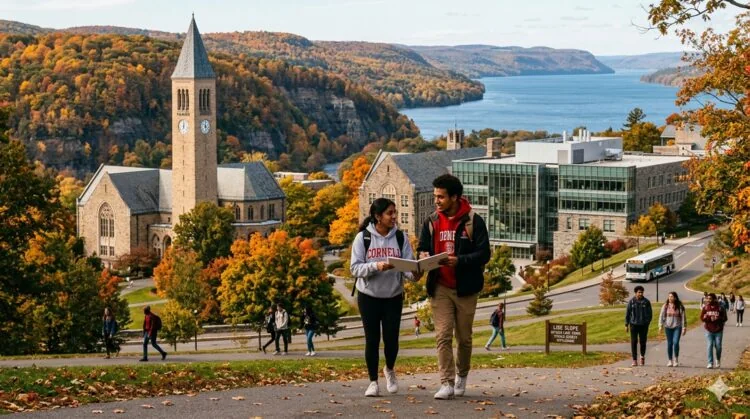
Quick summary: Choosing an Ivy League school is about more than just rankings; it’s about finding a "home" for four years. Cornell University, often called the "Big Red," offers a unique blend of elite academics and a rugged, natural lifestyle. But is it the right fit for you?
Choosing an Ivy League school is about more than just rankings; it’s about finding a "home" for four years. Cornell University, often called the "Big Red," offers a unique blend of elite academics and a rugged, natural lifestyle. But is it the right fit for you?
From a real student perspective, here is what life at Cornell is actually like.
1. The Campus: "Ithaca is Gorges" (But Hilly!)
Cornell’s campus is arguably the most beautiful in the Ivy League, but it comes with a physical price.
- The Terrain: Everything is on a literal slope. You will develop "Cornell Calves" from walking up Libe Slope every day.
- The Gorges: Cascades and waterfalls are everywhere. It’s breathtaking, but in winter, these views become icy and sharp.
- Transportation: The TCAT bus system is a lifesaver. Most freshmen get a free bus pass, which is essential when it’s -10°C outside.
2. Academics: "Any Person, Any Study"
Ezra Cornell’s motto, "I would found an institution where any person can find instruction in any study," is taken seriously here.
- Diversity of Majors: You can study Hotel Administration (one of the world's best) in the morning and Viticulture (winemaking) in the afternoon.
- Academic Rigor: It is often said, "Cornell is the easiest Ivy to get into, but the hardest to stay in." The workload is intense, especially in Engineering and Pre-med.
- Support: While classes are large, the Office Hours culture is strong. Professors at Cornell are highly regarded researchers who actually want to help you if you show up.
3. The Infamous Ithaca Winter
USA search users often look for "Cornell Weather." Let’s be real:
- The "Grey" Period: From November to March, Ithaca can be very cloudy.
- Preparation: A high-quality parka and waterproof boots aren't "fashion statements"—they are survival gear.
- Mental Health: Cornell provides extensive counseling services (CAPS) because the combination of high pressure and cold weather can be tough.
4. Social Life: More Than Just Libraries
- Slope Day: The comprehensive Cornell tradition. On the last day of classes in the Spring, the entire university gathers on Libe Slope for a massive concert and celebration. It’s the reward for surviving the winter.
- Collegetown: This is where the action is. From late-night "Hot Truck" sandwiches to grabbing a drink at The Nines (or local spots), Collegetown is the social hub for upperclassmen.
- Greek Life: About 25-30% of students are in fraternities or sororities. It's big, but if you aren't in one, you won't feel left out—there are 1,000+ other clubs.
5. Dining: Ivy League’s Best Food
It is a well-known fact: Cornell has the best campus dining in the USA.
- The Dairy Bar: Cornell produces its own ice cream and milk. The "Clocktower Thaw" is a must-try flavor.
- Dining Halls: Places like West Campus Dining feel like Harry Potter’s Great Hall and serve everything from sushi to authentic Moroccan food.
6. Career & Networking
Cornell’s alumni network is a global powerhouse.
- Recruitment: Top firms from Wall Street, Silicon Valley, and NASA come to campus specifically for Cornellians.
- The "Cornell Connection": Whether you are in the Hotel School or ILR (Industrial and Labor Relations), the specific college networks are incredibly tight-knit.
7. Is Cornell Worth It? (The Verdict)
Pros:
- Unmatched academic diversity.
- Stunning natural beauty.
- High "prestige" value for employers.
Cons:
- Intense academic pressure (Stress culture).
- Brutal winters.
- Large campus can feel isolating if you don't join clubs.
Verdict: If you are a student who loves nature, doesn't mind hard work, and wants a university that offers literally everything, Cornell is 10/10.
FAQs
Q: How hard is it to get into Cornell? A: With an acceptance rate around 7-8%, it is highly competitive. They look for "fit" within specific colleges (e.g., Architecture vs. Agriculture).
Q: Is it true that Cornell is the "depressing" Ivy? A: This is an old stereotype. While academics are hard, the school has invested heavily in student wellness and outdoor recreation to keep spirits high.
Q: Do I need a car?A: Freshman year? No. Junior/Senior year? It helps if you want to explore the Finger Lakes wineries or go skiing.
For more info visit:- topschoolsrankings.com

Saahil
Saahil is an education researcher and content creator specializing in university rankings, admissions strategies, and student guides. He is dedicated to helping students make informed academic decisions.
Continue your research
Algoma University for International Students: Admissions, Fees, Courses & Visa Guide
Choosing the right university in Canada is a crucial decision for international students.
Read the guide →Frequently Asked Questions About Cornell
What is the difference between Cornell's state and endowed colleges?
Cornell is unique in the Ivy League because it is a hybrid institution. It operates privately endowed colleges (like Arts & Sciences and Engineering) alongside publicly supported statutory colleges (like Agriculture & Life Sciences, and Industrial & Labor Relations). New York State residents receive significantly reduced tuition if they enroll in one of the statutory colleges.
Is Ithaca really as isolated as people say?
Ithaca is located in upstate New York, about a four-hour drive from New York City. While it is geographically isolated compared to urban Ivies like Columbia or UPenn, Ithaca is a vibrant, quintessential college town surrounded by stunning gorges and waterfalls. The isolation fosters an incredibly tight-knit campus community.
How bad is the grade deflation at Cornell?
Cornell has a historical reputation for intense academic rigor and strict grading curves, particularly in pre-med and engineering prerequisite courses. While "grade deflation" is heavily debated, students should expect that earning an 'A' requires significantly more effort than at some peer institutions that are known for grade inflation.
Appleby College Canada: Boarding School, Admissions, Fees & Student Life Guide for International Students
Appleby College is an independent boarding school in Canada.
Read the guide →Frequently Asked Questions About Cornell
What is the difference between Cornell's state and endowed colleges?
Cornell is unique in the Ivy League because it is a hybrid institution. It operates privately endowed colleges (like Arts & Sciences and Engineering) alongside publicly supported statutory colleges (like Agriculture & Life Sciences, and Industrial & Labor Relations). New York State residents receive significantly reduced tuition if they enroll in one of the statutory colleges.
Is Ithaca really as isolated as people say?
Ithaca is located in upstate New York, about a four-hour drive from New York City. While it is geographically isolated compared to urban Ivies like Columbia or UPenn, Ithaca is a vibrant, quintessential college town surrounded by stunning gorges and waterfalls. The isolation fosters an incredibly tight-knit campus community.
How bad is the grade deflation at Cornell?
Cornell has a historical reputation for intense academic rigor and strict grading curves, particularly in pre-med and engineering prerequisite courses. While "grade deflation" is heavily debated, students should expect that earning an 'A' requires significantly more effort than at some peer institutions that are known for grade inflation.
Douglas College Canada: Admissions, Fees, Courses & University Transfer Guide for International Students
For international students looking for an affordable and career-focused education in Canada, Douglas College is one of the most popular choices in British…
Read the guide →Frequently Asked Questions About Cornell
What is the difference between Cornell's state and endowed colleges?
Cornell is unique in the Ivy League because it is a hybrid institution. It operates privately endowed colleges (like Arts & Sciences and Engineering) alongside publicly supported statutory colleges (like Agriculture & Life Sciences, and Industrial & Labor Relations). New York State residents receive significantly reduced tuition if they enroll in one of the statutory colleges.
Is Ithaca really as isolated as people say?
Ithaca is located in upstate New York, about a four-hour drive from New York City. While it is geographically isolated compared to urban Ivies like Columbia or UPenn, Ithaca is a vibrant, quintessential college town surrounded by stunning gorges and waterfalls. The isolation fosters an incredibly tight-knit campus community.
How bad is the grade deflation at Cornell?
Cornell has a historical reputation for intense academic rigor and strict grading curves, particularly in pre-med and engineering prerequisite courses. While "grade deflation" is heavily debated, students should expect that earning an 'A' requires significantly more effort than at some peer institutions that are known for grade inflation.
Harvard University Admissions 2026: Rates, Deadlines, Costs & International Student Guide
Harvard University admissions: official admit data, deadlines, SAT/ACT rules, costs, international tips, tables, and FAQs for parents and students.
Read the guide →Frequently Asked Questions About Cornell
What is the difference between Cornell's state and endowed colleges?
Cornell is unique in the Ivy League because it is a hybrid institution. It operates privately endowed colleges (like Arts & Sciences and Engineering) alongside publicly supported statutory colleges (like Agriculture & Life Sciences, and Industrial & Labor Relations). New York State residents receive significantly reduced tuition if they enroll in one of the statutory colleges.
Is Ithaca really as isolated as people say?
Ithaca is located in upstate New York, about a four-hour drive from New York City. While it is geographically isolated compared to urban Ivies like Columbia or UPenn, Ithaca is a vibrant, quintessential college town surrounded by stunning gorges and waterfalls. The isolation fosters an incredibly tight-knit campus community.
How bad is the grade deflation at Cornell?
Cornell has a historical reputation for intense academic rigor and strict grading curves, particularly in pre-med and engineering prerequisite courses. While "grade deflation" is heavily debated, students should expect that earning an 'A' requires significantly more effort than at some peer institutions that are known for grade inflation.
Frequently Asked Questions About Cornell
What is the difference between Cornell's state and endowed colleges?
Cornell is unique in the Ivy League because it is a hybrid institution. It operates privately endowed colleges (like Arts & Sciences and Engineering) alongside publicly supported statutory colleges (like Agriculture & Life Sciences, and Industrial & Labor Relations). New York State residents receive significantly reduced tuition if they enroll in one of the statutory colleges.
Is Ithaca really as isolated as people say?
Ithaca is located in upstate New York, about a four-hour drive from New York City. While it is geographically isolated compared to urban Ivies like Columbia or UPenn, Ithaca is a vibrant, quintessential college town surrounded by stunning gorges and waterfalls. The isolation fosters an incredibly tight-knit campus community.
How bad is the grade deflation at Cornell?
Cornell has a historical reputation for intense academic rigor and strict grading curves, particularly in pre-med and engineering prerequisite courses. While "grade deflation" is heavily debated, students should expect that earning an 'A' requires significantly more effort than at some peer institutions that are known for grade inflation.