
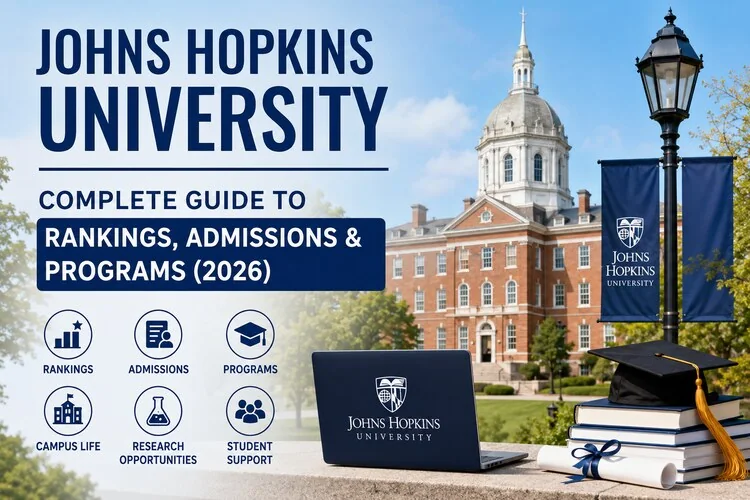
Are you considering applying to one of the world's highly competitive universities but feeling overwhelmed by the information? You're not alone. Thousands of students worldwide dream of studying at Johns Hopkins University, yet many struggle to find clear, accurate information about admissions, tuition, programs, and what makes this institution unique.
This comprehensive guide delivers everything you need to know about Johns Hopkins University in one place. Whether you're from the UK, Australia, Canada, USA, or any other country, you'll find factual, up-to-date information about rankings (currently #7 nationally and #24 globally), tuition costs ($68,670 for 2026-27), admission requirements (only 6.4% acceptance rate), and complete program details.
By reading this guide, you'll understand why Johns Hopkins has been America's first research university since 1876, how it receives the most federal research funding of any university annually, and what steps you need to take to join its elite community of scholars. Let's dive into everything that makes Johns Hopkins University a top choice for ambitious students worldwide.
What is Johns Hopkins University?
America's First Research University
Johns Hopkins University, founded in 1876, holds the prestigious title of being America's first research university. Located in Baltimore, Maryland, this privately controlled institution transformed the American education system by introducing the German university model, which emphasised specialised training and groundbreaking research.
The university takes its name from Johns Hopkins, a 19th-century Maryland philanthropist and entrepreneur with Quaker roots who believed intensely in improving public health and education. In his will, he set aside $7 million (a massive amount at that time) to establish a hospital, training colleges, an orphanage, and the university itself.
Mission That Still Guides Today
Daniel Coit Gilman, Johns Hopkins' first president, described the university's mission at his 1876 inauguration:
"To educate its students and cultivate their capacity for lifelong learning, to foster independent and original research, and to bring the benefits of discovery to the world."
This mission statement, "Knowledge for the world," remains the university's guiding principle nearly 150 years later.
Academic Divisions
Johns Hopkins is home to ten highly regarded academic divisions working together as one unified university:
-
Krieger School of Arts and Sciences
-
Whiting School of Engineering
-
School of Medicine
-
School of Nursing
-
School of Education
-
Sally Quillian Yates School of Public Health
-
Picker Institute Graduate School of Arts and Sciences
-
Johns Hopkins Engineering for Professionals
-
Continuing and Professional Education
-
Additional graduate programmes
Johns Hopkins University Rankings & Reputation
National Rankings (USA)
Johns Hopkins University consistently ranks among America's top universities:
| Ranking System | Position | Year |
|---|---|---|
| U.S. News & World Report (National Universities) | #7 | 2025 |
| CWUR (Center for World University Rankings) | #15 | 2025 |
| U.S. News Best Colleges | #7 (tied with Duke, Northwestern, UPenn) | 2025 |
Johns Hopkins has claimed a spot among the nation's top 10 universities each year since 2019 and has been among the top 20 in all but one year since U.S. News launched its rankings in the 1980s.
Global Rankings
Internationally, Johns Hopkins University maintains exceptional standing:
| Ranking System | Position | Year |
|---|---|---|
| QS World University Ranking | #24 | 2026 |
| Times Higher Education (THE) World University | #16 | 2026 |
| CWUR World Rank | #18 out of 21,462 | 2025 |
Out of 171 United States schools included in THE rankings this year, Hopkins is #10, the same spot it held last year.
Research Leadership
What truly distingu Johns Hopkins is its research dominance:
-
Leading recipient of research funding from the federal government every year since 1979
-
In fiscal year 2024, every dollar in federal research investment by the National Institutes of Health generated approximately $2.56 in economic activity
-
Pioneer of historic discoveries including: water purification, CPR, corrective surgery for infant heart defects, and asteroid deflection techniques
-
Championed lifesaving public health interventions like vitamin A supplementation and seat belt safety
-
Authenticated the Dead Sea Scrolls
Academic Programs & Degrees Offered
Undergraduate Programmes
Johns Hopkins offers over 180 programmes regularly recognised as among the nation's best. Students can pursue:
-
Certificate degrees
-
Bachelor's degrees
-
Specialised majors in arts, sciences, engineering, and humanities
Popular Majors & Fields of Study
Based on graduate numbers and programme strength:
| Field | Popular Majors | Graduates |
|---|---|---|
| Health Professions | Public Health | 177 |
| Arts | Music Performance | 67 |
| Arts | Dance, Music Theory, Music Technology | 8-9 each |
Graduate & Professional Programmes
All ten academic divisions offer full-time graduate programmes:
-
School of Medicine: MD programme ($66,580 tuition for 2025-26)
-
Whiting School of Engineering: Graduate courses ($5,455 per 3-credit course after Dean's fellowship)
-
School of Nursing: Advanced nursing degrees
-
School of Education: Teaching and education leadership
-
School of Public Health: Public health research and practice
Engineering for Professionals
For working professionals, Johns Hopkins offers flexible graduate programmes:
-
Per-course tuition: $6,670 for three-credit graduate-level courses
-
After Dean's support: $5,455 for graduate courses (600-level and higher)
-
Undergraduate courses (200-level): $1,475 after fellowship
Admissions Requirements & Process
Acceptance Rate & Competitiveness
Johns Hopkins University is extremely selective:
-
Acceptance rate: 6.43% (one of the lowest in the USA)
-
Graduation rate: 95% (exceptionally high)
-
Classified as a medium, 4-year, private school
This makes Johns Hopkins among the most competitive universities globally, requiring outstanding academic credentials.
Application Deadlines
For undergraduate admission to the School of Arts and Sciences and/or School of Engineering:
| Decision Plan | Deadline |
|---|---|
| Early Decision I | November 1 |
| Early Decision II | January 2 |
| Regular Decision | January 2 |
| Transfer Applicants | March 1 |
Applications are accepted for the fall semester from August through January.
Required Application Materials
Through Common Application or Coalition on Scoir:
Completed application
-
Hopkins supplement (includes supplemental essay)
-
$70 application fee (or fee waiver)
-
Standardised test scores (SAT/ACT considered)
-
Early Decision Agreement (for ED I & II only)
From your school:
-
Secondary school report
-
Two teacher evaluations
-
Mid-year report (due mid-February)
From applicant portal (international students only):
-
International Certification of Finances form
-
Additional optional materials
Standardised Testing
Johns Hopkins considers:
-
SAT: Considered
-
ACT: Considered
-
TOEFL: Considered (for international students)
-
IELTS: Considered (for international students)
Tuition Fees & Financial Aid
2026-27 Academic Year Costs
Johns Hopkins University tuition is substantial but includes extensive financial aid options:
| Living Situation | Tuition | Total Cost of Attendance |
|---|---|---|
| On-Campus (Freshman) | $68,670 | $94,858 |
| On-Campus (Sophomore) | $68,670 | $95,729 |
| Off-Campus | $68,670 | $88,233 |
| Living With Parents | $68,670 | $80,080 |
Tuition based on 12+ credits per semester. Less than full-time: $2,289 per credit hour
Cost Breakdown (On-Campus Freshman)
-
Tuition: $68,670
-
Matriculation Fee (one-time): $500
-
Housing (On-Campus): $13,073
-
Meals (On-Campus): $8,894
-
Personal Expenses: $1,606
-
Books & Supplies: $1,377
-
Transportation: $738
-
Total: $94,858
Summer 2026 Costs
-
Tuition and Fees: $15,300
-
Total (On-Campus): $20,775
-
Tuition per credit: $1,275
Health Insurance
-
Required for all students
-
2026-27 academic year: $3,624 ($1,359 Fall / $2,265 Spring)
-
International students (F1/J1 visa): Cannot waive coverage
Financial Aid Options
Johns Hopkins offers:
-
No-interest payment plans for flexible college cost coverage
-
Need-based financial aid (loans not included in offers but available separately)
-
Scholarships and merit-based awards
-
Federal Direct Student Loan options (average fees: $50)
International Students Guide
Application Process for International Students
International students follow the same application process but with additional requirements:
-
Application deadline for Fall: January 2
-
No separate application form required
-
No conditional admission offered
-
Early decision options available only
English Language Requirements
For students whose undergraduate instruction was primarily in a language other than English:
-
TOEFL: Required and considered
-
IELTS: Considered
Special Requirements for Foreign University Preparation
Applicants from foreign universities (most cases):
-
Must supplement preparation with one year or more at an accredited US university
-
Exception: Canadian bachelor's degree holders do NOT need this supplement
Financial Requirements for International Students
Students who are neither US citizens nor permanent residents must satisfy the international medical student financial requirement:
-
First-year medical studies: $76,397 USD (non-negotiable)
-
Satisfied through:
-
Cash
-
Irrevocable Letter of Credit (LOC)
-
Combination of cash and LOC
-
Letter of Guarantee (LOG) from embassy/government
-
Visa Information
-
F1/J1 visa status required
-
International students cannot waive health insurance coverage
-
International Certification of Finances form required
Campus Life & Student Experience
Location & Setting
-
Address: 3400 North Charles Street, Baltimore, MD 21218
-
Setting: Large city, urban environment
-
Type: Coeducational, 4-year private research university
-
Phone: (410) 516-8171
Economic Impact
Johns Hopkins is deeply connected to its hometown:
-
Largest private employer in Baltimore and Maryland
-
Economic impact in Baltimore: $19.4 billion
-
Economic impact in Maryland: $40 billion
-
Broad economic, social, and cultural ties to Baltimore
Student Community
Life as a Hopkins student means:
-
Discovering new ways to express yourself
-
Collaborating on solutions to big societal challenges
-
Close-knit undergraduate community with top-funded research resources
-
Charting the unknown and changing the world
Research Opportunities
Students benefit from:
-
Access to top-funded research in the US
-
Work with faculty on lifesaving innovations
-
Participation in studies spanning cancer, Alzheimer's, Parkinson's, stroke, opioid addiction, and more
-
Exploration of farthest reaches of our solar system
Key Takeaways
-
Johns Hopkins University ranks #7 nationally (U.S. News 2025) and #24 globally (QS 2026)
-
Founded in 1876 as America's first research university
-
Extremely selective with only 6.43% acceptance rate but 95% graduation rate
-
2026-27 tuition: $68,670; total cost (on-campus): $94,858
-
Offers 180+ programmes across 10 academic divisions
-
Leading recipient of federal research funding every year since 1979
-
Application deadlines: Early Decision I (Nov 1), Regular Decision (Jan 2)
-
International students: TOEFL/IELTS required, may need 1+ year US university preparation
Conclusion
Johns Hopkins University stands as a beacon of academic excellence, research innovation, and global impact. As America's first research university founded in 1876, it has maintained its position among the world's top institutions for nearly 150 years, currently ranking #7 nationally and #24 globally.
FAQs
What is Johns Hopkins University known for?
Johns Hopkins University is known for being America's first research university (founded 1876), receiving the most federal research funding annually since 1979, and pioneering groundbreaking discoveries including CPR, water purification, infant heart surgery, and asteroid deflection techniques. It ranks #7 nationally and #24 globally.
What is the acceptance rate at Johns Hopkins University?
Johns Hopkins University has an acceptance rate of 6.43%, making it one of the most selective universities in the USA. However, it boasts an exceptional 95% graduation rate, indicating that admitted students successfully complete their programmes.
How much does Johns Hopkins University cost in 2026?
For the 2026-27 academic year, Johns Hopkins tuition is $68,670. The total cost of attendance for on-campus freshmen is $94,858, including housing ($13,073), meals ($8,894), books ($1,377), and personal expenses ($1,606).
What are the application deadlines for Johns Hopkins University?
Johns Hopkins undergraduate application deadlines are: Early Decision I on November 1, Early Decision II and Regular Decision on January 2, and Transfer applicants on March 1. Applications are accepted from August through January.
Can international students apply to Johns Hopkins University?
Yes, international students can apply to Johns Hopkins University. They must submit TOEFL or IELTS scores, may need one year of US university preparation (unless they have a Canadian bachelor's degree), and must satisfy financial requirements of $76,397 USD for medical studies.
What programs does Johns Hopkins University offer?
Johns Hopkins offers over 180 programmes across 10 academic divisions, including the School of Arts and Sciences, Whiting School of Engineering, School of Medicine ($66,580 tuition), School of Nursing, School of Education, and School of Public Health. Degrees include certificates, bachelor's, master's, and doctoral programmes.
Is Johns Hopkins University ranked globally?
Yes, Johns Hopkins University ranks #24 in the QS World University Ranking 2026, #16 in Times Higher Education World University Rankings 2026, and #18 globally out of 21,462 universities according to CWUR 2025. It consistently ranks among the world's top 20 universities.

Saahil
Saahil is an education researcher and content creator specializing in university rankings, admissions strategies, and student guides. He is dedicated to helping students make informed academic decisions.
Continue your research
Duke University: Complete Guide 2026 – Admissions, Fees & Rankings
Discover everything about Duke University in 2026. Learn about admissions requirements, tuition fees ($70,265), rankings (#6 US News), acceptance rate (4.8%).
Read the guide →
University of New South Wales: Complete Guide 2026 – Rankings, Courses, Fees & Admissions
Discover everything about the University of New South Wales (UNSW Sydney) – global rankings, courses, tuition fees, scholarships, admission requirements.
Read the guide →
University of Virginia: Admissions, Programs & Campus Guide 2026
Discover everything about the University of Virginia (UVA)—admission requirements, true tuition fees for international students, top programs, rankings.
Read the guide →
Yale University: History, Programs, Admissions Guide 2026
Discover everything about Yale University - from its 1701 history to top academic programs, admissions requirements, and student life.
Read the guide →