
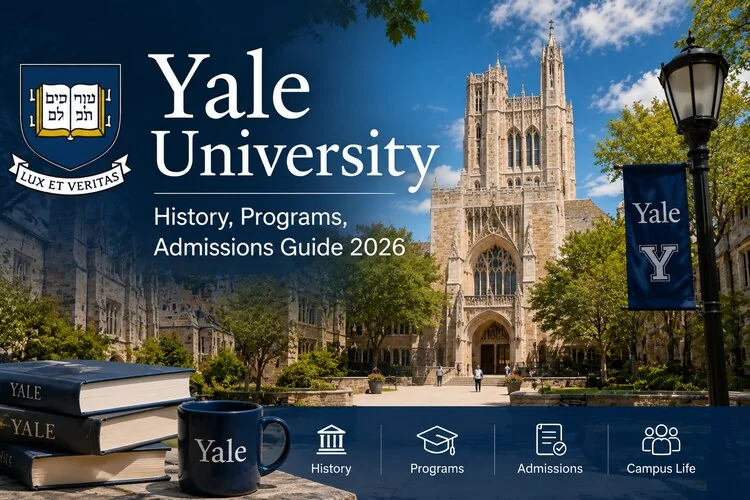
Are you dreaming of attending one of the world's highly competitive universities but feel overwhelmed by the information out there? You're not alone. Thousands of students worldwide search for Yale University details every year, from admissions requirements to academic programs, yet finding accurate, comprehensive information can be challenging.
This complete guide covers everything you need to know about Yale University - its fascinating history spanning over 320 years, highly regarded academic programs, admissions process, student life, and why it remains one of the most coveted institutions globally. Whether you're from the UK, Australia, Canada, or anywhere else, you'll get actionable insights to help you understand what makes Yale unique.
By reading this blog, you'll discover:
-
The complete history of Yale from 1701 to present
-
All 15 schools and 200+ majors available
-
Detailed admissions requirements and acceptance rates
-
Financial aid options worth $564M+ annually
-
Campus life, traditions, and notable alumni
Let's dive into what makes Yale University truly exceptional.
1. The Rich History of Yale University
1.1 Origins: From Collegiate School to Yale College
Yale University traces its beginnings to October 9, 1701, when the General Court of the Colony of Connecticut passed "An Act for Liberty to Erect a Collegiate School". This act aimed to establish an institution for educating ministers and lay leaders.
Ten Congregational ministers met in Branford to donate books for the school's library, forming what we now know as the "Founders." The institution opened as the Collegiate School in the home of its first rector, Abraham Pierson, in Killingworth.
The school's journey included:
-
1703: Moved to Saybrook when Nathaniel Lynde donated land
-
1716: Relocated to New Haven, Connecticut
-
1718: Renamed Yale College after Elihu Yale donated nine bales of goods worth £560
1.2 Evolution into Yale University
For over 169 years, the institution operated as Yale College. In 1887, under President Timothy Dwight V, it was officially renamed Yale University to reflect its elevated status as a comprehensive university.
Key milestones in this transformation:
-
1810: Yale School of Medicine established
-
1822: Yale Divinity School and Yale Law School founded
-
1847: Graduate School of Arts and Sciences created
-
1861: Awarded the first PhD in the United States
-
1900: Yale School of Forestry & Environmental Studies opened
-
2022: Jackson School of Global Affairs established
1.3 Yale's Colonial Legacy
Yale holds a special distinction as the third-oldest institution of higher education in the United States, following only Harvard (1636) and the College of William and Mary (1693). It's one of nine "colonial colleges" chartered before the American Revolution.
2. Academic Excellence: Schools and Programs
2.1 The 15 Constituent Schools
Yale University is organized into 15 constituent schools, offering unparalleled academic diversity:
| School | Year Founded | Focus Area |
|---|---|---|
| Yale College | 1701 | Undergraduate programs |
| Graduate School of Arts & Sciences | 1847 | Graduate research |
| Yale Law School | 1824 | Legal education |
| Yale School of Medicine | 1810 | Medical training |
| Yale Divinity School | 1822 | Religious studies |
| Yale School of Engineering & Applied Science | 1852 | Engineering |
| Yale School of Art | 1869 | Fine arts |
| Yale School of Music | 1894 | Music education |
| Yale School of the Environment | 1900 | Environmental studies |
| Yale School of Public Health | 1915 | Public health |
| Yale School of Architecture | 1916 | Architecture |
| Yale School of Nursing | 1923 | Nursing |
| David Geffen School of Drama | 1955 | Drama & theater |
| Yale School of Management | 1976 | Business management |
| Jackson School of Global Affairs | 2022 | Global affairs |
2.2 Undergraduate Majors: 200+ Options
Yale College offers nearly 2,000 undergraduate courses and over 200 majors across diverse fields. Popular majors include:
-
Computer Science (B.A. or B.S.)
-
Economics (B.A.)
-
Political Science (B.A.)
-
Biology (B.A. or B.S.)
-
Psychology (B.A.)
-
English (B.A.)
-
History (B.A.)
-
Mathematics (B.A. or B.S.)
Unique programs include:
-
Computing and Linguistics
-
Ethics, Politics, and Economics
-
Ethnicity, Race, and Migration
-
History of Science, Medicine, and Public Health
2.3 Graduate and Professional Programs
Yale's graduate programs are equally prestigious, with the Graduate School of Arts and Sciences offering PhDs and master's degrees in humanities, sciences, and social sciences. Professional schools like Law, Medicine, and Business consistently rank among the top globally.
3. Yale University Admissions: Everything You Need to Know
3.1 Acceptance Rate and Selectivity
Yale University maintains one of the lowest acceptance rates among American universities, making it incredibly selective. The university admits approximately 4-5% of applicants, competing closely with Harvard and Princeton for the most exclusive admissions.
3.2 Standardized Testing Requirements
Yale requires all first-year and transfer applicants to submit ACT or SAT scores. Here's what admitted students typically score:
| Test | Score Range (Middle 50%) |
|---|---|
| SAT | 1500-1580 |
| ACT | 33-35 |
Important notes:
-
One quarter of admitted students scored above these ranges
-
One quarter scored below these ranges
-
SAT/ACT scores must be received by March 15
-
Non-native English speakers need additional English proficiency tests
3.3 Application Deadline and Process
Application Deadline: January 2
Required Materials:
-
SAT or ACT scores
-
Letters of recommendation (very important)
-
School report with transcript
-
Standardized test scores
-
High school GPA (very important factor)
Additional Recommendations:
-
Campus visit (recommended)
-
Interview (recommended)
-
High school class rank (very important when available)
3.4 What Admissions Officials Value Most
Yale's admissions officials consider these factors very important:
-
GPA - Most critical academic factor
-
High school class rank - When available
-
Letters of recommendation - Essential for evaluation
-
Standardized test scores - Required for all applicants
4. Student Life at Yale University
4.1 Student Demographics
Yale University boasts a diverse, international student body:
| Metric | 2025 Data |
|---|---|
| Total Students | 15,657 |
| Undergraduates | 6,740 |
| Postgraduates | 8,750 |
| Faculty Members | 5,842 |
| International Students | 108 countries |
| Living Alumni | 190,000+ |
Yale students come from all 50 U.S. states and 108 foreign countries, creating a truly global community.
4.2 Residential College System
Yale College uses a residential college system where undergraduates follow a liberal arts curriculum organized into social systems. This creates tight-knit communities within the larger university.
Key features:
-
Each student belongs to a residential college
-
Colleges have their own dining halls, facilities, and traditions
-
Faculty members guide students within colleges
-
Creates lifelong connections and mentorship opportunities
4.3 Campus Beauty and Architecture
Yale's campus is renowned for its stunning Collegiate Gothic architecture from 1917-1931, financed largely by Edward S. Harkness.
Notable buildings:
-
Connecticut Hall (1750) - Oldest building, Georgian style
-
Harkness Tower (216 feet) - Original free-standing stone structure
-
Beinecke Rare Book Library - World's largest building reserved exclusively for rare books
-
Sterling Memorial Library - Iconic Gothic masterpiece
-
Ingalls Rink - Designed by Eero Saarinen
Travel + Leisure listed Yale's campus as one of the most beautiful in the United States in 2011, and Condé Nast ranked it again in 2025.
4.4 Yale Traditions and Secret Societies
Yale is famous for its secret societies, some called "tombs," built in diverse architectural styles:
-
Skull and Bones - Egypto-Doric style (1856)
-
Scroll and Key - Moorish-inspired Beaux-Arts (1869-70)
-
Book and Snake - Greek Ionic (1901)
-
Berzelius - Classical detailing (1908-10)
These societies date back to the 18th century, with the first debating society (Crotonia) founded in 1738.
4.5 Sports and Athletics
Yale athletes compete as the Bulldogs in NCAA Division I Ivy League:
-
Football: Harvard-Yale rivalry began in 1875
-
Mascot: Handsome Dan (live bulldog)
-
Colors: Yale blue & white
-
Olympics: Over 200 alumni competed, winning 110+ medals (55 gold)
5. Financial Aid and Costs
5.1 Financial Aid Investment
Yale invests $564 million in student financial aid in FY24, making it one of the most generous institutions.
5.2 Endowment Size
As of 2025, Yale's endowment was valued at $44.1 billion, making it:
-
The second-largest among all educational institutions
-
The second-largest among private universities
5.3 Annual Budget
Yale's operating budget for FY2025-26 is $6.37 billion, supporting extensive research, facilities, and student programs.
6. Notable Alumni and Achievements
6.1 Presidential Alumni
Yale alumni include 5 U.S. presidents:
-
Gerald Ford
-
George H. W. Bush
-
Bill Clinton
-
George W. Bush
-
Hillary Clinton (2016 nominee)
6.2 Nobel Laureates and Awards
As of October 2025:
-
72 Nobel laureates affiliated with Yale
-
5 Fields medalists
-
4 Abel Prize laureates
-
3 Turing Award winners
6.3 Other Prestigious Achievements
Yale has produced:
-
19 U.S. Supreme Court justices
-
31 living billionaires
-
263 Rhodes Scholars
-
99 MacArthur Fellows
-
123 Marshall Scholars
-
Over 200 Oscar, Emmy, and Grammy winners
7. Campus Sustainability and Economic Impact
7.1 Sustainability Initiatives
Yale's Office of Sustainability develops and implements comprehensive sustainability practices across the university, committing to environmental responsibility.
7.2 Economic Impact
Yale generates an $8 billion statewide economic impact per year, supporting Connecticut's economy through jobs, research, and infrastructure.
7.3 Campus Facilities
-
1,015 acres (411 ha) total campus
-
15+ libraries, galleries, museums
-
7 forests in Connecticut, Vermont, and New Hampshire
-
Largest: Yale-Myers Forest (7,840 acres)
Conclusion
Yale University stands as a beacon of academic excellence, combining 325 years of history with cutting-edge research and highly regarded programs. From its founding as the Collegiate School in 1701 to becoming the second-largest endowed educational institution globally, Yale has consistently shaped leaders, Nobel laureates, and innovators.
Whether you're drawn to its 200+ undergraduate majors, 15 constituent schools, stunning Collegiate Gothic campus, or $564M financial aid investment, Yale offers unparalleled opportunities for students from the UK, Australia, Canada, and worldwide.
FAQs About Yale University
1. What is Yale University known for?
Yale University is known for being one of the world's highly competitive Ivy League institutions, with 72 Nobel laureates, 5 U.S. presidents, and 19 Supreme Court justices among its alumni. It offers 200+ undergraduate majors across 15 schools, maintains a $44.1 billion endowment (second-largest globally), and features stunning Collegiate Gothic architecture in New Haven, Connecticut.
2. How difficult is it to get into Yale University?
Yale has one of the lowest acceptance rates at approximately 4-5%, making it extremely selective. Admitted students typically score SAT 1500-1580 or ACT 33-35. The university considers GPA, class rank, and recommendation letters as very important factors. The application deadline is January 2, and SAT/ACT scores are required for all applicants.
3. When was Yale University founded?
Yale University was founded on October 9, 1701, as the "Collegiate School" in Connecticut. It moved to New Haven in 1716 and was renamed "Yale College" in 1718 after benefactor Elihu Yale's donation. The institution officially became "Yale University" in 1887. It's the third-oldest university in the United States, after Harvard (1636) and William and Mary (1693).
4. How much does it cost to attend Yale University?
While Yale doesn publish a single "cost," the university invests $564 million in student financial aid annually (FY24), making it extremely affordable for most students. With a $44.1 billion endowment, Yale offers generous need-based aid. Many students graduate debt-free. Contact Yale's financial aid office for personalized cost estimates based on your situation.
5. What is the student population at Yale University?
As of 2025, Yale University has 15,657 total students: 6,740 undergraduates and 8,750 postgraduates. The student body includes students from all 50 U.S. states and 108 foreign countries, with 5,842 faculty members. Yale has 190,000+ living alumni and 296 Yale clubs worldwide.
6. Does Yale University require SAT or ACT scores?
Yes, Yale requires all first-year and transfer applicants to submit ACT or SAT scores. This is a mandatory requirement with no exceptions for domestic students. Scores must be received by March 15. Non-native English speakers also need English proficiency tests. The middle 50% of admitted students score SAT 1500-1580 or ACT 33-35.
7. Where is Yale University located?
Yale University is located in New Haven, Connecticut, United States (41°18′59″N 72°55′20″W). The central campus covers 260 acres in downtown New Haven, with additional athletic facilities in western New Haven, a campus in West Haven, and seven forests throughout New England. The 1,015-acre total campus includes the Yale-Myers Forest (7,840 acres) in Connecticut's Quiet Corner.

Saahil
Saahil is an education researcher and content creator specializing in university rankings, admissions strategies, and student guides. He is dedicated to helping students make informed academic decisions.
Continue your research
Johns Hopkins University: Rankings, Admissions, Tuition & Programs Guide
Discover everything about Johns Hopkins University — rankings (#7 US, #24 global), tuition ($68,670), admission requirements (6.4% acceptance), programs.
Read the guide →
University of Virginia: Admissions, Programs & Campus Guide 2026
Discover everything about the University of Virginia (UVA)—admission requirements, true tuition fees for international students, top programs, rankings.
Read the guide →
Brown University: Admissions Guide 2026 | Requirements & Majors
Everything you need to know about Brown University: admission requirements, SAT/ACT scores, tuition costs, popular majors, and campus life. Apply now!
Read the guide →
Duke University: Complete Guide 2026 – Admissions, Fees & Rankings
Discover everything about Duke University in 2026. Learn about admissions requirements, tuition fees ($70,265), rankings (#6 US News), acceptance rate (4.8%).
Read the guide →