
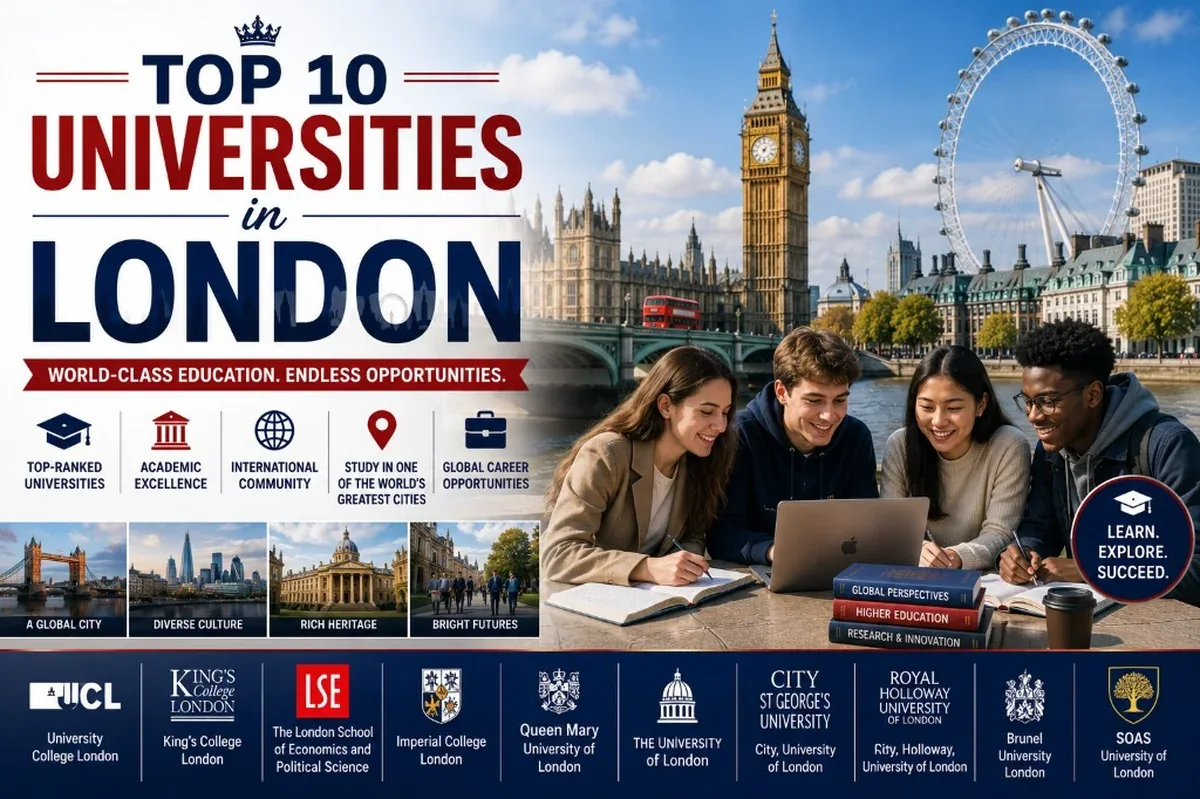
Overview: London is home to more world-top-100 universities than almost any other city on earth. In the QS World University Rankings 2026, Imperial College London climbed to #2 in the world — ahead of Oxford and Cambridge — while UCL holds steady at #9 globally. This guide ranks the top 10 universities in London using their actual 2026 QS global positions, explains what QS measures, and compares costs and strengths for international students.
London’s university scene is unusual: six of its institutions place inside the QS global top 100 for 2026, a concentration few other cities can match. Because so many families search “top universities in London” without a clear source, this guide uses the QS World University Rankings 2026 (released June 2025) as the primary reference — QS is the most widely used global ranking for comparing UK universities against international peers.

How QS ranks universities (quick methodology)
- Academic reputation (largest single weighting) — global survey of academics
- Employer reputation — survey of graduate employers worldwide
- Faculty/student ratio — a proxy for teaching resources
- Citations per faculty — research impact
- International faculty & student ratios, plus newer indicators for sustainability and employment outcomes
Source: QS World University Rankings 2026.
Top 10 universities in London (QS World University Rankings 2026)
| London rank | University | QS World rank 2026 | Known for |
|---|---|---|---|
| 1 | Imperial College London | #2 (world) | Engineering, medicine, science — UK’s #1 university overall in 2026 |
| 2 | University College London (UCL) | #9 (world) | Multidisciplinary breadth, 150+ nationalities on campus |
| 3 | King’s College London | #31 (world) | Medicine, law, humanities; jumped from a #40 tie in 2025 |
| 4 | London School of Economics (LSE) | #56 (world) | Global leader in economics, politics, and social sciences |
| 5 | Queen Mary University of London | #110 (world) | Russell Group research university, strong medicine and law |
| 6 | City St George’s, University of London | ~#310 (world) | Business (Bayes Business School), journalism, health sciences |
| 7 | Brunel University of London | ~#343 (world) | Engineering with strong industry placement links |
| 8 | Birkbeck, University of London | #388 (world) | Evening/flexible study model for working students |
| 9 | Royal Holloway, University of London | #461 (world) | Arts, sciences, and a campus outside central London (Surrey) |
| 10 | SOAS University of London | ~#511+ (world) | Global specialist in Asian, African, and Middle Eastern studies |
Source: QS World University Rankings 2026, cross-checked with reporting from The Tab. World ranks marked “~” are approximate band positions — confirm exact figures on QS.com before publishing elsewhere.
Imperial and UCL: London’s two global top-10 universities
Imperial College London is the standout story of the 2026 cycle: it retained its #2 global ranking, placing it above the University of Oxford (#4) and University of Cambridge (#6) and making it the #1 university in the entire UK for 2026. Imperial is a STEM-focused specialist institution — no humanities or law faculty — covering engineering, medicine, natural sciences, and business.
UCL held its long-standing #9 global position, with its overall QS score rising from 91.6 to 95.8 year-on-year. UCL is Great Britain’s largest multidisciplinary research university by some measures, spanning medicine, law, architecture (the Bartlett School), engineering, and the humanities.

King’s College London and LSE: strong risers and specialists
King’s College London (KCL) jumped from a tied #40 position in 2025 to a solid #31 in 2026 — one of the largest single-year improvements among major London universities. KCL is especially strong in medicine, law, and the humanities, and sits in central London across several historic campuses (Strand, Guy’s, Denmark Hill).
The London School of Economics (LSE) is a globally recognized specialist social science institution — it does not offer engineering or most natural sciences, focusing instead on economics, politics, law, and international relations. LSE dropped from a tied #50 in 2025 to #56 in 2026, though its underlying score actually improved; other universities simply gained faster.
Tuition costs for international students (approximate, 2025–26)
| University | Approx. undergraduate tuition (international) |
|---|---|
| Imperial College London | £31,750–£55,800 |
| UCL | £23,290–£50,300 |
| King’s College London | £30,000–£35,000 |
| LSE | £21,570–£34,000 |
| Queen Mary University of London | £20,000–£40,000 |
| Birkbeck / Royal Holloway / SOAS | £18,000–£35,000 (varies by course) |
Add London living costs (often £15,000–£20,000+ per year for accommodation and living expenses) on top of tuition. Always confirm the current fee for your specific course and entry year on each university’s official fees page.
Choosing between London universities by subject strength
| If you want… | Consider | Why |
|---|---|---|
| Engineering, medicine, or pure sciences | Imperial College London | UK’s top-ranked STEM specialist, #2 globally |
| A broad multidisciplinary research university | UCL | Global top 10, extremely wide subject range |
| Medicine, law, or humanities in central London | King’s College London | Strong clinical partnerships (Guy’s, King’s College Hospital) |
| Economics, politics, or international relations | LSE | World-leading specialist social science institution |
| A large Russell Group research university at lower cost | Queen Mary University of London | Strong research profile with generally lower fees than the “big four” |
| Flexible or evening study while working | Birkbeck, University of London | Purpose-built for part-time and mature students |
| Regional studies (Asia, Africa, Middle East) | SOAS University of London | Globally recognized area-studies specialist |
International student essentials for studying in London
- Student visa: Most international students need a UK Student visa (formerly Tier 4), sponsored by the university via a Confirmation of Acceptance for Studies (CAS).
- English proficiency: IELTS (commonly 6.5–7.5+) or an equivalent test, with exact requirements varying by course and university.
- Healthcare surcharge: International students on a Student visa typically pay the Immigration Health Surcharge to access NHS care during study.
- Graduate visa route: The UK’s post-study Graduate visa currently allows eligible graduates to stay and work for a period after finishing their degree — verify current duration and eligibility on GOV.UK before relying on it in your planning.
Official visa guidance: GOV.UK Student visa.
QS vs. Times Higher Education: why rankings differ
Families often notice that Imperial’s position looks different across ranking systems. QS weights academic and employer reputation surveys heavily (roughly 40% combined), which tends to favor globally recognized, employer-connected institutions like Imperial. Times Higher Education (THE) weights research citations, income, and teaching environment more heavily, which can produce different orderings — THE has historically placed Oxford and Cambridge above Imperial in several editions. Neither methodology is “wrong”; they simply measure different things, so it is worth checking both if a specific factor (research output vs. employer reputation) matters most to you.
| Ranking system | Heaviest weighting | Tends to favor |
|---|---|---|
| QS World University Rankings | Academic & employer reputation surveys | Globally recognized brand-name institutions with strong employer ties |
| Times Higher Education (THE) | Research citations, income, teaching environment | Research-output powerhouses, often favoring Oxbridge |
| The Complete University Guide / Guardian (UK domestic) | UK-specific metrics: entry standards, student satisfaction, graduate prospects | UK-focused comparisons, less useful for global positioning |
Campus life and location differences across London universities
London universities differ substantially in how “campus-based” they feel, since most sit inside a dense global city rather than a self-contained quad:
- Imperial College London: Main campus in South Kensington, adjacent to the Natural History Museum and Royal Albert Hall; a more traditional single-campus feel than most London universities.
- UCL: Centered in Bloomsbury, spread across numerous buildings near the British Museum, with a distinctly urban, walk-everywhere campus culture.
- King’s College London: Multiple campuses across central London (Strand, Guy’s, Denmark Hill, Waterloo), each linked to a different faculty focus.
- LSE: A compact campus near Holborn/Covent Garden, one of the most centrally located university sites in the world.
- Royal Holloway: The notable exception on this list — a traditional, self-contained campus in Egham, Surrey, roughly 40 minutes from central London by train.
London vs. Oxford and Cambridge: how do they compare?
Oxford (#4) and Cambridge (#6) both rank higher globally than every London university except Imperial. However, London universities offer distinct advantages: direct access to the UK’s largest job market, NHS teaching hospital partnerships, and a globally diverse, less collegiate campus culture than Oxbridge’s tutorial system. Many applicants shortlist Imperial or UCL alongside Oxford and Cambridge rather than instead of them.
Explore more UK options in our UK Universities category.
Frequently asked questions: top universities in London
What is the best university in London for 2026?
Imperial College London is the top-ranked London university for 2026, placing #2 in the QS World University Rankings — ahead of every other UK university, including Oxford and Cambridge.
Is UCL better than King’s College London?
By QS World Rankings 2026, UCL (#9 globally) ranks well ahead of King’s College London (#31 globally), though KCL made one of the largest jumps of any major UK university this year and is especially strong in medicine and law.
Why is Imperial College London ranked above Oxford and Cambridge?
QS weights academic and employer reputation, research citations, and internationalization heavily. Imperial’s STEM specialization, strong employer reputation, and international profile helped it edge ahead of Oxford (#4) and Cambridge (#6) in the 2026 QS methodology specifically — other rankings (like Times Higher Education) may order these differently.
Does LSE offer engineering or science degrees?
No. LSE is a specialist social science institution focused on economics, politics, law, sociology, and international relations — it does not offer engineering, medicine, or most natural sciences.
How much does it cost to study at a top London university as an international student?
Tuition alone typically ranges from about £18,000 to over £55,000 per year depending on the university and course (medicine and some STEM programs cost more). Add London living costs of roughly £15,000–£20,000+ per year.
Which London university is best for medicine?
Imperial College London and King’s College London both have strong, long-established medical schools with major NHS teaching hospital partnerships; UCL Medical School is also highly regarded. Compare course structure and hospital placements directly, as they differ significantly.
Can international students get a UK visa to stay after graduating from a London university?
Currently, eligible graduates can apply for the UK’s Graduate visa route to work after finishing a degree. Rules and permitted duration can change, so verify current details on GOV.UK before planning around it.
Are all these universities part of the University of London federation?
Several are (UCL, King’s College London, Queen Mary, Birkbeck, Royal Holloway, SOAS, and City St George’s are part of or affiliated with the University of London federation), while Imperial College London became fully independent of the federation in 2007. LSE is also a member institution of the University of London federation.
Why do QS and Times Higher Education rank London universities differently?
QS weights academic and employer reputation surveys heavily, which tends to favor institutions like Imperial with strong global employer recognition. THE weights research citations, income, and teaching environment more heavily, which has historically favored Oxford and Cambridge. Check both rankings if you want a fuller picture rather than relying on a single system.
Is Royal Holloway actually located in London?
Royal Holloway’s campus is in Egham, Surrey, about 40 minutes from central London by train — it is a University of London federation member but has a more traditional, self-contained campus than most institutions on this list, which are based directly in central London.
Final overview
The top universities in London for 2026 — led by Imperial College London (#2 globally) and UCL (#9 globally) — give students access to elite research, NHS-linked medical training, and a genuinely global student body, all within one of the world’s major job markets. King’s College London and LSE round out London’s global top-100 presence, while Queen Mary, City St George’s, Brunel, Birkbeck, Royal Holloway, and SOAS offer strong, more specialized or lower-cost alternatives.
Disclaimer: Rankings, tuition fees, and visa policies change annually. This article summarizes publicly available information for planning purposes only — not immigration or financial advice. Confirm all figures on QS.com, official university fee pages, and GOV.UK before applying.

Saahil
Saahil is an education researcher and content creator specializing in university rankings, admissions strategies, and student guides. He is dedicated to helping students make informed academic decisions.
Continue your research

How to Compare Universities Beyond Rankings: A 2026 Framework
Compare course fit, cost, outcomes, support and learning experience with official data instead of relying on one league-table position.
Read the guide →
Top 20 Universities in Australia (2026 QS Rankings Guide)
Top 20 universities in Australia for 2026 using QS rankings: Melbourne, UNSW, Sydney, ANU, Monash, UTS and more with FAQs.
Read the guide →
Top 50 Universities in USA (2026 Rankings Guide)
Official-style 2026 guide to the top 50 US universities — verified U.S. News ranks, international student tips, costs, and links to school-by-school guides on T
Read the guide →
Top 100 Universities in the World: 2026 QS Rankings & Admissions Guide
The top 100 universities in the world for 2026, ranked by QS. MIT, Imperial, Stanford, Oxford and more — countries, scores, and international admissions tips.
Read the guide →