
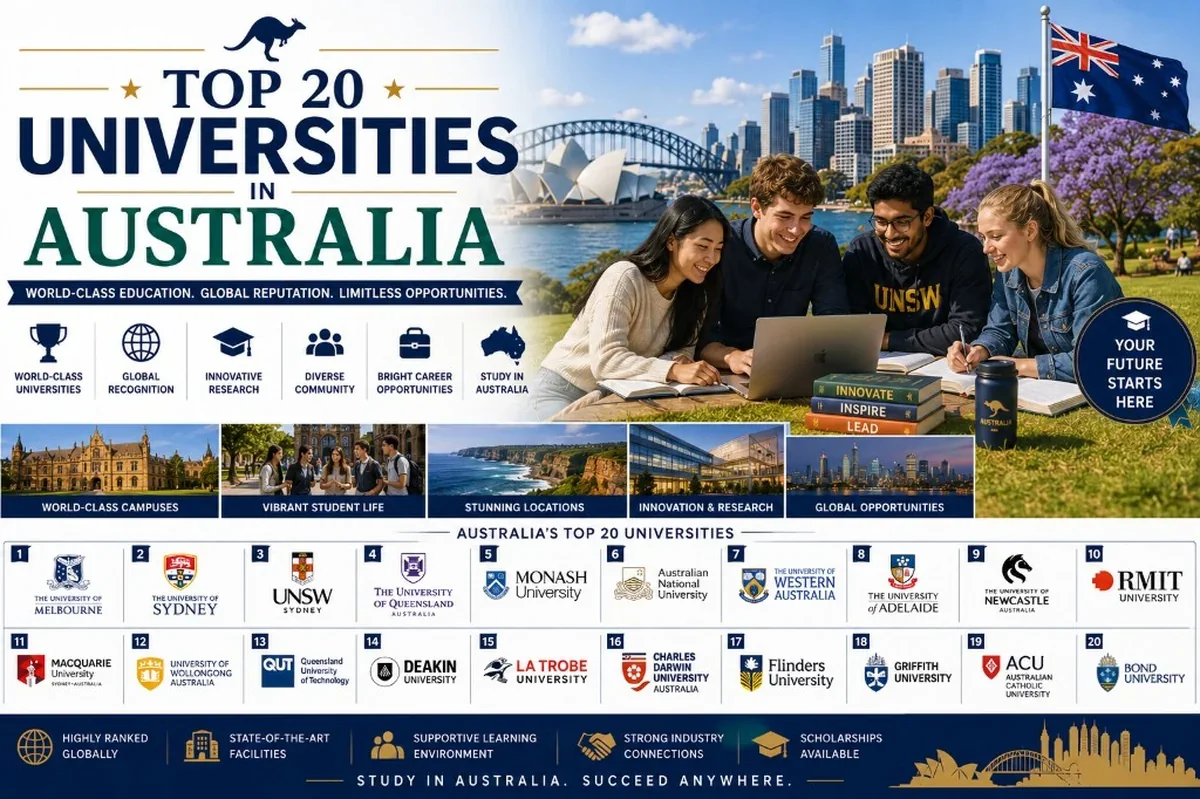
Top 20 universities in Australia for international students (2026) — This independent editorial guide helps prospective applicants navigate Australia's higher education landscape. We break down the leading research flagships and top technology institutes to help you find the right fit beyond just a numerical rank.
Our "Top 20" list aggregates and contextualizes data from major educational indices. Please note: This is a research guide compiled by Top Schools Rankings. While we use recognized datasets like the QS World University Rankings as foundational reference points, this is not an official ranking published by the Australian Government, the Group of Eight, or QS.
Ranking Methodology & Sources
To build this guide, we referenced the QS World University Rankings (2026 edition) to establish the leading Australian institutions by global academic reputation. QS evaluates universities on metrics such as academic reputation, employer reputation, and international research networks.
Ranks 1–11 strictly reflect the published QS 2026 Australian ordering for institutions that landed inside the global top 150. Ranks 12–20 expand our editorial shortlist to include high-enrollment destinations recognized for industry connections and international student satisfaction.
Top 20 Universities in Australia (2026 Guide)
The table below outlines the top 20 institutions, their primary city locations, and their 2026 QS World University Rank (where applicable within the global top 150). Note that Adelaide University is listed reflecting the recent merger between the University of Adelaide and the University of South Australia.
| AU # | University | City | QS 2026 / note |
|---|---|---|---|
| 1 | University of Melbourne | Melbourne | 19 |
| 2 | UNSW Sydney | Sydney | 20 |
| 3 | University of Sydney | Sydney | =25 |
| 4 | Australian National University (ANU) | Canberra | =32 |
| 5 | Monash University | Melbourne | =36 |
| 6 | University of Queensland | Brisbane | 42 |
| 7 | University of Western Australia | Perth | 77 |
| 8 | Adelaide University | Adelaide | =82 |
| 9 | University of Technology Sydney | Sydney | 96 |
| 10 | RMIT University | Melbourne | 125 |
| 11 | Macquarie University | Sydney | =138 |
| 12 | Curtin University | Perth | Go8-adjacent research strength |
| 13 | University of Wollongong | Wollongong | Coastal research university |
| 14 | Deakin University | Melbourne/Geelong | Growing international intake |
| 15 | Queensland University of Technology | Brisbane | Applied learning focus |
| 16 | University of Newcastle | Newcastle | Research + industry links |
| 17 | Griffith University | Gold Coast/Brisbane | International pathways |
| 18 | La Trobe University | Melbourne | Improving QS trajectory |
| 19 | Swinburne University of Technology | Melbourne | Tech & design |
| 20 | Western Sydney University | Sydney | Large diverse campus |
The Group of Eight (Go8) Explained
When researching Australian universities, international students will frequently encounter the Group of Eight (Go8). The Go8 comprises Australia’s leading research-intensive universities: Melbourne, UNSW, Sydney, ANU, Monash, Queensland, UWA, and Adelaide University.
These institutions dominate international searches because they consistently appear in the global top 100, receive the majority of Australia's competitive research grant funding, and maintain strong employer recognition across the Asia-Pacific region.
Read our detailed admissions guides for key Go8 members: UNSW, University of Queensland, and Monash University.

Technology and Applied Learning Campuses
It is important not to limit your search strictly to the Go8. Students targeting design, media, nursing, or applied engineering often prefer the Australian Technology Network (ATN) universities or similar industry-focused campuses.
Institutions like the University of Technology Sydney (UTS), RMIT University, and Queensland University of Technology (QUT) maintain exceptional graduate employability rates because their degrees often integrate practical industry placements rather than focusing purely on academic research.

What International Students Need to Consider
Before applying to an Australian university, evaluate these critical factors beyond global prestige:
- Admissions & ATAR Equivalency: Australian universities primarily evaluate international applicants based on their high school graduation scores, converted to an ATAR (Australian Tertiary Admission Rank) equivalent. Unlike the U.S. system, admissions are highly transparent and grade-driven, with clear cutoff scores published for most courses.
- Tuition Fees & Cost of Living: International undergraduate tuition generally ranges from AUD 35,000 to AUD 55,000+ per year depending on the degree (medicine and veterinary sciences are significantly higher). Living costs also vary by city: Sydney is generally the most expensive for rent, followed closely by Melbourne, while cities like Brisbane, Perth, and Adelaide can offer a lower cost of living.
- Visas and Post-Study Work Rights: Many international students hope to gain work experience in Australia after graduating. Eligibility is governed by the Temporary Graduate visa (subclass 485). Immigration rules, age limits, and eligible occupations change frequently. Always verify the latest visa regulations directly on the official Department of Home Affairs website.
Limitations of This Ranking
Global rankings heavily weight academic research citations and international faculty ratios. They do not measure undergraduate teaching quality, student support services, or the availability of on-campus housing.
Always verify current tuition rates, admission requirements, course CRICOS codes, and scholarship opportunities directly on the official university websites before accepting an offer.
FAQs: Top Universities in Australia
Which Australian university is #1 in QS 2026?
According to the QS 2026 global ranks, the University of Melbourne leads Australian institutions at global rank 19.
Is UNSW better than Melbourne?
In the QS 2026 data, Melbourne (#19) and UNSW (#20) are separated by a single rank. Both are elite Go8 institutions. Your choice should be dictated by specific program strengths (e.g., UNSW's engineering reputation) and city preference rather than this minor ranking difference.
What is Adelaide University in QS 2026?
QS 2026 lists the newly merged Adelaide University (combining the University of Adelaide and the University of South Australia), placing it firmly within the global top 100.
Are all top 20 universities Go8 members?
No. The Go8 consists of only eight research-intensive flagships. Other highly ranked institutions like UTS, RMIT, and Macquarie are excellent, industry-aligned alternatives that broaden the practical choices for students.
Which is the best city for international students?
Sydney and Melbourne host the largest numbers of international students and offer vibrant, multicultural lifestyles. However, Brisbane, Perth, and Adelaide are increasingly popular due to potentially lower living costs and different regional migration incentives.
Do I need to only apply to a top 100 global university?
Not necessarily. While a top 100 university carries global brand recognition, you should also compare faculty-specific scholarships, graduate employment rates, and industry placement opportunities at other strong Australian universities.

Saahil
Saahil is an education researcher and content creator specializing in university rankings, admissions strategies, and student guides. He is dedicated to helping students make informed academic decisions.
Continue your research

How to Compare Universities Beyond Rankings: A 2026 Framework
Compare course fit, cost, outcomes, support and learning experience with official data instead of relying on one league-table position.
Read the guide →
Top 10 Universities in London (2026 QS Rankings Guide)
The top 10 universities in London for 2026 ranked using QS World University Rankings: Imperial College London (#2 globally), UCL (#9), King's College London, LSE, and more.
Read the guide →
Top 50 Universities in USA (2026 Rankings Guide)
Official-style 2026 guide to the top 50 US universities — verified U.S. News ranks, international student tips, costs, and links to school-by-school guides on T
Read the guide →
Top 100 Universities in the World: 2026 QS Rankings & Admissions Guide
The top 100 universities in the world for 2026, ranked by QS. MIT, Imperial, Stanford, Oxford and more — countries, scores, and international admissions tips.
Read the guide →