
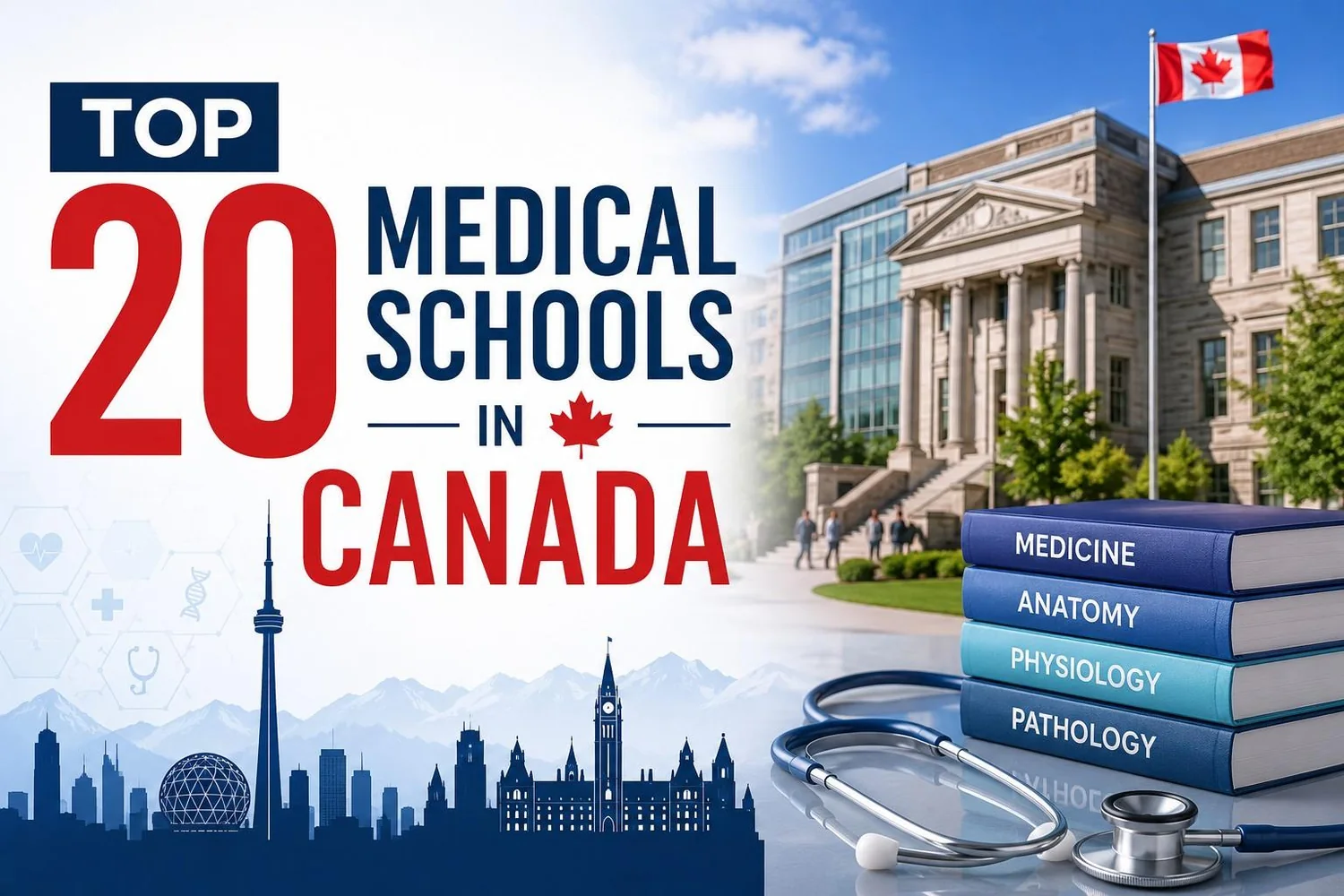
Quick summary: Canada has 17–19 MD-granting medical faculties graduating ~2,800 doctors yearly (AFMC). National acceptance rate is typically under 7.5%. This guide ranks the top 17 established schools plus 3 new/emerging programs — with 2026/27 tuition, class sizes, MCAT rules, and provincial admission notes. Ontario applicants apply via OMSAS.
Choosing among the top medical schools in Canada is one of the hardest decisions in higher education — not because Canada lacks excellent programs, but because seats are scarce and most faculties strongly favour in-province residents. Whether you are a Canadian undergraduate planning an MD, an international student exploring limited pathways, or a parent researching options, this guide ranks Canada’s medical schools using transparent criteria and verified data from the Association of Faculties of Medicine of Canada (AFMC).
Important: AFMC lists faculties geographically with no official rank order. Our rankings below are editorial — based on research intensity, program reputation, innovation, and admissions data — not an official government or university league table.
How we ranked Canada’s top medical schools
We scored each MD faculty on five factors parents and applicants care about most:
| Factor | Weight | What we measured |
|---|---|---|
| Research & university strength | 30% | Parent university research output (Maclean’s Medical-Doctoral 2026 context) |
| Clinical & hospital network | 25% | Affiliated teaching hospitals and specialty breadth |
| Program innovation | 20% | PBL curriculum, 3-year MD options, bilingual training |
| Class size & access | 15% | First-year MD seats (more seats = slightly more opportunity) |
| Applicant fit | 10% | Language options, rural medicine focus, unique pathways |
Top 20 medical schools in Canada — ranked list (2026)
The table below covers all 17 long-established Canadian MD faculties plus three newer or upcoming programs to complete a top-20 overview.
| Rank | Medical school | University | Province | MD length | ~Year 1 seats | Typical ON/BC tuition (CAD/yr) |
|---|---|---|---|---|---|---|
| 1 | Temerty Faculty of Medicine | University of Toronto | ON | 4 years | ~305 | $23,090 (ON res.) |
| 2 | Faculty of Medicine & Health Sciences | McGill University | QC | 4–5 years | ~250 | $6,356 (QC res.) |
| 3 | Faculty of Medicine | UBC | BC | 4 years | ~328 | $24,838 (BC res.) |
| 4 | Michael G. DeGroote School of Medicine | McMaster University | ON | 3 years | ~217 | $25,130 (ON res.) |
| 5 | Faculty of Medicine & Dentistry | University of Alberta | AB | 4 years | ~192 | $16,141 (AB res.) |
| 6 | Faculty of Medicine | University of Ottawa | ON | 4 years | ~183 | $25,487 (ON res.) |
| 7 | Cumming School of Medicine | University of Calgary | AB | 3 years | ~185 | $25,244 (AB res.) |
| 8 | Schulich School of Medicine & Dentistry | Western University | ON | 4 years | ~187 | $25,703 (ON res.) |
| 9 | School of Medicine | Queen’s University | ON | 4 years | ~140 | See registrar |
| 10 | Faculty of Medicine | Dalhousie University | NS | 4 years | ~169 | $26,783 |
| 11 | Max Rady College of Medicine | University of Manitoba | MB | 4 years | ~125 | $13,800 |
| 12 | Faculté de médecine (MD program) | Université de Montréal | QC | 4–5 years | ~200+ | QC rates |
| 13 | Faculté de médecine | Université Laval | QC | 4–5 years | ~160 | QC rates |
| 14 | Faculté de médecine et sciences de la santé | Université de Sherbrooke | QC | 4 years | ~140 | QC rates |
| 15 | College of Medicine | University of Saskatchewan | SK | 4 years | ~108 | $21,897 |
| 16 | Faculty of Medicine | Memorial University | NL | 4 years | ~110 | $14,250 |
| 17 | NOSM University | NOSM University | ON | 4 years | ~88 | $23,247 |
| 18 | School of Medicine (new) | Toronto Metropolitan University | ON | 4 years | ~94 | $26,586 (ON res.) |
| 19 | School of Medicine (opening) | Simon Fraser University | BC | TBC | TBC | TBC |
| 20 | School of Medicine (planned) | York University | ON | 3-yr planned | ~80 planned | TBC |
Top medical schools in Canada — detailed profiles
1. University of Toronto — Temerty Faculty of Medicine
Why it ranks #1: Canada’s largest MD intake (~305 domestic seats), unmatched hospital network (Toronto academic health sciences), and the country’s highest medical research funding. Ideal for applicants targeting competitive specialties and academic medicine.
- Location: Toronto, Ontario (St. George + Mississauga campuses)
- Tuition (2026/27 guide): $23,090/year (Ontario resident); $27,510 out-of-province; international ~$97,350
- MCAT: Required; used competitively
- Best for: Research-heavy medicine, diverse clinical exposure, largest Canadian faculty
2. McGill University — Faculty of Medicine and Health Sciences
Why it ranks #2: McGill’s parent university topped Maclean’s Medical-Doctoral rankings for 2026. The MD-CM program is globally recognized with strong Oxbridge/Ivy placement.
- Location: Montreal, Quebec
- Tuition: Quebec residents ~$6,356/year; Canadian non-Quebec ~$33,282; international higher
- MCAT: Not required for Quebec CEGEP pathways; required for most university-entry applicants
- Best for: Bilingual Montreal environment, international prestige, Med-P preparatory pathway
See our McGill University admissions guide for broader university context.
3. University of British Columbia — Faculty of Medicine
Why it ranks #3: Largest west-coast MD program (~328 seats), distributed campuses (Vancouver, Victoria, Prince George, Kelowna), and top-tier Maclean’s research standing.
- Tuition: ~$24,838/year (BC resident); out-of-province similar; international seats very limited
- MCAT: Required
- Best for: BC residents, distributed/rural training, Pacific Northwest lifestyle
4. McMaster University — Michael G. DeGroote School of Medicine
Why it ranks #4: Pioneer of problem-based learning (PBL) and Canada’s best-known 3-year MD program — graduates enter residency a year earlier.
- Location: Hamilton, Ontario
- Tuition: ~$25,130/year (Ontario resident)
- MCAT: Required — CARS section weighted heavily
- Seats: ~217
- Best for: Self-directed learners wanting accelerated training
Read more in our McMaster University guide.
5. University of Alberta — Faculty of Medicine & Dentistry
Why it ranks #5: Strong research hospital system (Edmonton) with among the lowest tuition of major research medical schools (~$16,141/year for Alberta residents).
- Seats: ~192
- MCAT: Required
- Best for: Alberta residents, value-focused applicants, rural & Indigenous health pathways
6. University of Ottawa — Faculty of Medicine
Why it ranks #6: Canada’s largest bilingual (English/French) MD program — unique for francophone applicants outside Quebec.
- Tuition: $25,487 (Ontario); $29,504 out-of-province
- MCAT: Not required
- Seats: ~183
7. University of Calgary — Cumming School of Medicine
Why it ranks #7: 3-year MD like McMaster, Calgary’s growing health sector, and tied #5 on Maclean’s Medical-Doctoral 2026.
- Tuition: ~$25,244/year (Alberta resident)
- MCAT: Required — CARS focused
- Seats: ~185
8. Western University — Schulich School of Medicine & Dentistry
Why it ranks #8: Strong clinical training in London, Ontario with competitive Southwestern Ontario hospital access.
- Tuition: ~$25,703 (Ontario resident)
- Seats: ~187
- Best for: Ontario applicants wanting mid-size city clinical training
9. Queen’s University — School of Medicine
Why it ranks #9: Smaller cohort (~140) with tight-knit community; Kingston’s university-town environment; strong student satisfaction scores on Maclean’s.
- MCAT: Used as cut-off threshold
- Best for: Applicants preferring smaller class sizes
10. Dalhousie University — Faculty of Medicine
Why it ranks #10: Atlantic Canada’s largest medical faculty; serves Maritime provinces with distributed campuses (Halifax, Saint John, Cape Breton).
- Tuition: ~$26,783/year
- Seats: ~169
- Best for: Atlantic Canada residents, maritime clinical training
11–17. Other established Canadian medical schools
| Rank | School | Standout feature |
|---|---|---|
| 11 | University of Manitoba | Requires completed degree before MD; affordable tuition (~$13,800) |
| 12 | Université de Montréal | French-language MD; major Quebec intake |
| 13 | Université Laval | French MD in Quebec City; CEGEP entry pathway |
| 14 | Université de Sherbrooke | Regional distributed campuses; French program |
| 15 | University of Saskatchewan | Prairie medicine focus; ~108 seats |
| 16 | Memorial University (NL) | Lowest tuition among established schools (~$14,250); Atlantic access |
| 17 | NOSM University | Northern & rural Ontario focus; MCAT not required; ~88 seats |
18–20. New and emerging medical schools in Canada
Canada’s medical school map is expanding to address physician shortages:
- #18 Toronto Metropolitan University (TMU): Opened 2025 in Brampton — ~94 seats, primary-care focused, OMSAS application
- #19 Simon Fraser University: Surrey, BC campus opening 2026 — new faculty expanding BC training capacity
- #20 York University: Planned Toronto opening ~2028 — proposed 3-year MD with community-based training
These programs are too new for long-term outcome data but matter for applicants planning 2026–2030 entry cycles.
Canadian medical school admissions — what you need to know
Who can apply?
Most Canadian MD programs require 2–4 years of undergraduate study or a completed bachelor’s degree. Quebec CEGEP graduates can enter some faculties after 2 years. Manitoba requires a prior degree.
MCAT requirements by medical school
| MCAT policy | Medical schools |
|---|---|
| MCAT required | UofT, UBC, McMaster, Alberta, Calgary, Western, Queen’s, Dalhousie, Saskatchewan, Memorial, most others |
| MCAT not required | Ottawa, NOSM, Quebec French-language faculties (no French MCAT equivalent) |
| CARS-heavy weighting | McMaster, Calgary (Critical Analysis & Reasoning Skills) |
Provincial preference — critical for success
Most seats are reserved for residents of the province where the university is located. Ontario has 7+ MD faculties; BC, Alberta, and Quebec similarly protect in-province applicants. Out-of-province and international acceptance rates are far lower — often under 2% for international applicants where any seats exist.
Ontario medical school applications (OMSAS)
All seven Ontario medical schools (UofT, McMaster, Ottawa, Queen’s, Western, NOSM, TMU) use the centralized Ontario Medical School Application Service (OMSAS) through OUAC. Each school makes independent admission decisions after shared application components (autobiographical sketch, CASPer test where required, references).
Typical application components
- Undergraduate GPA (often 3.8+ competitive)
- MCAT scores (where required)
- CASPer situational judgement test (many schools)
- Autobiographical sketch / personal statements
- Confidential references or assessments
- Multiple Mini Interviews (MMI) — pioneered at McMaster, now widely used
International students — realistic expectations
Most Canadian medical schools accept few or zero international MD applicants. UofT lists international tuition at ~$97,350/year. Many faculties accept only Canadian citizens or permanent residents. International students should verify each faculty’s current policy in the annual AFMC guide before applying.
MD program length and curriculum types
| Program type | Schools | Duration |
|---|---|---|
| Standard 4-year MD | UofT, UBC, Ottawa, Western, Queen’s, Dalhousie, most others | 4 years |
| Accelerated 3-year MD | McMaster, Calgary | 3 years (year-round) |
| Extended 5-year (incl. preparatory year) | McGill, Université de Montréal (some pathways) | 5 years |
After the MD, graduates enter residency training through CaRMS (Canadian Resident Matching Service) and must pass the MCCQE Part 1 (Medical Council of Canada Qualifying Examination) for licensure.
How much does medical school cost in Canada?
| Tier | Annual tuition (resident) | Examples |
|---|---|---|
| Budget-friendly | $13,800–$16,200 | Manitoba, Alberta, Memorial |
| Mid-range | $21,000–$26,000 | UBC, Dalhousie, Saskatchewan, NOSM, Ontario schools |
| Quebec resident advantage | ~$6,000–$8,000 | McGill (QC residents) |
| International (where available) | $70,000–$97,000+ | UofT, Dalhousie (limited seats) |
Average Canadian medical student debt at graduation has drawn media attention — budget for living costs, exam fees (MCAT, MCCQE), and relocation for clerkships.
Which Canadian medical school is right for you?
| Your goal | Consider |
|---|---|
| Fastest MD completion | McMaster, Calgary (3-year) |
| Largest research network | University of Toronto |
| Lowest tuition (established school) | Memorial, Manitoba, Alberta |
| French-language training | Montréal, Laval, Sherbrooke, Ottawa (bilingual) |
| Rural & northern medicine | NOSM University |
| BC residency advantage | UBC |
| Primary care / community focus | TMU (new), NOSM |
Frequently asked questions about medical schools in Canada
How many medical schools are there in Canada?
There are 17 long-established MD faculties, plus TMU (from 2025) and Simon Fraser (from 2026), with York University planned — 19–20 total depending on the intake year. AFMC represents all accredited faculties.
What are the top 3 medical schools in Canada?
By research output, class size, and university reputation, University of Toronto, McGill University, and UBC consistently lead. McMaster ranks top-tier for innovative 3-year PBL training.
Is it hard to get into medical school in Canada?
Yes — very. National acceptance rates are typically below 7.5%. Only ~2,900 first-year MD seats exist annually against thousands of strong applicants.
Do Canadian medical schools require the MCAT?
Most do. Exceptions include University of Ottawa, NOSM University, and Quebec French-language programs. Always check the current AFMC guide for your target school.
Can international students study medicine in Canada?
Options are very limited. Most faculties prioritize Canadian citizens and permanent residents. Where international seats exist (e.g. UofT), tuition exceeds $90,000/year.
How do I apply to Ontario medical schools?
Through OMSAS (Ontario Medical School Application Service) via OUAC — one application portal for all seven Ontario MD faculties, with separate institutional fees per school.
Which Canadian medical school is the cheapest?
Memorial University (~$14,250/year) and University of Manitoba (~$13,800/year) are among the lowest. Quebec residents at McGill pay significantly less (~$6,356/year) than out-of-province students.
What is the shortest MD program in Canada?
McMaster and University of Calgary offer 3-year MD programs without a summer break — graduates enter residency one year earlier than standard 4-year paths.
Last updated: June 2026. Tuition, seat counts, and admission policies sourced from the AFMC Admission Requirements guide (2026/27 cycle) and official faculty websites. Requirements change annually — verify with each school before applying.

Saahil
Saahil is an education researcher and content creator specializing in university rankings, admissions strategies, and student guides. He is dedicated to helping students make informed academic decisions.
Continue your research

Top 100 High Schools in England: 2026 Rankings & Admissions Guide
The top 100 high schools in England for 2026, ranked by Sunday Times Parent Power GCSE and A-level results. Grammar, independent schools, fees & admissions.
Read the guide →
Appleby College Canada: Boarding School, Admissions, Fees & Student Life Guide for International Students
Appleby College is an independent boarding school in Canada.
Read the guide →
Douglas College Canada: Admissions, Fees, Courses & University Transfer Guide for International Students
For international students looking for an affordable and career-focused education in Canada, Douglas College is one of the most popular choices in British…
Read the guide →
Duke University: Complete Guide 2026 – Admissions, Fees & Rankings
Discover everything about Duke University in 2026. Learn about admissions requirements, tuition fees ($70,265), rankings (#6 US News), acceptance rate (4.8%).
Read the guide →