
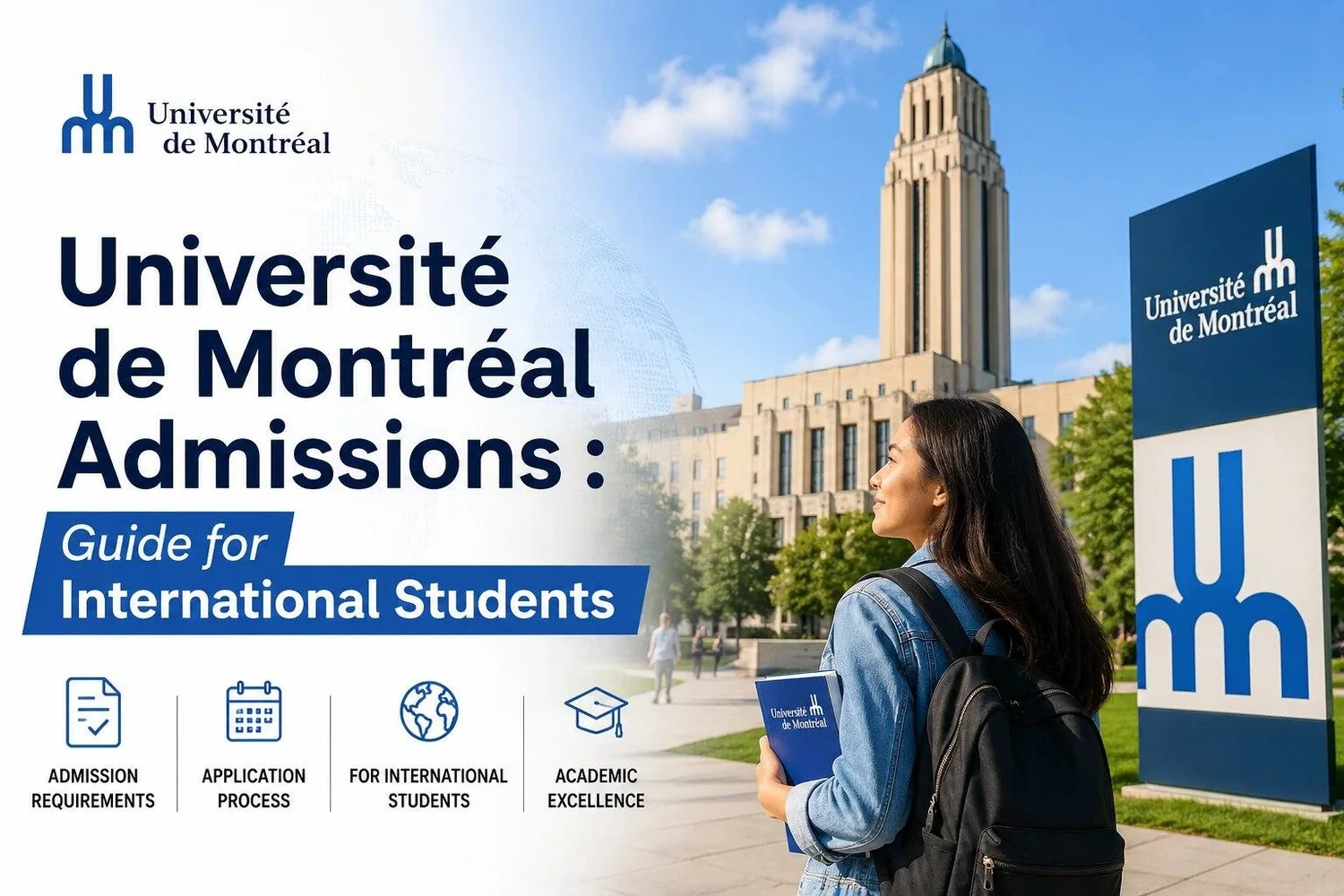
Quick summary: Université de Montréal (UdeM) is Canada’s largest French-language research university — founded in 1878, ~67,000 students, ranked #168 in QS World University Rankings 2026. Most programs require French proficiency (B2). International students receive automatic exemption scholarship evaluation — up to $14,015/year at undergraduate Level A. Apply via UdeM’s online portal; deadlines: April 1 (Fall), August 1 (Winter), December 1 (Summer).
Université de Montréal admissions attract thousands of international students each year to one of North America’s most affordable major research universities — and one of the world’s leading francophone institutions. Located on Mount Royal in Montreal, Quebec, UdeM offers 250+ programs across 13 faculties, from medicine and law to artificial intelligence and visual arts. Unlike English-language McGill across the city, UdeM delivers most coursework in French — making it ideal for students who want a globally ranked Canadian degree combined with French-language immersion. This guide explains admission requirements, tuition, the automatic exemption scholarship, immigration steps, and how UdeM compares with other Canadian universities — using official UdeM sources.
Université de Montréal — profile at a glance
UdeM is a public research university and member of the U15 group of Canada’s leading research-intensive institutions. It operates alongside affiliated schools HEC Montréal (business) and Polytechnique Montréal (engineering) on a shared campus ecosystem.
| Detail | Information |
|---|---|
| Founded | 1878 (originally Université Laval à Montréal) |
| Type | Public research university |
| Location | Montreal, Quebec, Canada (Mount Royal campus) |
| Language | Primarily French; select graduate programs in English |
| Enrollment | ~67,000 students (including affiliated institutions) |
| International students | ~9,500+ from 150+ countries |
| Faculties | 13 faculties; 250+ undergraduate and graduate programs |
| QS World Ranking 2026 | #168 globally |
| Admissions portal | admission.umontreal.ca |
Université de Montréal world rankings (2026)
UdeM consistently ranks among the top francophone universities worldwide and holds strong positions in research-intensive fields.
| Ranking system | 2025–2026 position | Notes |
|---|---|---|
| QS World University Rankings | #168 (2026); #159 (2025) | Top francophone university in North America |
| International student share | ~23% of student body | Highly multicultural campus |
| Research strength | AI, medicine, law, pharmacology, neuroscience | Major Montreal research hub |
Rankings shift yearly — use them to shortlist programs, not as the sole decision factor. Always compare specific faculty reputation, program structure, and total cost for your situation.
Université de Montréal admissions — who can apply?
Admission criteria vary by program and country of prior study. UdeM evaluates each application against program-specific requirements listed on individual program pages under “Admission et exigences” (undergraduate) or “Admission and Regulations” (graduate).
General admission requirements for international students
| Level | Typical requirement |
|---|---|
| Undergraduate (1st cycle) | Secondary school diploma + at least one year of university-level studies, OR UdeM’s preparatory year (first year of a 4-year bachelor’s) |
| Master’s (2nd cycle) | Completed bachelor’s degree in a related field; minimum GPA varies by program (often ~3.0/4.3 equivalent) |
| Doctorate (3rd cycle) | Master’s degree or equivalent; research proposal where required |
| French language | Required for most programs — demonstrated via test, diploma, or UdeM’s Intensive University French Program (B2 target) |
| English programs | Limited graduate programs taught in English (e.g. LL.M. Comparative Common Law, select science PhDs) — check program page |
Important: Several health programs (medicine, nursing, etc.) are not open to international applicants holding a study permit. Always verify program eligibility on the official curriculum page before applying.
UdeM provides a Grade Converter tool on its admissions site to translate international GPAs into Quebec grading scales — essential for graduate applicants.
French language requirements at Université de Montréal
Knowledge of spoken and written French is required for university studies in French. For graduate programs, you must demonstrate French proficiency meeting your program’s stated level — typically B2 on the CEFR scale.
If you do not yet meet B2, UdeM’s Intensive University French Program (4 months) helps future students reach the required level before entering a degree program. This is a major pathway for international students from non-francophone countries who want to study at UdeM.
How to apply to Université de Montréal — step by step
All applications are submitted online through UdeM’s admissions portal. You can apply to up to 10 program choices within the same session.
| Step | Action |
|---|---|
| 1. Research programs | Search programs at admission.umontreal.ca; use Affiniti tool to match interests |
| 2. Verify eligibility | Check country-specific requirements and diploma equivalency |
| 3. Create application | Complete online form with personal, academic, and program details |
| 4. Upload documents | Transcripts, diplomas, ID, French proficiency proof (if applicable) |
| 5. Pay application fees | Credit card payment required to submit (non-refundable) |
| 6. Track application | Monitor status in your Centre étudiant (student portal) |
| 7. Receive offer | Accept admission; exemption scholarship evaluated automatically |
| 8. Immigration | Apply for CAQ + Canadian study permit immediately after acceptance |
Full international student guidance is published on the official UdeM international student admissions page.
Université de Montréal application fees (2025/26)
| Fee type | Amount (CAD) |
|---|---|
| Base fee per session | $81.00 (pay once per session, even for multiple programs) |
| Fee per regular program | $22.70 |
| Example: 1 program application | ~$103.70 total |
| Admission reconsideration request | $33.60 |
Application fees are non-refundable and cannot be transferred to another program or session. Payment is by Visa, Mastercard, Visa Debit, Apple Pay, or Google Pay.
Université de Montréal admissions deadlines (2026)
While some programs extend deadlines, UdeM sets these general session deadlines for international applicants:
| Session | Application deadline | Study period |
|---|---|---|
| Fall (Automne) | April 1 | September – December |
| Winter (Hiver) | August 1 | January – April |
| Summer (Été) | December 1 | May – August |
Submit all required documents by the deadline — incomplete files may be closed. Start immigration procedures (CAQ + study permit) immediately after receiving your admission letter, as processing can take several months.
Université de Montréal tuition fees for international students
Quebec international tuition is regulated provincially and varies by credit load, program level, and student status. Use UdeM’s official tuition calculator for precise estimates — amounts below reflect the exemption scholarship structure from the official scholarship page (2024–25 fee year; verify current rates).
Before vs after exemption scholarship
Since Fall 2020, most international students admitted to degree programs are automatically evaluated for the UdeM Exemption Scholarship — no separate application required. The scholarship deducts from differential tuition fees normally charged to international students.
| Level | Scholarship tier | Annual exemption value (CAD) | Basis |
|---|---|---|---|
| Undergraduate (bachelor’s) | Level A | $14,015.40/year (30 credits) | Outstanding academic record |
| Undergraduate (bachelor’s) | Level B | $6,679.20/year (30 credits) | Strong academic record |
| Master’s (research) | Partial exemption | $15,452.55/year (45 credits) | Automatic on admission |
| Master’s (non-research) | Partial exemption | $11,004.30/year (45 credits) | Automatic on admission |
| PhD (doctorate) | Full differential waiver | Same rates as Quebec graduate students (~$23,367/year total) | Complete waiver of international premium |
Who is excluded from the exemption scholarship? French citizens and French-speaking Belgian citizens (they already receive preferential Quebec rates). Students in certificates, minors, short programs, or preparatory year programs (from Winter 2024 onward) are also excluded.
If your file does not qualify for Level A or B at undergraduate level, you pay full international differential fees with no exemption.
Understanding credits and full-time status
Quebec universities use a credit system on the North American model:
- 1 credit = ~45 hours of work (including classroom time)
- Bachelor’s degree = ~90 credits total
- Full-time undergraduate = 12–15 credits per term (4–5 courses)
- Full-time graduate = minimum 9 credits (Fall/Winter), 6 credits (Summer)
International students must maintain full-time enrollment throughout their program to keep a valid study permit.
Living costs in Montreal for UdeM students
Montreal is among the most affordable major North American cities — a key reason international students choose UdeM over Toronto or US alternatives.
| Expense | Estimated monthly cost (CAD) |
|---|---|
| Shared apartment rent | $600 – $1,000 |
| Food & groceries | $300 – $500 |
| STM transit (student Opus card) | ~$60 |
| Health insurance (if not covered) | ~$80/month average |
| Phone & personal expenses | $100 – $200 |
| Total monthly budget | ~$1,200 – $1,900 |
UdeM’s Mount Royal campus is well served by Montreal’s metro and bus network. Many students live in neighbourhoods like Côte-des-Neiges, Plateau Mont-Royal, or Rosemont — all within commuting distance.
Immigration requirements for Université de Montréal
International students residing outside Canada must complete Quebec and federal immigration steps before arriving:
| Document | Issued by | Purpose |
|---|---|---|
| Letter of admission | UdeM | Required for CAQ and study permit applications |
| CAQ (Certificat d’acceptation du Québec) | Quebec government (MIFI) | Provincial authorization to study in Quebec |
| Study permit | IRCC (Government of Canada) | Federal authorization to study in Canada |
| eTA or entry visa | IRCC | Required for citizens of certain countries |
| Work permit (internships) | IRCC | Some programs require co-op/internship authorization |
Start these steps immediately after accepting your offer. Delays can force postponement to a later session. UdeM International (page in French) provides immigration support for incoming students.
Work while studying and after graduation
With a valid Canadian study permit, international students at UdeM can work:
- Up to 20 hours/week off-campus during regular academic sessions
- Full-time during scheduled breaks (check current IRCC rules)
- On-campus jobs without separate work permit in most cases
After graduation, the Post-Graduation Work Permit (PGWP) allows work in Canada for up to 3 years depending on program length — a pathway toward permanent residence through Quebec Experience Program (PEQ) or Federal Express Entry.
Université de Montréal vs McGill University — which is right for you?
Both universities sit in Montreal, but they serve different student profiles. If you are comparing options, read our detailed McGill University admissions guide alongside this article.
| Factor | Université de Montréal | McGill University |
|---|---|---|
| Primary language | French (most programs) | English |
| QS ranking 2026 | #168 | Top ~30 globally |
| Student population | ~67,000 (larger) | ~40,000 |
| International tuition (UG) | Lower with exemption scholarship | Higher; faculty-based fees |
| Auto scholarship | Exemption scholarship (no application) | Entrance scholarships (grade-based) |
| Best for | French immersion, francophone careers, value | English programs, global brand, medicine/law prestige |
| Campus feel | Mount Royal, francophone culture | Downtown, bilingual city |
For broader Canadian university comparisons including Ontario and BC options, see our University of Toronto admissions guide.
Top programs at Université de Montréal for international students
| Field | Why UdeM stands out |
|---|---|
| Medicine & health sciences | Major Quebec medical research hub (limited intl. study-permit access) |
| Artificial intelligence & computer science | Mila AI institute partnership; strong ML research |
| Law | Leading French-language law faculty in North America |
| Pharmacology & neuroscience | Internationally cited research output |
| Arts & humanities | Francophone cultural and literary studies |
| English-language graduate options | LL.M. Comparative Common Law; select science doctorates |
Financing your studies beyond the exemption scholarship
Additional funding sources for international students:
- Directory of scholarships — 5,000+ awards listed on UdeM’s financial aid site
- Graduate integrated funding — some master’s and PhD programs include research assistantships
- +$8 million/year in graduate and postdoctoral financial support
- Country agreements — some nations have Quebec mobility agreements reducing differential fees
- On-campus employment — part-time work to offset living costs
Frequently asked questions about Université de Montréal admissions
Is Université de Montréal hard to get into?
Difficulty varies by program. Competitive faculties (law, medicine-related graduate programs) have stricter cut-offs. Overall, UdeM is moderately selective — less competitive than McGill or U of T for equivalent programs, but French proficiency is a significant barrier for many international applicants.
Do I need to speak French to study at Université de Montréal?
Yes, for most programs. UdeM is a French-language university. You typically need B2-level French, demonstrated through tests or UdeM’s Intensive University French Program. A limited number of graduate programs are offered in English.
How much does Université de Montréal cost for international students?
Total cost depends on program and exemption scholarship level. With Level A undergraduate exemption, you receive up to $14,015/year deducted from fees. PhD students receive a full waiver of international differential tuition. Use UdeM’s tuition calculator for your specific program.
What is the UdeM exemption scholarship and how do I apply?
You do not apply separately. When you receive an admission offer, your file is automatically evaluated based on academic transcripts. Eligible undergraduate students receive Level A ($14,015/year) or Level B ($6,679/year) exemptions deducted from tuition.
What are the application deadlines for Université de Montréal?
General international deadlines: April 1 (Fall), August 1 (Winter), and December 1 (Summer). Individual programs may have earlier cut-offs — always check your program page.
Can I work while studying at Université de Montréal?
Yes. With a valid study permit, you can work up to 20 hours per week off-campus during academic terms and full-time during breaks, subject to current IRCC regulations.
What immigration documents do I need for UdeM?
International students need a CAQ (Quebec acceptance certificate) and a Canadian study permit from IRCC. Some nationalities also require an entry visa or eTA. Start immediately after accepting your admission offer.
Is Université de Montréal better than McGill?
Neither is universally “better.” Choose UdeM if you want French-language education, lower tuition with exemption scholarships, and a large francophone research environment. Choose McGill if you prefer English instruction and higher global ranking prestige. Both offer strong PGWP and PR pathways in Quebec.
What is Université de Montréal ranked in the world?
UdeM ranked #168 in QS World University Rankings 2026 (#159 in 2025). It is among the top francophone universities globally and a leading public research university in Canada.
Last updated: June 2026. Fees, scholarship amounts, and deadlines sourced from Université de Montréal’s official admissions website (admission.umontreal.ca). Policies change annually — verify current requirements on the official site before applying.

Saahil
Saahil is an education researcher and content creator specializing in university rankings, admissions strategies, and student guides. He is dedicated to helping students make informed academic decisions.
Continue your research
Algoma University for International Students: Admissions, Fees, Courses & Visa Guide
Choosing the right university in Canada is a crucial decision for international students.
Read the guide →
Douglas College Canada: Admissions, Fees, Courses & University Transfer Guide for International Students
For international students looking for an affordable and career-focused education in Canada, Douglas College is one of the most popular choices in British…
Read the guide →
Harvard University Admissions 2026: Rates, Deadlines, Costs & International Student Guide
Harvard University admissions: official admit data, deadlines, SAT/ACT rules, costs, international tips, tables, and FAQs for parents and students.
Read the guide →
McGill University for International Students: The Comprehensive 2026 Admissions Guide
Founded in 1821, McGill University is not just a school; it is a global research powerhouse.
Read the guide →