The Global Prestige of Ann Arbor
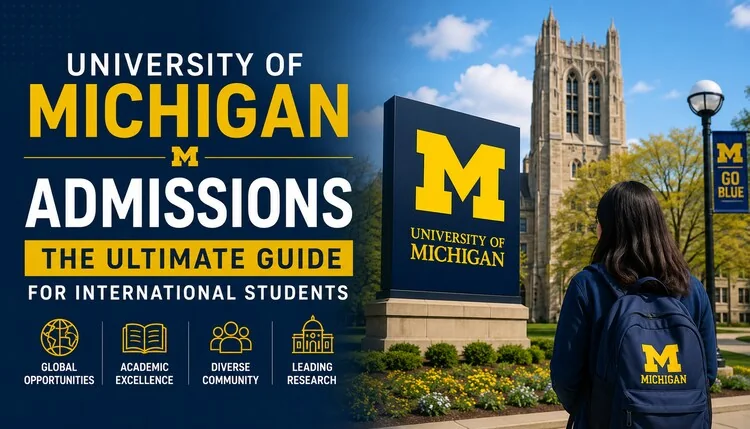
Are you dreaming of studying at one of America's highly competitive public research universities? The University of Michigan (also known as U-Michigan, UMich, or U-M) stands as a top destination for students from the UK, Australia, Canada, India, and around the globe. Founded in 1817, this world-renowned institution in Ann Arbor, Michigan, offers over 280 degree programs across 19 schools and colleges.
Often referred to as a "Public Ivy," U-Michigan provides an academic environment that rivals the most selective private institutions in the United States. For international students, entering UMich means gaining access to groundbreaking research facilities, top-tier faculty, and a vibrant multicultural student body. However, navigating the admissions landscape for the 2026-2027 academic cycle requires a deep understanding of recent policy overhauls, cost adjustments, and campus selection criteria. This comprehensive guide breaks down everything you need to know to build a winning application.
1. University of Michigan Rankings & Global Reputation
National and Global Institutional Rankings
The University of Michigan consistently ranks among the upper echelon of global universities. Its dual identity as a massive research hub and an elite undergraduate institution keeps it highly positioned across all major global indexes:
-
U.S. News & World Report (2026 National Universities): #20 (tie)
-
U.S. News & World Report (Top Public Schools): #3 Nationwide
-
QS World University Rankings 2026: #45 globally
-
Times Higher Education (THE) World Rankings: #23
-
Academic Ranking of World Universities (ARWU): #33
-
Forbes Top Colleges: #21
UMich proudly holds the prestigious "R1: Doctoral Universities – Very high research activity" classification from the Carnegie Classification of Institutions of Higher Education. This means the campus receives billions of dollars in research funding annually, directly impacting undergraduate lab opportunities.
Program-Specific Standouts
When ranking a university, looking at individual departments is just as critical as the institutional rank. U-Michigan excels with 101 graduate programs ranked in the top 10 by U.S. News & World Report:
-
Ross School of Business: #4 Nationally (US News 2026)
-
College of Engineering: #5 Nationally
-
Master's in Supply Chain Management: #1 Globally (QS)
-
Undergraduate Psychology: #5 Nationally
-
Undergraduate Economics: #14 Nationally
-
School of Nursing: #6 Nationally (Climbed 3 spots recently)
2. Top Programs and Most Popular Majors
With over 280 undergraduate and graduate degree programs spread across 19 schools, it can be overwhelming to choose. Here is a detailed look at the core academic pathways that international students target most.
The College of Engineering
Renowned for turning complex theoretical science into practical, real-world solutions, UMich Engineering is highly competitive. The most popular sub-disciplines include:
-
Computer Science: Heavily integrated with tech hubs across North America.
-
Aerospace Engineering: Deep ties with NASA and private aerospace giants.
-
Mechanical & Industrial Engineering: Leveraging Michigan's historic position as an industrial and automotive capital.
The Ross School of Business
The Stephen M. Ross School of Business utilizes action-based learning, meaning students manage real investment funds and consult for actual corporations before graduating.
-
Bachelor of Business Administration (BBA): A highly selective direct-admit program.
-
Supply Chain Management: Ranked #1 globally, blending data analytics with global logistics.
Medical, Life, and Social Sciences
-
School of Nursing & Public Health: Offering state-of-the-art simulation labs.
-
Psychology & Economics: Backed by massive statistical research divisions on campus like the Institute for Social Research (ISR).
3. Admissions Requirements & The 2026 Test-Required Shift
The Acceptance Rate Reality Check
The University of Michigan has become incredibly competitive over the last decade. While historical acceptance rates hovered around mid-20%, recent cycles have seen a massive surge in applications:
| Application Metrics | Data / Statistics |
| Total Annual Applications | 84,289+ |
| Total Admitted Students | ~14,914 |
| Overall Acceptance Rate | 17.69% (Solidly under 20%) |
The Standardized Testing Policy Change (Mandatory for 2026)
Critical Policy Alert: The temporary test-optional/test-flexible pathway implemented in previous years is no longer active. Starting with the 2026 application timelines, the University of Michigan has officially returned to a Test-Required policy. All international freshmen applicants must submit official SAT or ACT scores to be valid for review.
-
UMich SAT Code: 1839
-
UMich ACT Code: 2062
Complete Application Checklist for International Students
To apply, international students must submit their files through the Common Application portal. Ensure you prepare the following pieces:
-
Official High School Transcripts: Must include an official English translation if your school issues grades in another language.
-
School Report & Counselor Recommendation: Provided by your high school administration.
-
One Teacher Evaluation: Must be from a core academic subject teacher (Math, Science, English, or Social Sciences).
-
Standardized Test Scores: Official SAT or ACT results.
-
English Proficiency Proof: Mandatory if your native language is not English. UMich accepts TOEFL (minimum 100 recommended), IELTS (minimum 7.0 recommended), or the Michigan English Test (MET).
-
Explanation of Educational Gaps: A detailed summary if you took a gap year or had an interruption in your schooling.
Key Application Deadlines
Freshmen applications are primarily processed for the Fall intake cycle. Secondary terms have severe restrictions for major international programs.
-
Early Action (EA) Deadline: November 1 (Decision released in late January)
-
Regular Decision (RD) Deadline: February 1 (Decision released in early April)
4. Tuition Fees & Real Costs for International Students (2026)
Because the University of Michigan is a public state institution, it receives state tax money to discount tuition for local Michigan residents. International students do not qualify for this discount and are billed under the higher Non-Resident Tuition tier.
Estimated Cost of Attendance (Annual USD Projections)
| Expense Category | Annual Cost Range (USD) |
| International Tuition & Fees | $62,500 – $66,800 (Depending on program/school) |
| On-Campus Housing & Food | $15,800 |
| Books, Supplies & International Student Fee | $2,500 |
| Personal Miscellaneous Expenses | $2,200 |
| Total Annual Cost (All-In) | $83,000 – $87,300+ |
Currency Conversion Table for Global Planning
To help international families estimate their financial commitments, here is the total all-in cost converted into major currencies:
-
British Pound (GBP): £65,000 – £69,000
-
Australian Dollar (AUD): A$124,000 – A$131,000
-
Canadian Dollar (CAD): C$111,000 – C$117,000
-
Indian Rupee (INR): ₹69 Lakhs – ₹73 Lakhs per year
Financial Aid Guardrail: International students studying on temporary non-immigrant visas (F-1 or J-1) are not eligible for federal or state financial aid at U-Michigan. The university offers very few scholarships for international non-residents. You must demonstrate full financial self-sufficiency during your visa documentation phase.
5. Campus Life, Graduation Rates & The Alumni Network
The Ann Arbor Experience
Campus life at U-Michigan is famously energetic. Ann Arbor is consistently voted one of the best college towns in the United States, blending a vibrant cultural scene with unparalleled school spirit.
-
Student Scale: 53,488 total students (35,358 undergraduates and 18,130 postgraduates) working with a tight 15:1 student-to-faculty ratio.
-
Organizations: Over 1,400+ registered student organizations and 1,700+ student-run clubs.
-
The Big House: UMich is home to Michigan Stadium, the largest sports stadium in the United States and the entire Western Hemisphere, seating over 107,000 people.
Unmatched Student Success Metrics
UMich doesn't just enroll students; it graduates them. The university boasts some of the highest student retention and completion metrics globally:
-
Four-Year Graduation Rate: ~80%
-
Six-Year Graduation Rate: ~93%
-
Graduation Success Rate (GSR): 96% (An NCAA-monitored student-athlete framework record).
The Power of 695,000+ Alumni
When you graduate from U-Michigan, you enter one of the largest and most powerful alumni networks in the world, with over 695,000 living alumni worldwide.
Through the University Career Alumni Network (UCAN), international students get access to lifetime free career coaching, exclusive networking portals, and direct paths into global tech, finance, and healthcare industries.
6. Key Takeaways for the Class of 2026
-
Elite Standing: Ranked #20 nationally and #3 among all public schools in America.
-
Test-Required: SAT/ACT scores are no longer optional for 2026 applicants.
-
Highly Selective: Acceptance rates sit at a highly competitive 17.69%.
-
Financial Reality: Total costs for international students range between $83,000 – $87,300/year with zero access to domestic need-based financial aid.
-
Exceptional Outcomes: Backed by a 93% graduation rate and a global network of nearly 700,000 alumni.
7. Frequently Asked Questions (FAQs)
Q1: Can I apply to the University of Michigan test-optional in 2026?
No. U-Michigan has officially ended its test-optional policy for freshmen applicants. Submitting official SAT or ACT scores is a mandatory requirement for evaluation.
Q2: Why is the international tuition fee so much higher at UMich?
U-Michigan is a public state university funded partially by Michigan taxpayers. Because international students do not pay local state taxes, they are charged the full non-resident tuition rate, which covers the complete cost of instruction.
Q3: Is Montreal or Toronto cheaper than Ann Arbor for international students?
Yes, generally Canadian student hubs like Montreal offer lower average living expenses compared to premium US college towns like Ann Arbor, especially when factoring in currency exchange rates and mandatory US health insurance.
Q4: What is the minimum IELTS score required for UMich Engineering?
While the absolute minimum cutoff is 6.5, the university highly recommends an IELTS score of 7.0 or higher (or a TOEFL score of 100+) to be academically competitive in the international pool.

Saahil
Saahil is an education researcher and content creator specializing in university rankings, admissions strategies, and student guides. He is dedicated to helping students make informed academic decisions.
Continue your research
The Comprehensive International Student Guide to University of Chicago Admissions
Discover everything about the University of Chicago—admissions requirements, tuition fees, academic programs, campus life.
Read the guide →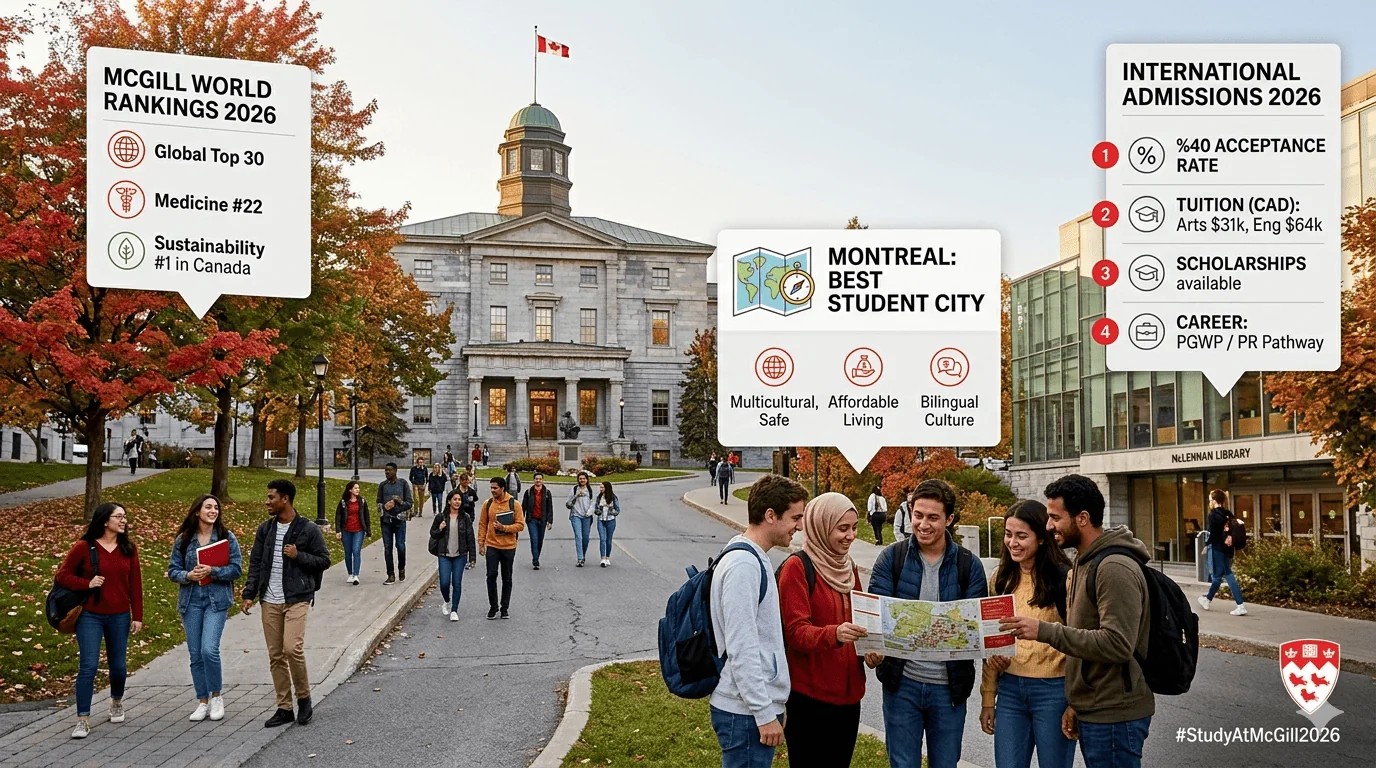
McGill University for International Students: The Comprehensive 2026 Admissions Guide
Founded in 1821, McGill University is not just a school; it is a global research powerhouse.
Read the guide →
University of British Columbia Admissions 2026: The Comprehensive Guide for International Students
The University of British Columbia (UBC) is consistently ranked among the top 3 universities in Canada and the top 40 globally.
Read the guide →
University of Queensland Admissions 2026: A Complete Guide for International Students
The University of Queensland (UQ) is more than just an educational institution; it is a global powerhouse of research and innovation.
Read the guide →