
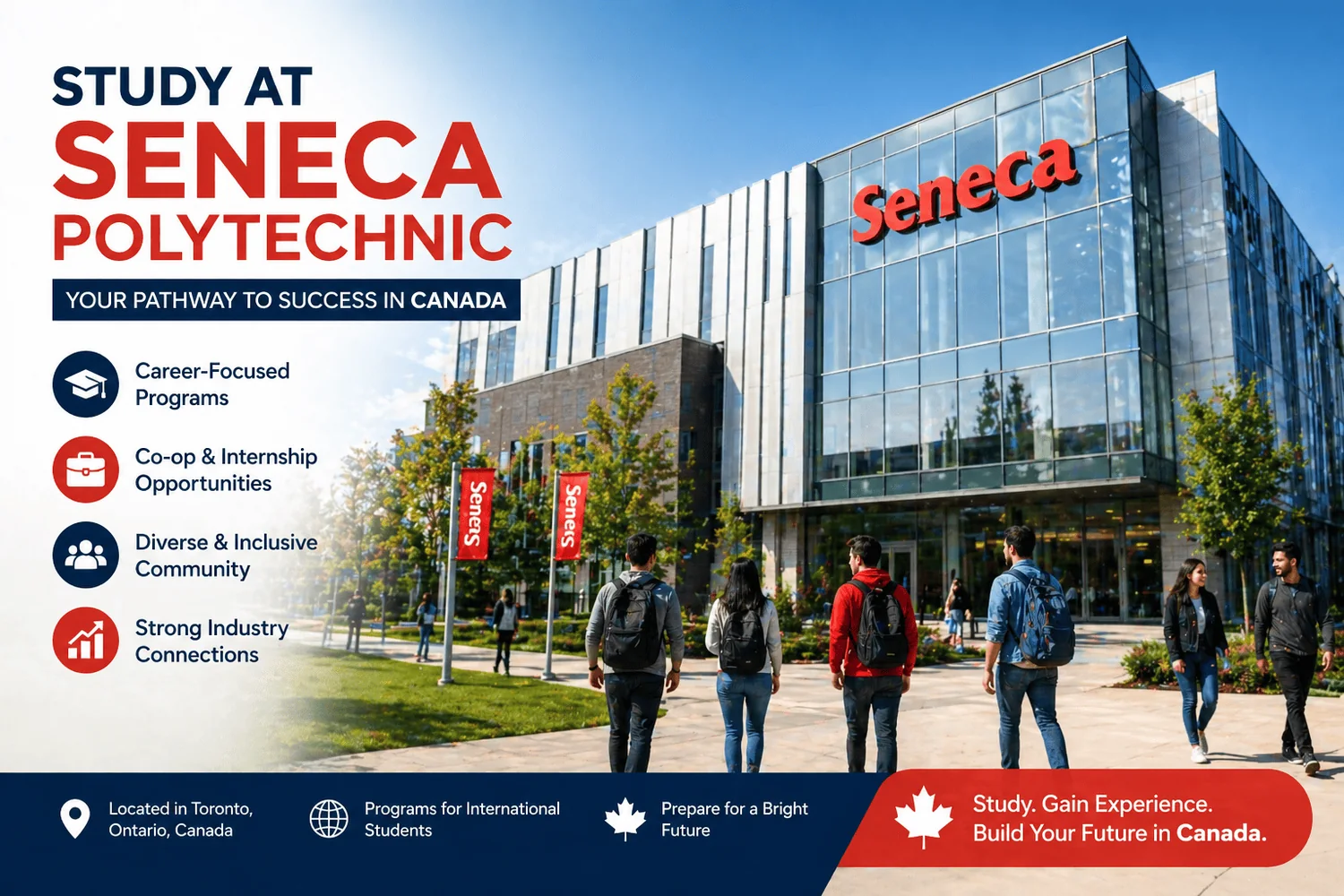
Seneca Polytechnic is Canada's polytechnic answer to a practical question: what if a college could teach like a trade school and credential like a university? It opened in 1967, is publicly funded by Ontario, and calls itself Ontario's first polytechnic. Seneca's own 2023–24 figures list 44,095 full-time students and 23,205 international students from more than 150 countries, across 300-plus programmes, from certificates to honours degrees and graduate certificates.
This guide covers the verified essentials: what Seneca is and where you would study, the programmes international students choose most, 2026/27 fees programme by programme, English minimums, the automatic entrance scholarship, how to apply, and the post-graduation work permit rules as they now stand. Three warnings: Seneca publishes no acceptance rate, so none is quoted here; it publishes no single tuition figure, so this guide gives verified per-programme examples, not an invented range; and the Markham campus is closed — it shut at the end of Fall 2024.
About Seneca Polytechnic
Seneca's name confuses applicants, so here is the short version. The legal name on all credentials is still Seneca College of Applied Arts and Technology. "Seneca Polytechnic" is a brand identity introduced in early 2023 under its strategic plan, The Next; it is not a legal rename. The polytechnic label signals status: as an Institute of Technology and Advanced Learning (ITAL), Seneca may offer more degrees than other Ontario colleges.
It was a co-founder of Polytechnics Canada, the first college in Ontario to offer a degree, and the first polytechnic or college to co-deliver a master's degree on its campus, with partner Niagara University. Its 2023–24 snapshot lists 13,193 graduates, 275,000 alumni worldwide, 4,576 employees and $11 million in financial aid, with employers reporting 88.9% satisfaction after hiring Seneca students for work-integrated learning. Its six academic areas are Applied Science & Engineering Technology, Arts, Communication, Art & Design, Community & Health, Seneca Business and Nursing.
Campuses: where you will actually study
Seneca's current campuses page lists four campuses plus online learning. The older version of this guide named Markham as a current campus; here is the corrected picture.
| Campus | Address | What to know |
|---|---|---|
| Newnham Campus | 1750 Finch Avenue East, Toronto | One of Canada's largest college campuses; the main campus for most programmes. |
| Seneca@York Campus | 70 The Pond Road, Toronto | On York University grounds, near Steeles Ave and Keele St; took Markham's programmes in Winter 2025. |
| King Campus | 13990 Dufferin Street, King City | 282 hectares, about 40 minutes north of Toronto; residence available. |
| Peterborough Campus | 925-580 Airport Road, Peterborough | Aircraft fleet and flight training devices; aviation years 2–4. |
| Online / Virtual Campus | — | Synchronous and asynchronous online learning. Online study can affect PGWP eligibility. |
Markham Campus is closed. Seneca's own words: "Due to recent decisions by the federal government related to international students, enrolment at Markham Campus declined… we temporarily closed the Markham Campus at the end of the Fall 2024 Term. We have moved programs to either Newnham Campus or Seneca@York Campus as of the Winter 2025 Term." Markham, opened in 2005 and home to the Seneca International Academy, still appears as a legacy heading on some listings but is not a current campus. Seneca International: 416.764.9900, seneca.international@senecapolytechnic.ca.
A Closer Look: Five Programme Areas Worth Knowing (2026)
Seneca publishes no official "in-demand programmes" ranking, so the five areas below are not a league table. Availability is programme- and intake-specific: Seneca's list (updated 20 October 2026) shows applications open for January, May and September 2027.
1. Business — Seneca Business, Toronto
Seneca Business, the largest grouping, has five schools: accounting and financial services, global business, hospitality and tourism, management and human resources, and marketing. International routes include the Business – International Business diploma and the Honours Bachelor of Commerce in Accounting & Finance.
2. Information Technology and Cybersecurity — Newnham, Toronto
Computing runs from the two-year Computer Programming diploma through the advanced diploma in Computer Programming & Analysis to the Honours Bachelor of Information Technology in Cybersecurity and the graduate certificate in Cybersecurity & Threat Management. Computer Programming & Analysis was Open for all three 2027 intakes at Newnham in November 2026 and meets PGWP eligibility (CIP 11.0201).
3. Aviation — Newnham, then Peterborough
The Honours Bachelor of Aviation Technology is Seneca's most expensive and most distinctive programme: a four-year honours degree including flight training, year 1 at Newnham and years 2–4 at Peterborough. Tuition is $27,130.33 a semester ($54,260.66 a year).
4. Health and Nursing — King and Newnham
Health sits across the Faculty of Community & Health and the Nanji Foundation School of Nursing, including the Honours Bachelor of Science in Nursing and the Practical Nursing diploma — both with higher English requirements (see below). The Occupational English Test is accepted at C+ minimum, but only for INSCOL nursing programmes.
5. Creative Arts and Animation — Faculty of Communication, Art & Design
Creative Arts & Animation offers Animation, 3D Animation and Game Art & Animation, alongside fashion and media. No Seneca-published ranking of its animation school exists, so none is claimed here. Non-academic requirements (portfolios, auditions) vary by programme — check its page.
Tuition and Fees: What a Year Actually Costs (2026/27)
There is no single international rate card: fees are set per programme and published on each programme's "Costs" tab, and Seneca states the costs shown "reflect the total first-semester fees for students starting in September with a full-time course load… All costs are approximate and subject to change." Three verified examples from the Costs pages, November 2026 (2026/27 fee year):
| Programme | Tuition / semester | Tuition / year | Total due, 1st semester* |
|---|---|---|---|
| Business – Supply Chain & Operations (Diploma, Newnham) | $7,891.50 | $15,783.00 | $9,372.02 |
| Honours Bachelor of Child Development (Degree, King / Newnham) | $9,597.00 | $19,194.00 | $11,077.52 |
| Honours Bachelor of Aviation Technology (Degree, Newnham / Peterborough) | $27,130.33 | $54,260.66 | $28,610.85† |
*First-semester totals include the $934.72 annual health insurance charge (billed once a year, in the first semester) and a one-time $58.71 Student Achievement fee, so semester 2 is lower. Books are extra ($535.00 semester 1 for Child Development; $2,150.00 for Aviation). †Aviation first-semester total is $28,417.71 at Peterborough.
Health insurance is mandatory and charged within tuition fees: Morcare becomes Alumo on 1 September 2026, coverage unchanged; Fall start $934.72 (1 September 2026 – 31 August 2027), Winter $703.73, Summer $464.12, taxes included. Seneca's worked study-permit example — a single applicant from Brazil, two-year Early Childhood Education diploma at Newnham, September 2026 — totals $44,652.32 for Year 1 and $44,156.32 for Year 2 (tuition $16,178 then $16,582; books $2,100; insurance $934.72; ancillary $1,091.60; living $23,448; travel $900). Living costs use the IRCC single-applicant figure ($23,448); permit $150, biometrics $85 ($170 family).
English-Language Requirements
Requirements are set by credential level; the table below follows Seneca's official one for international applicants, checked in November 2026. Tests are valid only if taken within the last two years, and meeting the minimum does not guarantee admission. Note the TOEFL column: Seneca gives per-skill floors on the 1–6 band scale (with /30 in brackets), not an overall iBT total.
| Test | Certificate | Diploma & Adv. Diploma | Degree | Master's & Grad. Certificate |
|---|---|---|---|---|
| IELTS Academic | 6.0, no skill below 5.5 | 6.0, no skill below 5.5 | 6.5, no skill below 6.0 | 6.5, no skill below 6.0 |
| TOEFL (incl. MyBest & Home Edition) | No skill below 4/6 (or 20/30) | No skill below 4/6 (or 20/30) | No skill below 4.5/6 (or 21/30) | No skill below 4.5/6 (or 22/30) |
| PTE Academic | 58 | 58 | 60 | 60 |
| Duolingo | 105–110 | 105–110 | 115–120 | 120–125 |
| CAEL CE / CAEL online | Min 60 | Min 60 | Min 70 (Writing ≥ 60) | Min 70 (Writing ≥ 60) |
| Cambridge English (B2 First / C1 Advanced / C2 Proficiency) | Min 169, no skill below 162 | Min 169, no skill below 162 | Min 176, no skill below 169 | Min 176, no skill below 169 |
Nursing uses the degree row: Practical Nursing and the BSN both need IELTS 6.5, no skill below 6.0 (PTE 60; Duolingo 115–120 for Practical Nursing, 120–125 for the BSN; CAEL 70, Writing ≥ 60; Cambridge 176). Test-free routes: two years of full-time study in an English-primary country, one year of postsecondary study there, or Seneca's English Language Institute (ELI) — about $3,700 per seven-week level including health insurance; Level 8 completion admits you without a test score.
Scholarships and Financial Aid
The old version of this guide called Seneca's scholarships merit-based and highly competitive. That was wrong: the main international entrance scholarship is automatic — no separate application, and the amount is set by programme length, not grades.
For September 2027 starts the successor offer is a flat $2,000 International Entrance Award, also automatic: confirm your offer between 3 November 2026 and 1 July 2027, apply for your study permit by 15 July 2027, and have your SIN/ITN in Student Home by 31 October 2027. ELI students earn $500 per seven-week level ($500–$2,000, up to four levels). A renewable degree scholarship pays up to $1,000 a year on academic performance.
How to Apply: The International Route, Step by Step
The most common mistake is applying through the wrong system. International applicants do not apply through OCAS or ontariocolleges.ca — that is the domestic route only ($150 fee; 1 February equal-consideration date). International applicants use Seneca's own International Student Web Application. Three intakes a year — Fall, Winter and Summer — but each programme sets its own; applications for January, May and September 2027 are open now. There is no general international deadline: admission is rolling while seats remain. Apply six to eight months ahead if you can — our advice, not a Seneca rule, as study-permit processing takes months.
Applying, step by step
- Open the International Student Web Application, create an account and complete your personal information.
- Review programmes by semester, select your English proficiency, then choose your start date, programme choices (maximum three) and campus.
- Provide your academic history and upload all required documents; credentials from outside Canada need a course-by-course assessment (WES or ICAS) where required.
- Complete the Information Release form if Seneca may contact trusted people, then review and print the "Review Application" page.
- Pay the $90 fee by credit card; Seneca credits it back to your Student Home account after acceptance and payment of first-semester fees.
- Watch for your Student Home login email; updates appear in Student Home. Then pay first-semester fees by your offer deadline to confirm your seat and receive your Letter of Acceptance (LOA) and Provincial Attestation Letter (PAL); PALs are limited and not guaranteed to all applicants.
Academic requirements are per programme. Certificates, diplomas and advanced diplomas need an OSSD or equivalent, or mature status, plus prerequisites. Degrees need an OSSD or equivalent with six Grade 12 U/M courses and a 65% minimum average; graduate certificates need a completed degree or diploma, or equivalent. Note: Seneca's international Academic Requirements page returned a 404 in November 2026, so no country-specific grade cut-offs are printed here.
Co-op, Work Placements and Career Outcomes
Employability is built into the curriculum, not left to chance. Work-integrated learning runs in 80-plus programmes, mandatory or optional by programme; co-op and work terms are typically a full-time paid position of about one semester, with a mandatory co-op minimum of 420 hours, and all degree programmes include a mandatory WIL experience. A $495 non-refundable WIL participation fee applies in WIL programmes. The hub is Seneca Works: resumé critiques, interview preparation, employer interviews, career fairs, and a job bank of 16,000-plus companies posting 7,000-plus jobs a year. It supports the co-op search, but the search is student-driven and a placement is not guaranteed.
Post-Graduation Work Permit (PGWP): Read the Fine Print
Seneca is a public, government-funded Designated Learning Institution (DLI) — the starting point for post-graduation work eligibility, but only that. The old guide said graduates "generally qualify for the PGWP… up to three years". That blanket phrasing is no longer safe: PGWP eligibility is now programme-specific. Each programme page states whether it meets PGWP eligibility, with its CIP code; verify eligibility against your study-permit application date. Length follows IRCC rules and the programme's field-of-study status. Students must maintain full-time status, and studying online or flexible delivery can affect eligibility.
Housing and Student Life
Seneca offers residences at the Newnham and King campuses — apartment-style — which also serve Seneca@York students. Applications are first-come, first-served: open in March for Summer (May–August) and the Academic Year (September–April), and in October for Winter; you may apply before being accepted. Off-campus, Newnham and Seneca@York sit inside Toronto, where the IRCC living figure Seneca cites ($23,448 a year for a single applicant) is the planning anchor. King, 40 minutes north of the city, has its own residence.
Seneca in Your Canadian Shortlist
Most applicants weighing Seneca are also weighing other Ontario colleges and the universities. Our Douglas College guide covers a smaller British Columbia college with a similar applied, transfer-friendly model. Our University of Waterloo guide shows the other end: a research university built around co-op, where first-year international tuition runs $51,000 to $75,000 a year — three to five times a standard Seneca diploma. Seneca sits between: university-level degrees at college-level fees, with placements built in.
Frequently Asked Questions
Is Seneca a college or a university?
Seneca is a publicly funded Ontario college of applied arts and technology — a polytechnic. Its legal name is still Seneca College of Applied Arts and Technology, and as an Institute of Technology and Advanced Learning (ITAL) it can grant full four-year honours bachelor's degrees alongside diplomas and certificates.
How much is tuition for international students at Seneca?
Seneca publishes no single institution-wide tuition figure — fees are set per programme and shown on each programme's Costs tab. Verified 2026/27 examples: a standard two-year diploma such as Business – Supply Chain & Operations is $15,783 a year; an honours bachelor's degree such as Child Development is $19,194 a year; and the Honours Bachelor of Aviation Technology, including flight training, is $54,260.66 a year.
Do international students apply to Seneca through OCAS?
No. International applicants apply through Seneca's own International Student Web Application, not through OCAS, the domestic route. The international application fee is $90, credited back to your student account after you are accepted and have paid your first-semester fees, and you may list up to three programme choices.
Does Seneca offer scholarships for international students?
Yes — and the main one is automatic, not competitive. New international students starting a full-time postsecondary programme in September 2026, January 2027 or May 2027 receive an entrance scholarship by programme length: $2,000 for one year, $3,000 for two, $4,000 for three and $5,000 for four, with no separate application. For September 2027 starts, the successor offer is a flat $2,000 award.
Can I transfer my Seneca diploma to a university later?
Seneca publishes more than 4,000 pathway options with over 50 partner institutions in Canada and worldwide — but every pathway is a programme-specific agreement. There is no blanket guarantee of direct entry into the third year of a bachelor's degree at a named university; the credit you receive and the year you enter depend on the specific agreement and programme.
Sources, Updates and Corrections
Every figure comes from Seneca Polytechnic's own published pages, checked on 14 November 2026: international students; campuses; Markham Campus closure; programme availability; Supply Chain & Operations costs; Child Development costs; Aviation Technology costs; how to apply (international); English requirements; International Entrance Award; ELI tuition credit; health insurance rates; pathways; and Seneca at a Glance 2023–24. The Waterloo figures in the shortlist come from our University of Waterloo guide, verified from uwaterloo.ca. Seneca publishes no acceptance rate and no single tuition figure; neither is quoted here. The Cybersecurity & Threat Management international fee is not printed because its Costs tab did not render the international table in full. Corrections: topschoolsrankings@gmail.com.
Saahil
Saahil is an education researcher and content creator specializing in university rankings, admissions strategies, and student guides. He is dedicated to helping students make informed academic decisions.
Continue your research
Douglas College Canada: Admissions, Fees, Courses & University Transfer Guide for International Students
For international students looking for an affordable and career-focused education in Canada, Douglas College is one of the most popular choices in British…
Read the guide →
Algoma University for International Students: Admissions, Fees, Courses & Visa Guide
Choosing the right university in Canada is a crucial decision for international students.
Read the guide →
Appleby College Canada: Boarding School, Admissions, Fees & Student Life Guide for International Students
Appleby College is an independent boarding school in Canada.
Read the guide →
Harvard University Admissions 2026: Rates, Deadlines, Costs & International Student Guide
Harvard University admissions: official admit data, deadlines, SAT/ACT rules, costs, international tips, tables, and FAQs for parents and students.
Read the guide →