
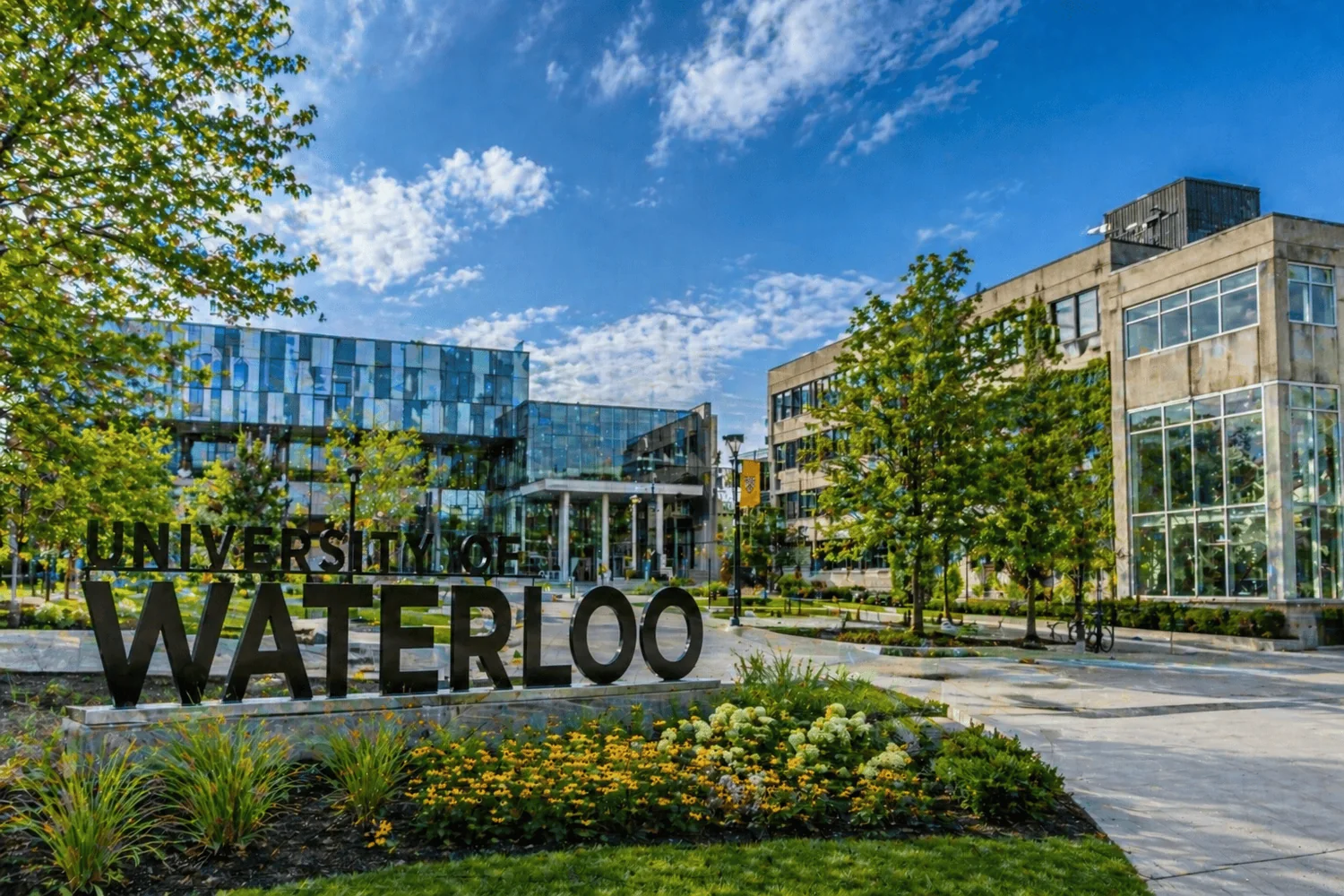
The University of Waterloo is Canada's co-op university. It opened in 1957 with 74 students, with engineering and co-operative education as its founding cornerstones, and it has built everything since around that pairing: more than 41,000 students across six faculties, 26,000-plus of them in what Waterloo itself calls the world's largest co-operative education programme. International students are 15 per cent of its undergraduates and 41 per cent of its graduate students. For applicants, the appeal is precise rather than vague — a degree that alternates study with up to six paid work terms, in the programmes (Computer Science, Engineering, Mathematics) where competition is fiercest and published admission averages run into the 90s. This guide covers the verified essentials: 2026-27 international tuition programme by programme, the Fall 2027 deadlines, the Admission Information Form that Waterloo weighs alongside grades, English-language minimums, entrance scholarships, and what residence and living costs actually look like. Every figure comes from the University of Waterloo's own published pages, listed at the end. For quick facts, see Waterloo's institution profile.
One warning before the detail, because it shapes how you should read everything else about this university online: Waterloo publishes no acceptance rate, and it explicitly says there is no absolute grade cut-off for its most competitive programmes. Admission is by individual selection — grades, the Admission Information Form, and for Engineering an online interview. Any website quoting you a Waterloo acceptance percentage has invented it. What the university does publish — its admission-average texture, programme by programme — is in the admissions section below, and it tells you more than a fake rate ever could.
About the University of Waterloo
Waterloo's six faculties — Arts, Engineering, Environment, Health, Mathematics and Science — sit on a 1,000-acre main campus in Waterloo, Ontario, with three satellite locations: Health Sciences and Pharmacy in Kitchener (6 km away), Architecture in Cambridge (30 km) and the Stratford School in Stratford (45 km). The structure matters to applicants for two reasons. First, you apply to a specific programme in a specific faculty, and the tuition, deadlines and competitiveness differ sharply between them — Computer Science and Engineering are effectively different admissions contests from Arts or Environment. Second, the faculty system is where co-op lives: more than 120 accredited co-op programmes run across the university, and 77 per cent of all Waterloo students take part. Waterloo is not a generalist university with a co-op option bolted on; the work-integrated model is the institution.
The co-op programme: how it actually works
Waterloo's own description of its programme is unambiguous — "the world's largest co-operative education program", with more than 26,000 active co-op students, 8,000-plus employers in over 70 countries, and a 96 per cent employment rate for co-op graduates within six months of finishing. The mechanics: students alternate study terms with four to six paid work terms of about four months each, graduating with up to two years of work experience. Most students start co-op in second year, though some Engineering and Mathematics sequences begin in first year. Waterloo publishes typical co-op earnings of $9,600–$22,800 per work term in Canada (with totals reaching up to $137,000 across a degree for some students) — money that materially changes the affordability maths in the fees section below. Two cost details students often miss: a co-op fee of $836 is charged per school term, and no tuition is charged during work terms.
The honest trade-off sits in that last line: a co-op degree takes longer. You are trading roughly an extra year for paid experience, an employer's-eye view of your field before you graduate, and a hiring pipeline — Waterloo reports 96 per cent of co-op graduates employed within six months. Students who want the fastest possible route to a degree, or who already have a research/graduate-school plan that does not need industry terms, should weigh the regular streams that some programmes also offer.
Tuition fees and the real cost of a year
Waterloo publishes first-year international fees programme by programme — tuition plus incidental fees for two terms, September 2026 entry. Incidental fees are not padding: they include the student health and dental plans, a transit pass and recreation access. Books and supplies are extra — budget about $1,500 a year, except Architecture, where Waterloo puts them at $8,100.
| Programme / faculty | First-year fees (CAD) |
|---|---|
| Environment | $51,000 |
| Health | $54,000 |
| Science | $54,000 |
| Global Business and Digital Arts | $56,000 |
| Arts | $58,000 |
| Accounting and Financial Management / Sustainability and Financial Management | $58,000 |
| Mathematics | $62,000 |
| Mathematics / Financial Analysis and Risk Management | $63,000 |
| Computing and Financial Management | $64,000 |
| Computer Science | $73,000 |
| Engineering / Software Engineering | $75,000 |
| Architecture | $75,000 |
On top of tuition, Waterloo's own estimate of living costs is $19,000–$24,000 for two terms. Its residence prices sit inside that range: for 2026-27, eight months in a traditional residence including the mandatory meal plan runs roughly $15,130–$19,290, while suite-style accommodation without a meal plan starts from about $8,000. So a realistic first-year budget is roughly $70,000–$99,000 all-in depending on programme and housing choice — before any co-op earnings, which from second year onward can claw back a meaningful share. The application itself also has a cost: Waterloo lists the OUAC fees as $156 for the first three programme choices, $50 for each additional choice, plus a $10 international service fee.
Admissions: deadlines, the AIF and published averages
International students apply through the OUAC (Ontario Universities' Application Centre), and Waterloo lets you list at most three Waterloo programmes — only one of which may be Engineering. Entry is September only. The Fall 2027 deadlines reward early filers: for Engineering, apply by 15 January 2027 with documents by 1 February 2027; for most other programmes, apply by 1 February 2027 with documents by 15 February 2027. International applicants work to the same deadlines as domestic ones — there is no separate later round.
The piece of the application that surprises most international students is the Admission Information Form (AIF): a supplementary form, submitted once through the applicant portal, in which you share your interests, experiences and abilities beyond grades. For selective programmes it is not decoration. Computer Science states that the AIF is required and that admission is by individual selection "from the low to mid-90s" — meaning a 93 with a strong AIF and a 93 with an empty one are different files. Engineering goes further: selection combines grades, the mandatory AIF and an online interview, with — in Waterloo's own words — no guaranteed average and "no absolute grade cut-off for each engineering program". Its published texture of competitive averages runs from the mid-to-high 80s for programmes such as Civil and Chemical Engineering up to the low-to-mid 90s for Electrical and for Software Engineering, which has only 130 seats. That scarcity, not a secret acceptance rate, is what "competitive" means here.
Applying, step by step
- Choose up to three Waterloo programmes on the OUAC (one Engineering maximum) and note which deadline column each falls into.
- Submit the OUAC application by 15 January 2027 (Engineering) or 1 February 2027 (most programmes).
- Complete the Admission Information Form thoughtfully — for Computer Science and Engineering it is a scored part of your file, and it also feeds some scholarship decisions.
- Engineering applicants: complete the online interview by the 1 February document deadline.
- Send documents and English-language scores by your deadline — and check the score-recency rule below before booking a test.
English-language requirements
Waterloo's published minimums: IELTS 6.5 overall, with 6.5 in writing and speaking and 6.0 in reading and listening (an overall 7.0 with no band below 6.0 is also accepted); TOEFL iBT 90 overall with 25 in writing and speaking (for tests taken before 21 January 2026); PTE Academic 63; Duolingo English Test 120. One administrative trap: Waterloo only accepts scores from tests taken on or after 1 May 2025 for this cycle — an older score, however strong, will not count.
Scholarships for international students
Waterloo's entrance funding for international students is real but modest next to its fees, and most of it is automatic — no separate application. The headline award is the International Student Entrance Scholarship: $10,000, paid as $5,000 per term across the first year and stackable with other awards. The university's general entrance scholarships are grade-banded and also automatic: the President's Scholarship of Distinction (admission average 95%+) pays $2,000 plus eligibility for a $1,500 International Experience Award and/or a $1,500 Research Award; the President's Scholarship (90–94.9%) pays $2,000; the Merit Scholarship (85–89.9%) pays $1,000. Programme-level awards exist too — Computing and Financial Management's entrance scholarship is $3,000 or $4,000, for example. Read those numbers honestly: against $73,000–$75,000 of Computer Science or Engineering tuition, even a stacked $14,000–$15,000 of entrance awards trims the bill rather than transforming it. The serious money at Waterloo is earned, not awarded — it is the co-op pay in the programme section above.
Housing and student life
Waterloo guarantees residence for first-year and transfer students — a genuine planning comfort for international families — with housing for nearly 7,000 students on campus. The process is deadline-driven: you reserve your place after accepting your offer, and the reservation deadline for this cycle is 8 June 2027. The two housing shapes price very differently (see the fees section): traditional residences bundle a mandatory meal plan; suite-style residences do not, leaving cooking to you. Beyond housing, campus life runs through the six faculties and their societies as much as through central clubs — at a university where three quarters of students disappear on work terms every few months, faculty communities and co-op cohorts are the social glue, and the friend group you make in first year is partly a function of your programme's study/work sequence.
Waterloo in your Canadian shortlist
Most international students weighing Waterloo are also weighing McGill and the University of Toronto, and the three publish genuinely different offers. On price, Waterloo Arts ($58,000, incidentals included) sits between McGill's BA ($54,000, with the rate locked for the degree under McGill's Guaranteed Tuition Model) and Toronto's Arts & Science ($66,110) — all 2026-27 figures from the universities themselves. On structure, Waterloo is the only one of the three built around paid work terms; on admissions, all three select individually in the 90s for their flagship programmes and none publishes an acceptance rate. Our McGill vs University of Toronto comparison works through the other two in the same verified detail, and our McGill guide and Toronto guide cover their applications end to end.
Who should choose Waterloo?
Ideal for: students targeting Computer Science, Engineering or Mathematics who want paid industry experience built into the degree; career-first applicants who value an employment pipeline (96 per cent of co-op graduates employed within six months, on Waterloo's figures) over a famous-name campus; and high achievers in the low-to-mid 90s prepared to write a serious Admission Information Form. Not ideal for: low-budget students (even the cheapest programme is $51,000 a year before living costs, and scholarships trim rather than solve that); students who want a four-year finish (co-op sequences run to about five); or applicants hoping a big-city campus — Waterloo is a mid-sized Ontario city, with Toronto a separate trip rather than a subway ride.
Frequently Asked Questions
Is University of Waterloo good for international students?
By the measures Waterloo itself publishes, yes — with a career-first flavour. International students are 15 per cent of undergraduates (and 41 per cent of graduate students), residence is guaranteed for first-years, the flagship International Student Entrance Scholarship pays $10,000 automatically, and the co-op system gives international students the same paid work-term route as domestic ones. The caveat is cost: $51,000–$75,000 a year in tuition alone makes Waterloo one of Canada's more expensive choices.
What is Waterloo known for?
Co-operative education first — Waterloo describes its own programme as the world's largest, with 26,000-plus students and 8,000-plus employers — and the programmes that feed it: Computer Science, Software Engineering and the wider Mathematics and Engineering faculties. It opened in 1957 with engineering and co-op as founding cornerstones, and that pairing still defines it.
What is the acceptance rate of Waterloo?
Waterloo does not publish one, and it states there is no absolute grade cut-off for its competitive programmes — so any percentage you see quoted elsewhere is an estimate with no official source. The useful published texture: Computer Science selects individually from the low to mid-90s with a required Admission Information Form; Engineering's competitive averages run from the mid-to-high 80s (e.g. Civil, Chemical) to the low-to-mid 90s (Electrical, Software Engineering), selected on grades plus the AIF and an online interview.
Is Waterloo expensive?
Yes by Canadian standards. First-year international tuition plus incidental fees for September 2026 runs from $51,000 (Environment) to $75,000 (Engineering, Architecture), and Waterloo estimates living costs at $19,000–$24,000 for two terms — roughly $70,000–$99,000 all-in for a first year. The offset is co-op: from second year, paid work terms (typically $9,600–$22,800 per term in Canada) return real money, and no tuition is charged during work terms.
Where is University of Waterloo located?
In Waterloo, Ontario. The 1,000-acre main campus is in the city of Waterloo; the university also runs satellite campuses for Health Sciences and Pharmacy in Kitchener (6 km), Architecture in Cambridge (30 km) and the Stratford School in Stratford (45 km). Toronto is a separate intercity trip — Waterloo's own tech ecosystem, not the GTA, is the local jobs market for co-op terms.
Does Waterloo offer co-op programs?
It is the centre of the university: more than 120 accredited co-op programmes, 26,000-plus active co-op students, 8,000-plus employers in 70-plus countries, and 77 per cent of all Waterloo students participating. Students complete four to six paid work terms of about four months each and can graduate with up to two years of work experience.
Is the University of Waterloo co-op mandatory?
It is fixed by the programme you apply to rather than chosen later: programmes are offered in co-op and, in some faculties, regular streams, and your application is to a specific stream. For Waterloo's flagship routes — Engineering and Computer Science among them — co-op is the standard structure (Engineering selection includes the mandatory AIF and an online interview), and with 77 per cent of students in co-op, the university's calendar, housing and employer cycles all assume it.
How competitive is Waterloo Engineering for international students?
Very — and Waterloo publishes the shape of it rather than a rate. There is no guaranteed average and no absolute cut-off; selection combines grades, the mandatory Admission Information Form and an online interview. Published competitive averages run from the mid-to-high 80s for Civil and Chemical up to the low-to-mid 90s for Electrical and for Software Engineering, which offers only 130 seats. International applicants face the same deadlines (apply by 15 January 2027) and the same process as domestic applicants.
Does Waterloo offer significant scholarships for international students?
It offers meaningful entrance awards but not full funding. The International Student Entrance Scholarship pays $10,000 (automatic, $5,000 per term in first year, stackable), and the automatic grade-banded awards add $1,000–$2,000 (President's Scholarship of Distinction at 95%+ also unlocks $1,500 experience/research awards). Against $51,000–$75,000 tuition these trim the first year rather than fund the degree — the larger financial lever at Waterloo is co-op earnings.
Sources, Updates and Corrections
Every figure in this guide comes from the University of Waterloo's own published pages, checked on 13 November 2026: University of Waterloo — quick facts; tuition fees; how to apply; application deadlines; the Admission Information Form; Engineering admission requirements; English language requirements; co-operative education at Waterloo; and what university costs. The McGill and University of Toronto figures in the shortlist section come from those universities' official pages and are fully sourced in our McGill vs University of Toronto comparison. Waterloo publishes no acceptance rate; none is quoted here. If you spot an error, email topschoolsrankings@gmail.com and we will correct it.

Saahil
Saahil is an education researcher and content creator specializing in university rankings, admissions strategies, and student guides. He is dedicated to helping students make informed academic decisions.
Continue your research
University of Alberta: Admissions, Fees, Ranking & Programs for International Students
If you're planning to study in Canada, the University of Alberta is one of the most respected universities to consider.
Read the guide →
Queen’s University Canada: Admissions, Fees, Ranking, Programs & Student Life
If you're planning to study in Canada at a prestigious and well-established institution, Queen’s University is a top choice.
Read the guide →
McGill vs University of Toronto: Canada University Comparison (2026)
International tuition ($54,000 vs $66,110 for arts), McGill’s locked tuition model, January deadlines, grade requirements and Montreal vs Toronto — compared on official figures.
Read the guide →
McGill University for International Students: The Comprehensive 2026 Admissions Guide
Founded in 1821, McGill University is not just a school; it is a global research powerhouse.
Read the guide →