
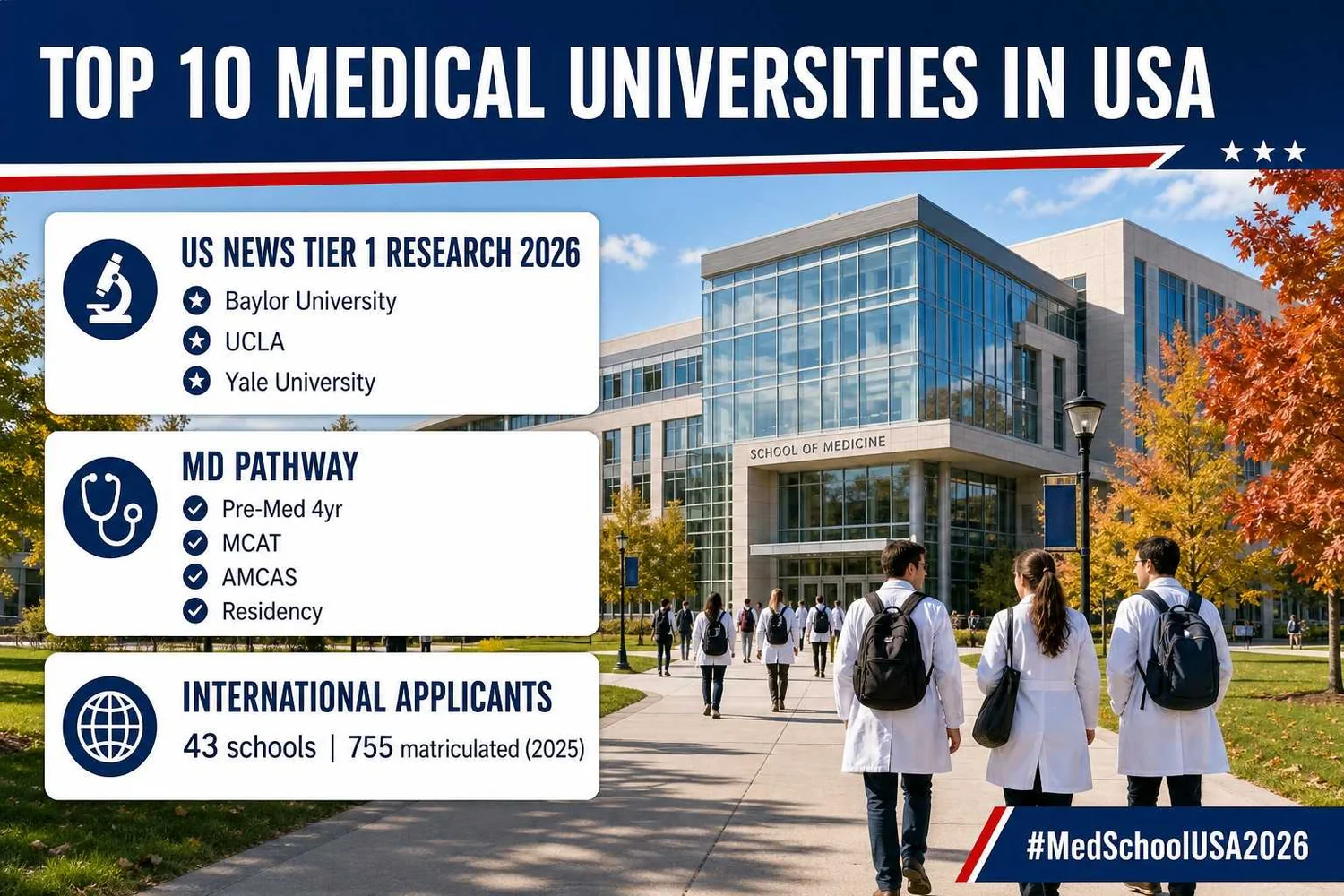
Overview: The top medical universities in the USA train future doctors through separate, highly competitive MD programs after undergraduate study. For 2025–2026, U.S. News & World Report no longer ranks medical schools #1–#10; it places schools into tiers (Tier 1 = highest research group, listed alphabetically). This guide lists ten Tier 1 research medical schools, explains the U.S. MD pathway, costs, international applicant rules, and how to compare programs using official sources.
Parents and students searching for the top 10 medical universities in USA often expect a simple numbered list like undergraduate college rankings. Medical school evaluation works differently: most applicants complete a U.S. bachelor’s degree first, take the MCAT, then apply through AMCAS to four-year Doctor of Medicine (MD) programs.
Below you will find ten medical schools in the U.S. News Tier 1 research group (2025–2026 cycle), plus essential context on admissions, money, and international eligibility—all tied to verifiable public data.
Important: how U.S. News ranks medical schools now (2025–2026)
Since 2025, U.S. News groups medical schools into four tiers for research and primary care instead of publishing a strict 1–10 ranking. Schools in Tier 1 research are described as the highest-performing group; within the tier they are listed alphabetically, not as #1 versus #10.
That means a blog title “top 10” reflects ten leading Tier 1 research institutions families should research—not an official claim that one school is definitively “#4” versus “#7” for 2026.
Source: U.S. News Best Medical Schools and 2025–2026 tier announcements reported by outlets such as Becker's Hospital Review.
Top 10 medical universities in USA: U.S. News Tier 1 research (2025–2026)
These ten schools are drawn from the U.S. News Tier 1 research medical school group for 2025–2026. Order is alphabetical (U.S. News method), not a new numbered ranking.
| # | Medical school (university) | Location | Why students research it |
|---|---|---|---|
| 1 | Baylor College of Medicine | Houston, TX | Major Texas medical center; strong research and clinical volume |
| 2 | Emory University School of Medicine | Atlanta, GA | Emory Healthcare network; research and public health links |
| 3 | Mayo Clinic Alix School of Medicine | Rochester, MN | Closely integrated with Mayo Clinic practice model |
| 4 | Ohio State University College of Medicine | Columbus, OH | Large academic medical center; broad specialty training |
| 5 | UCLA David Geffen School of Medicine | Los Angeles, CA | UC system flagship; Los Angeles clinical diversity |
| 6 | UC San Diego School of Medicine | San Diego, CA | Research-intensive UC campus; biomedical hub |
| 7 | UC San Francisco School of Medicine | San Francisco, CA | Health-sciences-focused; strong research reputation |
| 8 | University of Pittsburgh School of Medicine | Pittsburgh, PA | UPMC-affiliated training; research strength |
| 9 | University of Texas Southwestern Medical Center | Dallas, TX | Major Southwest academic medical center |
| 10 | Yale School of Medicine | New Haven, CT | Ivy research university; Yale New Haven Health system |
Also in Tier 1 research (2025–2026) but not in the table above: Case Western Reserve University, University of Colorado, University of Florida, University of Rochester, University of South Florida (Morsani), Vanderbilt University, and (in 2025) Hofstra/Northwell Zucker School of Medicine, UNC Chapel Hill, and others per U.S. News. Check the current tier list before you apply—membership changes year to year.
Harvard, Johns Hopkins, Stanford: why they are not in this Top 10 table
Many families still search for Harvard Medical School, Johns Hopkins, Stanford Medicine, Columbia, Duke, Penn (Perelman), and Northwestern. These remain among the most selective and well-known MD pathways in the world.
Under the 2025 U.S. News tier methodology, several historically famous names were not placed in Tier 1 research (for example, Northwestern Feinberg and others were reported as moving out of Tier 1 in 2025). That does not mean those schools are “weak”—it reflects U.S. News indicator weighting (NIH activity, faculty ratios, selectivity data, and participation).
When you build a school list, use MSAR, each school’s admissions site, and your stats—not only a single “top 10” article.
How medical study works in the USA
| Stage | Typical length | What happens |
|---|---|---|
| Undergraduate degree | ~4 years | Pre-med coursework (biology, chemistry, physics, math, English) at a college or university |
| MCAT | Prep + exam | Required by most U.S. MD programs; English-language exam |
| MD program | 4 years | Apply via AMCAS; clinical rotations; USMLE Step exams |
| Residency | ~3–7+ years | Specialty training; competitive match process |
| Licensure | After training | State medical license to practice |
Total timeline: Often about 11–15+ years after high school, depending on specialty.
Top medical universities in USA: admissions facts (verified)
- Separate applications: Getting into a university’s undergraduate college does not guarantee MD admission later.
- Holistic review: GPA, MCAT, clinical experience, research, letters, and personal narrative all matter.
- Supplemental apps: Many schools require secondary essays and extra forms after AMCAS.
- Selectivity: MD acceptance rates are very low at well-known programs; use MSAR for school-specific ranges.
Official applicant hub: AAMC Applying to Medical School.
International students: verified rules (AAMC, 2025 cycle)
International applicants can apply to some U.S. MD programs, but options are limited and competition is intense.
| Fact (AAMC / MSAR) | Detail |
|---|---|
| Schools accepting international applicants | 43 schools indicated on MSAR they accept international applicants (2025) |
| 2025 application cycle | 3,404 foreign applicants applied to MD programs; 845 accepted; 755 matriculated (includes TMDSAS) |
| Transcripts | AMCAS does not verify foreign coursework unless accepted by an accredited U.S., U.S. territorial, or Canadian institution |
| Federal student aid | Most international students are not eligible for U.S. federal loans; private or school funds often required |
| Some schools | May require proof of full tuition funds or escrow—check each school |
Source: AAMC — International Applicants.
Medical school costs in the USA (2024–2025 averages)
Costs vary by public vs private and residency status. These figures are tuition, fees, and health insurance only—not housing, food, or supplies.
| Category | Average annual cost (2024–25) |
|---|---|
| All schools (combined average) | ~$59,720 per year |
| Public — in-state resident | ~$41,869 |
| Public — nonresident | ~$66,355 |
| Private — resident | ~$67,145 |
| Private — nonresident | ~$68,767 |
| Typical four-year MD tuition stack | Often $230,000+ before living expenses (EducationData.org analysis of 2024–25 data) |
Some schools offer large scholarships (for example, NYU Grossman and others have had tuition-free initiatives for eligible students—verify current policy on each site). Always read the official cost of attendance for every school you target.
Sources: EducationData.org; AAMC tuition surveys cited in industry summaries.
Undergraduate planning (if you are not applying to MD yet)
Strong pre-med undergraduates often target rigorous universities with advising and research access. For broader USA university context, see our MIT overview and Cornell guide for science-heavy pathways—not because those schools grant MD degrees directly, but because early academic planning matters.
How to choose among top medical universities in USA
- Confirm international policy on MSAR if you are not a U.S. citizen or permanent resident.
- Match MCAT/GPA to school ranges; apply broadly.
- Compare total cost of attendance and scholarship rules.
- Consider location for clinical diversity and residency networking.
- Use U.S. News tiers as one data point—not the only measure.
Frequently asked questions: top medical universities in USA
What are the top 10 medical universities in USA for 2026?
U.S. News no longer publishes a simple 1–10 list. For 2025–2026, ten Tier 1 research medical schools include Baylor, Emory, Mayo Clinic Alix, Ohio State, UCLA Geffen, UC San Diego, UCSF, Pittsburgh, UT Southwestern, and Yale—listed alphabetically within Tier 1, not ranked #1 through #10.
Is Harvard Medical School in the U.S. News Tier 1 research list?
For the 2025 tier release reported widely in 2025, Harvard was not listed among Tier 1 research schools under that methodology. Harvard Medical School remains highly selective. Always check the current U.S. News tier page for the latest year.
Can international students study medicine in the USA?
Yes at some schools. In 2025, 43 MD programs indicated they accept international applicants on MSAR. Only 755 international applicants matriculated in the 2025 cycle nationwide—competition is very high.
Is the MCAT required for top medical universities in USA?
Most U.S. MD-granting programs require the MCAT. The exam is administered in English; international testing locations are listed on the official MCAT site.
How much does medical school cost in the USA?
For 2024–25, average tuition, fees, and insurance were about $59,720 per year across public and private schools. Nonresident and private costs often reach the high $60,000s per year before living expenses.
Can I become a doctor right after high school in the USA?
Usually no. The standard path is four years of undergraduate education, then four years of MD training. A small number of combined BS/MD programs exist but are extremely competitive.
Where should I verify admissions requirements?
Use the AAMC MSAR database, each medical school’s admissions website, and AMCAS instructions for the cycle you apply.
Final overview
The top medical universities in USA for 2026 are best understood through U.S. News Tier 1 research groups, AAMC admissions data, and school-specific MSAR profiles—not outdated numbered lists alone. Start early on pre-med academics, MCAT timing, clinical ethics, and financing—especially if you are an international applicant with limited school options.
Disclaimer: Rankings, tiers, tuition, and policies change annually. This article summarizes publicly available information for planning only—not medical, legal, financial, or immigration advice. Confirm all facts on U.S. News, AAMC, and official medical school websites before you apply.

Saahil
Saahil is an education researcher and content creator specializing in university rankings, admissions strategies, and student guides. He is dedicated to helping students make informed academic decisions.
Continue your research
Top 10 Universities in Canada for Engineering & Co-op Pathways (2026 Guide)
Discover the top 10 engineering universities in Canada for 2026: Waterloo, Toronto, UBC, McGill, Alberta, and more with co-op work programs, tuition fees, and admission requirements.
Read the guide →
How to Compare Universities Beyond Rankings: A 2026 Framework
Compare course fit, cost, outcomes, support and learning experience with official data instead of relying on one league-table position.
Read the guide →
Top 10 Computer Science Universities in the USA (2026 U.S. News Guide)
The top 10 computer science universities in the USA for 2026, ranked using U.S. News undergraduate CS data: MIT, Carnegie Mellon, Stanford, Berkeley, Georgia Tech, Princeton, and more.
Read the guide →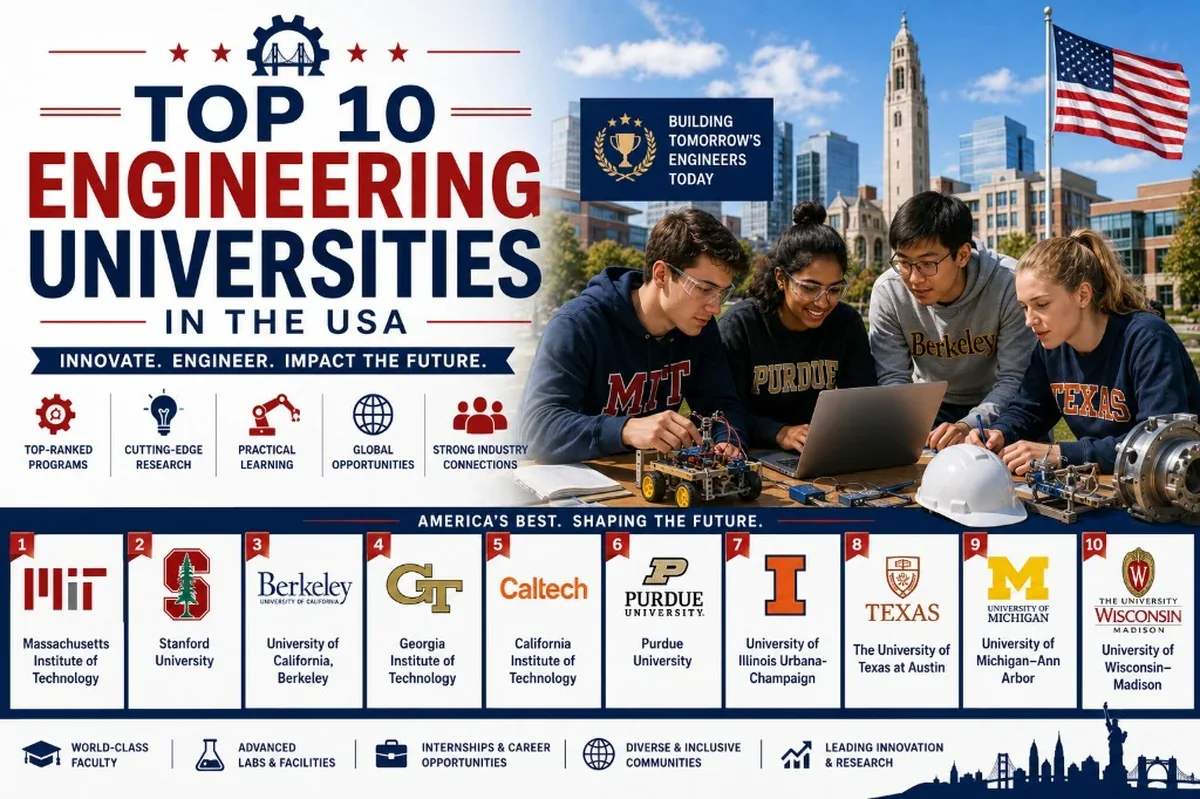
Top 10 Engineering Universities in the USA (2026 U.S. News Guide)
Top 10 engineering universities in the USA for 2026: verified U.S. News undergraduate rankings, specialty strengths, costs, and how international students should choose.
Read the guide →