
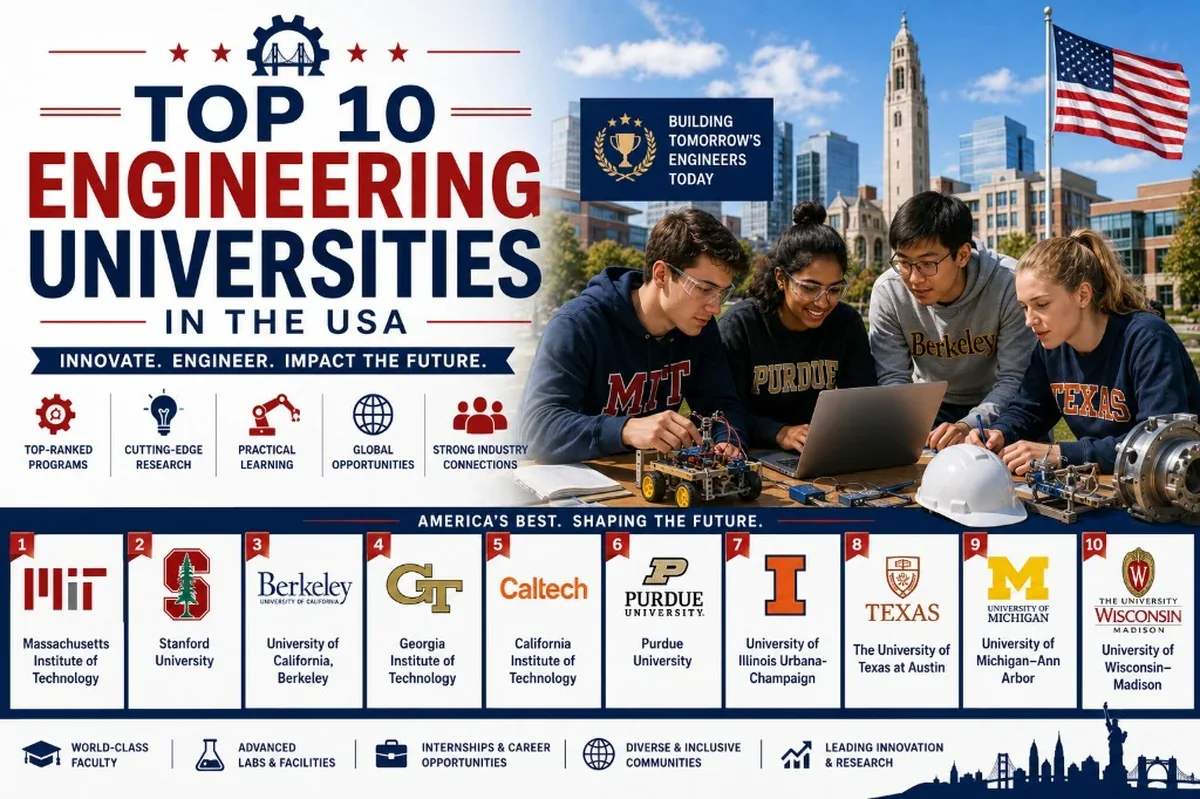
Overview: The top 10 engineering universities in the USA for the 2025–2026 cycle are led by MIT at #1, according to U.S. News & World Report’s Best Undergraduate Engineering Programs (Doctorate) ranking, released in September 2025 and reported directly by MIT’s own School of Engineering. This guide lists the full top 10 with tie positions, explains how specialty rankings (aerospace, computer engineering, biomedical, and more) shift the picture school by school, and adds cost and international-student context you will not find in a bare ranking table.
Families researching engineering universities in the USA quickly discover that “top 10” lists are not as simple as a single ordered column. U.S. News splits engineering programs into two tracks — schools where a doctorate is offered (large research universities like MIT and Georgia Tech) and schools where engineering is the highest degree (smaller undergraduate-focused colleges like Harvey Mudd and Rose-Hulman). This guide covers the doctoral-track ranking, which is what almost everyone means when they search for the biggest names in American engineering.
We also cover tie positions (several schools legitimately share the same rank), specialty strength (a school ranked #10 overall might be #1 in one discipline), and what the ranking does not measure — cost, class size, co-op access, and international-student support.
How U.S. News ranks undergraduate engineering programs (2025–2026)
The U.S. News Best Undergraduate Engineering Programs (Doctorate) ranking covers institutions that award engineering doctorates — effectively every major research university engineering school in the country. Rankings are built from a peer assessment survey of engineering deans and senior faculty, who rate program quality on a five-point scale, combined with selectivity and outcomes data. Because it is reputation-driven, this list changes slowly year to year, and ties are common — several schools often share the exact same rank.
Source: U.S. News Best Undergraduate Engineering Programs (Doctorate), 2026 edition (data released September 2025), as reported by MIT News and Georgia Tech College of Engineering.
Top 10 engineering universities in USA: 2025–2026 U.S. News ranking
MIT again tops the list, with a tight cluster of elite research universities filling out the remaining top 10 spots. Several schools tie — the table below reflects the actual published order, not an artificially spread-out list.
| Rank | University | State | Notable engineering strength |
|---|---|---|---|
| 1 | Massachusetts Institute of Technology (MIT) | MA | #1 in 5 of 10 disciplines tracked by U.S. News |
| 2 | Stanford University | CA | Interdisciplinary engineering, electrical & computer engineering |
| 3 (tie) | University of California, Berkeley | CA | EECS, mechanical, civil engineering |
| 3 (tie) / 4 | Georgia Institute of Technology | GA | Industrial engineering (#1 for 25 straight years), biomedical, environmental |
| 5 (tie) | California Institute of Technology (Caltech) | CA | Aerospace, applied physics, small cohort research intensity |
| 5 (tie) | University of Illinois Urbana-Champaign (Grainger) | IL | Computer engineering, electrical engineering |
| 5 (tie) | University of Michigan–Ann Arbor | MI | Aerospace, robotics, large alumni recruiting network |
| 8 (tie) | Carnegie Mellon University | PA | Electrical & computer engineering, robotics |
| 8 (tie) | Purdue University | IN | Aerospace engineering, industrial engineering, value for cost |
| 10 (tie) | Cornell University | NY | Operations research, biomedical, electrical & computer engineering |
Also tied at #10: University of Texas at Austin (Cockrell School of Engineering). Rankings just outside the top 10 include Princeton, Johns Hopkins, University of Wisconsin–Madison, and Virginia Tech, all tied around #12–#13.
Specialty variation: why the overall ranking is not the whole story
U.S. News also ranks ten individual engineering disciplines separately — aerospace, biomedical, chemical, civil, computer, electrical, environmental, industrial, materials, and mechanical. A school’s specialty rank can differ sharply from its overall position.
| Discipline | 2026 #1 (or co-#1) | Also strong |
|---|---|---|
| Aerospace / aeronautical | MIT | Georgia Tech, Purdue, Michigan |
| Biomedical | Georgia Tech (Georgia Tech & Emory joint program) | Johns Hopkins, Duke, MIT |
| Chemical | MIT | Caltech, Stanford, UC Berkeley |
| Civil | UC Berkeley | Georgia Tech, Illinois, Michigan |
| Computer engineering | MIT | Carnegie Mellon, Stanford, UC Berkeley |
| Electrical / electronic | MIT / Stanford | UC Berkeley, Illinois, Georgia Tech |
| Environmental | Georgia Tech | UC Berkeley, Stanford |
| Industrial / systems | Georgia Tech (25-year streak) | Purdue, Michigan |
| Materials | MIT | Caltech, UC Berkeley, Stanford |
| Mechanical | MIT | Stanford, UC Berkeley, Georgia Tech |
If you want to study a specific discipline, always check the specialty ranking before assuming a school’s overall rank tells the full story. A university ranked #20 overall can still run a top-5 program in one niche field.
MIT, Stanford, Berkeley: the elite tier explained
MIT leads because it places first in five of the ten tracked disciplines — aerospace, chemical, computer, materials, and mechanical engineering — and inside the top five in the rest. Its undergraduate engineering programs also feed directly into MIT’s research labs and startup ecosystem around Kendall Square.
Stanford holds #2 on the strength of its electrical and computer engineering programs and its proximity to Silicon Valley employers, which shapes recruiting, internships, and research funding.
UC Berkeley ties for #3 as the top-ranked public engineering school, with particular strength in EECS (electrical engineering and computer sciences, one of the most selective majors in the country) and civil engineering.
Public powerhouses: Georgia Tech, UIUC, Michigan, Purdue
Four public universities anchor the middle of the top 10, and all four are known for combining research strength with relatively lower in-state tuition (out-of-state and international tuition is closer to private-school levels).
- Georgia Tech — tied at #3–4 overall; #1 public engineering program (tied with Berkeley); a 25-year streak atop industrial engineering.
- University of Illinois Urbana-Champaign — tied at #5; the Grainger College of Engineering is especially strong in electrical and computer engineering.
- University of Michigan–Ann Arbor — tied at #5; broad strength across aerospace, mechanical, and robotics, backed by one of the largest engineering alumni networks in the country. See our University of Michigan guide for admissions detail.
- Purdue University — tied at #8; famous for aerospace engineering (astronaut alumni) and a lower relative cost of attendance for the ranking it delivers.
Private research heavyweights: Caltech, Carnegie Mellon, Cornell
Caltech ties for #5 with the smallest undergraduate population on this list (fewer than 1,000 undergraduates), delivering an unusually research-intensive, faculty-close experience. Read our Caltech acceptance rate and admissions guide for selectivity details.
Carnegie Mellon ties for #8, driven by its electrical and computer engineering and robotics programs, which sit alongside one of the most famous computer science departments in the world.
Cornell ties for #10, offering the broadest engineering catalog of any Ivy League school, including operations research and a strong biomedical engineering track. See our Cornell University guide for a first-hand admissions perspective.
What it costs to study engineering in the USA
Engineering programs at top universities sit at the high end of U.S. tuition, though public universities offer meaningfully lower costs for students who qualify for in-state rates (rare for most international applicants).
| School type | Typical annual tuition & fees (2024–25) | Example schools |
|---|---|---|
| Elite private (MIT, Stanford, Caltech, CMU, Cornell) | $62,000–$72,000 | MIT, Caltech, Cornell |
| Public — out-of-state / international | $38,000–$66,000 | Michigan, Berkeley, Illinois |
| Public — relative value pick | $29,000–$40,000 (out-of-state) | Purdue, Georgia Tech |
Add $16,000–$22,000 per year for housing, food, and health insurance at most of these schools. Always confirm current figures on each university’s official cost-of-attendance page before budgeting.
International students and engineering admissions
- Direct-entry majors: Many top engineering schools (MIT, Berkeley EECS, Michigan, Illinois) require you to apply directly into engineering as a freshman — you generally cannot switch in later from another college within the university.
- Math and physics depth matters: Admissions committees look closely at Calculus, Physics, and (where available) programming coursework on international transcripts.
- Standardized tests: SAT/ACT policies vary by school and are being reintroduced at several elite universities for the 2026 cycle — verify each school’s current policy.
- OPT STEM extension: All ten schools above qualify for the 24-month STEM OPT extension (36 months of work authorization total) for F-1 engineering graduates, a major reason engineering remains a top choice for international students.

How to choose among the top 10 engineering universities
- Pick the discipline first — use the specialty table above, not just the overall rank.
- Compare direct-entry policy — some schools admit to engineering directly; others allow an undeclared first year.
- Check co-op and internship structure — Georgia Tech and Purdue have especially strong co-op cultures.
- Factor in class size — Caltech and Cornell’s smaller programs feel very different from Berkeley or Michigan’s large lecture halls.
- Confirm total cost including international-student aid policy before you finalize a shortlist.
Explore more USA university guides on our site
- MIT complete overview
- Caltech acceptance rate & admissions guide
- Cornell University guide
- University of Michigan guide
- Top 50 Universities in the USA (2026)
Browse more admissions guides on our Top Schools Rankings blog.
Frequently asked questions: top engineering universities in USA
What is the #1 engineering university in the USA for 2026?
MIT is #1 in the U.S. News 2025–2026 Best Undergraduate Engineering Programs (Doctorate) ranking, placing first in five of ten tracked engineering disciplines.
Is Georgia Tech ranked higher than Caltech for engineering?
Georgia Tech is tied around #3–4 overall for 2026, ahead of Caltech, which ties at #5 alongside UIUC and Michigan. Caltech remains extremely research-intensive despite its smaller size and lower overall rank.
Do these rankings include liberal arts engineering colleges like Harvey Mudd?
No. This list covers the doctoral-granting track. U.S. News ranks undergraduate-only engineering schools (Harvey Mudd, Rose-Hulman, Cooper Union) in a separate category.
Which top-10 engineering school is best for computer engineering specifically?
MIT ranks #1 for computer engineering, with Carnegie Mellon, Stanford, and UC Berkeley close behind. Always check the specialty table, not just the overall rank, if you plan to major in computer engineering.
Are public universities like Georgia Tech and Purdue cheaper than MIT or Caltech?
For international students, not dramatically — most public universities charge non-resident or international rates close to private-school tuition. Purdue and Georgia Tech tend to be somewhat lower than Berkeley or Michigan, but always check current published rates.
Can international students get the STEM OPT extension after graduating from these schools?
Yes. Engineering degrees from all ten schools above qualify F-1 graduates for the 24-month STEM OPT extension, giving up to 36 months of total U.S. work authorization after graduation.
Does a lower overall rank mean a weaker engineering program?
Not necessarily. Schools like Johns Hopkins, Princeton, and Virginia Tech sit just outside the top 10 overall but lead in specific specialties such as biomedical engineering. Always cross-check the discipline-specific ranking for your intended major.
Where can I verify the current U.S. News engineering ranking myself?
Use the official U.S. News Best Undergraduate Engineering Programs (Doctorate) page, which updates annually each September.
Final overview
The top 10 engineering universities in the USA for 2026 — MIT, Stanford, Berkeley, Georgia Tech, Caltech, UIUC, Michigan, Purdue, Carnegie Mellon, and Cornell — represent the deepest concentration of engineering research funding, faculty reputation, and industry recruiting in the country. Use the overall ranking as a starting point, then confirm specialty strength, cost, and direct-entry admissions policy for your intended major before building your final shortlist.
Disclaimer: Rankings, tuition, and admissions policies change annually. This article summarizes publicly available U.S. News and university-reported data for planning purposes only. Confirm all figures on U.S. News and each university’s official admissions site before applying.

Saahil
Saahil is an education researcher and content creator specializing in university rankings, admissions strategies, and student guides. He is dedicated to helping students make informed academic decisions.
Continue your research
Top 10 Universities in Canada for Engineering & Co-op Pathways (2026 Guide)
Discover the top 10 engineering universities in Canada for 2026: Waterloo, Toronto, UBC, McGill, Alberta, and more with co-op work programs, tuition fees, and admission requirements.
Read the guide →
How to Compare Universities Beyond Rankings: A 2026 Framework
Compare course fit, cost, outcomes, support and learning experience with official data instead of relying on one league-table position.
Read the guide →
School of Science and Engineering Magnet: Full Overview
The School of Science and Engineering (SEM) at Yvonne A. Ewell Townview Center is a selective STEM magnet high school in Dallas ISD, widely regarded as one of…
Read the guide →
Top 10 Computer Science Universities in the USA (2026 U.S. News Guide)
The top 10 computer science universities in the USA for 2026, ranked using U.S. News undergraduate CS data: MIT, Carnegie Mellon, Stanford, Berkeley, Georgia Tech, Princeton, and more.
Read the guide →