
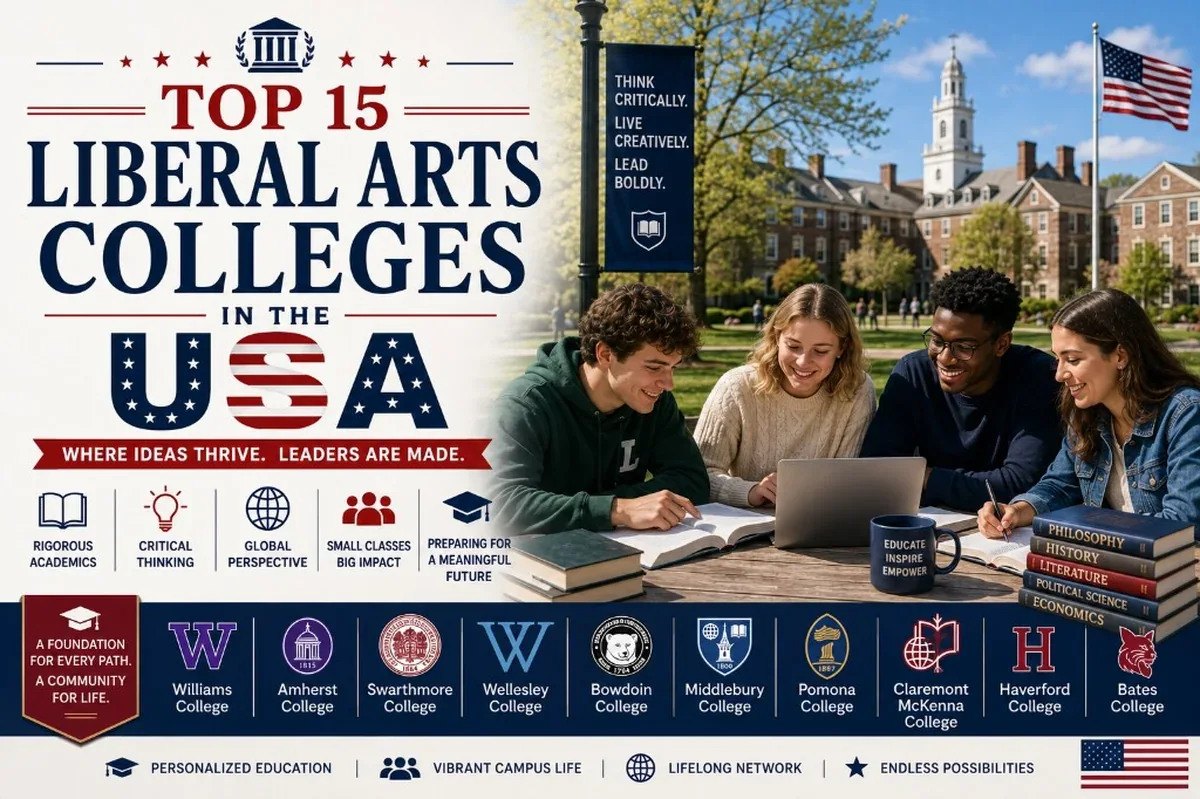
Overview: Liberal arts colleges (LACs) are small, undergraduate-focused institutions that emphasize close faculty contact, broad interdisciplinary study, and residential campus life — a very different experience from large research universities. For 2026, U.S. News & World Report ranks Williams College #1, followed by Amherst and Swarthmore. This guide lists the top 15 civilian national liberal arts colleges (excluding service academies, which U.S. News ranks in the same category), explains how LACs differ from universities like Harvard or MIT, and covers admissions, cost, and international student considerations.
Families researching top liberal arts colleges in USA often start after already knowing the big research-university names — Harvard, Stanford, MIT. Liberal arts colleges are a distinct category: undergraduate-only or undergraduate-first institutions, typically 1,500–3,000 students, with an academic model built around small seminar classes, the Harkness or discussion-based teaching style, and direct access to full professors rather than graduate teaching assistants.
U.S. News ranks these schools in a completely separate category from “National Universities,” using the same 17-factor methodology (graduation rates, faculty resources, peer assessment, financial resources, and more) but comparing LACs only against each other.

What is a liberal arts college? (LAC vs. research university)
| Feature | Liberal arts college (e.g. Williams, Amherst) | Research university (e.g. Harvard, MIT) |
|---|---|---|
| Typical enrollment | ~1,500–3,000 undergraduates | 6,000–30,000+ undergraduates, plus large graduate schools |
| Who teaches classes | Almost always full professors | Mix of professors and graduate teaching assistants, especially in intro courses |
| Class size | Often under 20 students; seminar/discussion format | Large intro lectures common (100+), smaller upper-level seminars |
| Majors offered | Broad humanities, sciences, social sciences; few or no professional/engineering schools | Full range including engineering, business, medicine, law (grad level) |
| Research access | Undergraduate research is common and often faculty-led directly | Research often driven by graduate students and postdocs; undergrads can join labs |
| Campus feel | Small, tight-knit, residential | Varies widely; often larger and more urban/dispersed |
Neither model is objectively “better” — the right fit depends on whether a student wants a large research ecosystem or an intensive, personal undergraduate experience.
Top 15 liberal arts colleges in USA (U.S. News 2026)
U.S. News’s National Liberal Arts Colleges category technically also includes the U.S. service academies (Naval Academy #3, Air Force Academy #5 tie, West Point #10 tie), which have unique funded, government-run admissions models. The table below lists the 15 civilian liberal arts colleges most families compare, in their actual 2026 U.S. News order, with approximate acceptance rates for context.
| List rank | College | U.S. News 2026 rank | Location | Approx. acceptance rate* |
|---|---|---|---|---|
| 1 | Williams College | #1 | Williamstown, MA | ~8% |
| 2 | Amherst College | #2 | Amherst, MA | ~7% |
| 3 | Swarthmore College | #4 | Swarthmore, PA | ~7% |
| 4 | Bowdoin College | #5 (tie) | Brunswick, ME | ~9% |
| 5 | Pomona College | #7 (tie) | Claremont, CA | ~7% |
| 6 | Claremont McKenna College | #7 (tie) | Claremont, CA | ~9% |
| 7 | Wellesley College | #7 (tie) | Wellesley, MA | ~14% |
| 8 | Carleton College | #10 (tie) | Northfield, MN | ~22% |
| 9 | Davidson College | #13 (tie) | Davidson, NC | ~17% |
| 10 | Hamilton College | #13 (tie) | Clinton, NY | ~12% |
| 11 | Middlebury College | #13 (tie) | Middlebury, VT | ~15% |
| 12 | Smith College | #13 (tie) | Northampton, MA | ~22% |
| 13 | Vassar College | #13 (tie) | Poughkeepsie, NY | ~15% |
| 14 | Washington and Lee University | #21 | Lexington, VA | ~17% |
| 15 | Colby College | #24 (tie) | Waterville, ME | ~10% |
*Acceptance rates are approximate figures compiled from recent admissions cycles and change every year — always confirm the current rate on each college’s official admissions or common data set page. Source: U.S. News Best National Liberal Arts Colleges 2026.

Notable ties and what they mean
- Five-way tie at #13: Barnard, Davidson, Grinnell, Hamilton, Middlebury, Smith, and Vassar all share rank #13 in 2026 — meaning U.S. News considers their overall statistical profiles effectively equivalent.
- Three-way tie at #7: Claremont McKenna, Pomona, and Wellesley are tied, despite very different campus cultures (Pomona and CMC are part of the five-college Claremont Consortium; Wellesley is a women’s college near Boston).
- Rank ≠ fit: A #21 school like Washington and Lee may be a stronger personal fit than a #7 school depending on program strength, geography, or culture.
Cost and financial aid at top liberal arts colleges
| Cost line | Typical range (sticker price, 2025–26) |
|---|---|
| Tuition & fees | $62,000–$72,000+ |
| Room & board | $16,000–$20,000 |
| Total sticker price | Often $80,000–$92,000+ per year |
| Typical aid coverage | Many top LACs (Williams, Amherst, Pomona) meet 100% of demonstrated financial need for admitted students |
Several elite LACs, including Amherst and Pomona, are need-blind for domestic applicants and offer generous aid; policies for international applicants vary significantly and are often need-aware. Always confirm current policy directly with each admissions office.
International students at liberal arts colleges
- Smaller international cohorts: LACs typically enroll a smaller number of international students per class than large universities, which can mean more individualized advising but fewer peers from your home country.
- Need-aware admissions is common: Unlike many need-blind domestic policies, several top LACs are need-aware specifically for international applicants — meaning ability to pay can factor into admission decisions.
- Limited pre-professional majors: Students planning engineering, nursing, or business degrees should check whether a LAC offers the specific major or only pre-professional advising toward graduate study.
- Strong graduate school placement: LACs like Swarthmore, Williams, and Pomona have historically strong per-capita PhD production and law/medical school admission rates.
Consortiums: how some liberal arts colleges add university-scale resources
One way top LACs offset their small size is through formal consortium agreements that let students cross-register for courses, share libraries, and access facilities at nearby partner schools:
| Consortium | Member colleges (from this list) | What it adds |
|---|---|---|
| Claremont Colleges Consortium | Pomona College, Claremont McKenna College | Cross-registration with five undergraduate colleges plus graduate institutions, sharing libraries, dining, and some facilities |
| Five College Consortium | Smith College, Amherst College | Cross-registration with Amherst, Smith, Mount Holyoke, Hampshire College, and UMass Amherst — effectively adding a large public research university’s course catalog |
| MIT cross-registration | Wellesley College | Wellesley students can cross-register for select MIT courses, adding engineering and technical depth |
These partnerships are a major reason a nominally “small” LAC can still offer engineering-adjacent coursework, larger social scenes, and broader course catalogs than its own enrollment numbers suggest.
Outcomes: graduate school and career placement
Liberal arts colleges are frequently cited in higher-education research for strong per-capita PhD production — meaning a higher share of their graduates eventually earn doctoral degrees compared to many larger universities, proportional to class size. Schools like Swarthmore, Carleton, and Williams have appeared prominently in this kind of analysis for decades. Beyond doctoral study, top LACs typically report:
- Strong law school and medical school admission rates, aided by close pre-professional advising from faculty who know students personally
- Robust on-campus recruiting from finance, consulting, and technology employers, particularly at Northeastern schools with strong alumni networks (Williams, Amherst, Middlebury)
- High reported rates of students completing at least one independent research project or senior thesis before graduation
Always ask a specific college for its own published outcomes data (often found in a “career development” or “fellowships” annual report) rather than relying on generalized claims about the LAC category as a whole.
Liberal arts colleges vs. Ivy League and research universities
Many applicants shortlist both categories. If you are also comparing large research universities, see our Top 50 Universities in USA guide and our Top 10 Computer Science Universities guide if a technical major is a priority — most LACs on this list do not offer ABET-accredited engineering degrees.
| If you want… | Consider |
|---|---|
| Small classes taught only by professors | Any school on this top 15 list |
| Engineering or a large STEM research lab | A research university (MIT, Georgia Tech, Berkeley) instead, or a LAC with a 3-2 engineering partnership |
| Big-time college sports culture | A large public flagship or Ivy over most LACs (though Williams and Amherst have strong Division III athletics) |
| Broad interdisciplinary exploration before choosing a major | A LAC — most do not require declaring a major until sophomore year |
How to choose among the top 15 liberal arts colleges
- Visit or take a virtual tour — culture varies enormously between a rural Maine campus (Bowdoin, Colby) and a five-college consortium (Pomona, Claremont McKenna).
- Check 3-2 or cross-registration programs if you want engineering alongside a liberal arts core.
- Compare need-based aid policy for your citizenship status before assuming a school is affordable or unaffordable.
- Look at outcomes data — PhD production rate, law/med school admission rate, and starting salaries by major.
- Consider single-sex options if relevant — Wellesley and Smith are historically women’s colleges with cross-registration options nearby.
Frequently asked questions: top liberal arts colleges in USA
What is the #1 liberal arts college in the USA for 2026?
Williams College ranks #1 in the U.S. News 2026 National Liberal Arts Colleges list, continuing a run near the top of the category for many years.
What is the difference between a liberal arts college and a university?
Liberal arts colleges are typically small, undergraduate-focused institutions where full professors teach nearly all classes and there are few or no large graduate schools. Universities are usually larger, offer graduate and professional degrees, and often use graduate teaching assistants for introductory courses.
Are liberal arts colleges harder to get into than Ivy League schools?
Several top LACs (Williams, Amherst, Swarthmore, Pomona) have acceptance rates in the same single-digit range as the most selective Ivies, so “easier” is not accurate. Selectivity is comparable at the very top of both categories.
Do liberal arts colleges offer engineering degrees?
Most do not offer full ABET-accredited engineering majors, though many offer physics, computer science, or a 3-2 dual-degree partnership with an engineering school (a common example pairs a LAC with a partner university for a combined bachelor's program).
Can international students get financial aid at liberal arts colleges?
Some do, but policy varies by school and is often need-aware for international applicants even at colleges that are need-blind for domestic students. Always check each college’s international aid page before applying.
Why are so many liberal arts colleges tied in the rankings?
U.S. News uses a weighted formula with limited decimal precision; several schools land on statistically similar composite scores, producing ties — for 2026, seven schools share rank #13 alone.
Is Wellesley College the same type of school as Williams or Amherst?
All three are top-ranked national liberal arts colleges, but Wellesley is a historically women’s college near Boston with cross-registration access to MIT, while Williams and Amherst are coeducational.
Should I choose a liberal arts college or a large research university?
It depends on your priorities: choose a LAC for small classes and close faculty mentorship, or a research university for larger labs, graduate-level resources, and broader major/professional-school options. Many strong students apply to both types and decide after admission and financial aid offers arrive.
Final overview
The top 15 liberal arts colleges in USA for 2026 — led by Williams, Amherst, and Swarthmore — offer an academically rigorous, personal alternative to large research universities, with several schools matching Ivy League selectivity. The right choice depends on major, cost after aid, and whether you want a small residential community or a larger university ecosystem.
Disclaimer: Rankings, acceptance rates, and financial aid policies change annually. This article summarizes publicly available information for planning purposes only. Confirm all figures on U.S. News and each college’s official admissions website before applying.

Saahil
Saahil is an education researcher and content creator specializing in university rankings, admissions strategies, and student guides. He is dedicated to helping students make informed academic decisions.
Continue your research

Top 100 Medical Colleges in India (2026 NIRF Rankings, NEET UG Cutoffs & Fees)
Complete 2026 guide to the top 100 medical colleges in India: NIRF rankings, AIIMS institutes, NEET UG cutoff trends, MBBS fees, clinical infrastructure, and seat intake.
Read the guide →
How to Compare Universities Beyond Rankings: A 2026 Framework
Compare course fit, cost, outcomes, support and learning experience with official data instead of relying on one league-table position.
Read the guide →
Duke University: Complete Guide 2026 – Admissions, Fees & Rankings
Discover everything about Duke University in 2026. Learn about admissions requirements, tuition fees ($70,265), rankings (#6 US News), acceptance rate (4.8%).
Read the guide →
How to Get Into Baulkham Hills High School: 2026 Admissions, Rankings, and Preparation Strategy
Baulkham Hills High School (BHHS) is not just a school; it is a hub for academic titans in New South Wales.
Read the guide →