
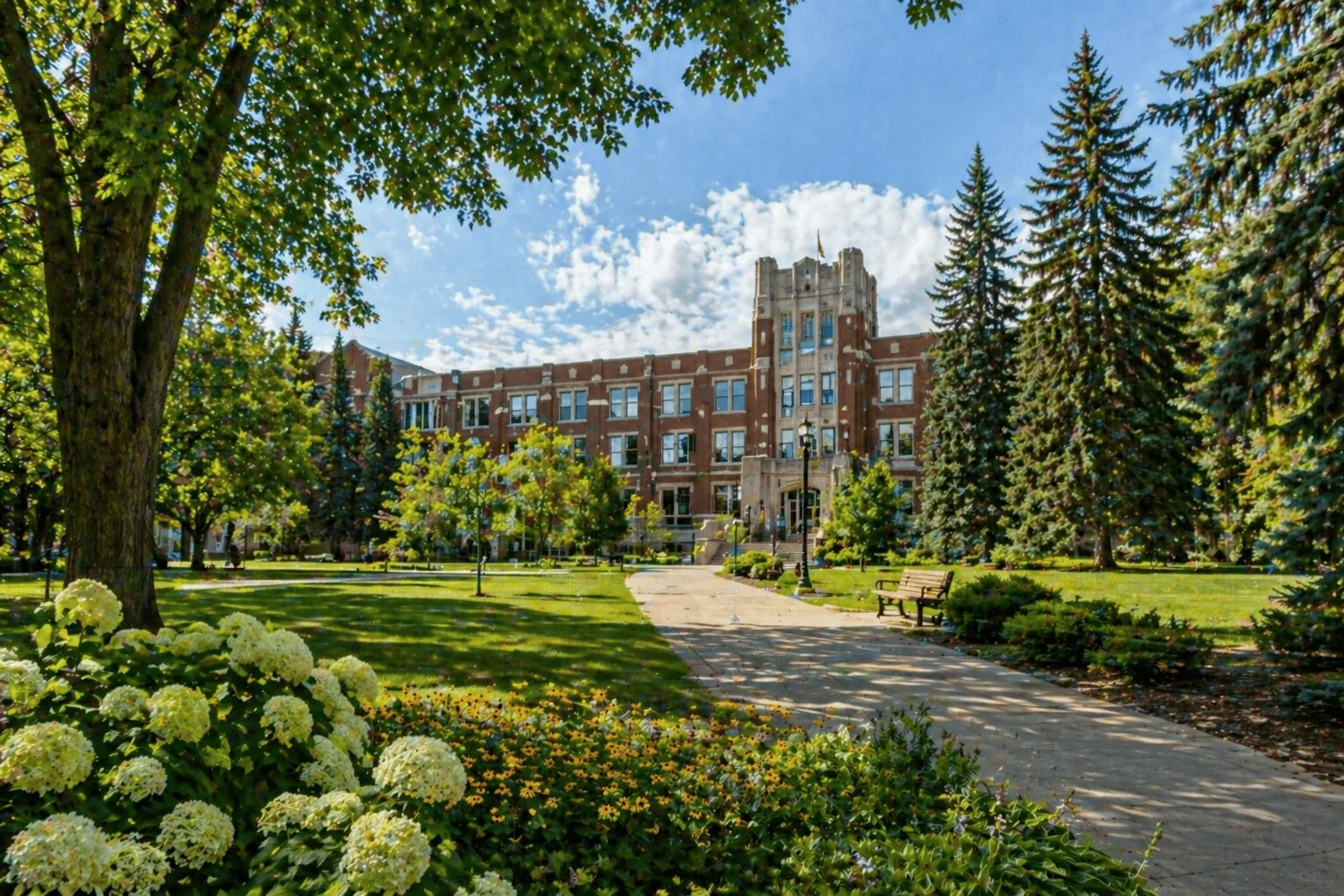
Quick summary: The University of Alberta charges international undergraduates CAD $35,908 a year at Augustana and up to CAD $49,952 for Engineering in 2026–27, with the total locked in for the whole degree. It sits at #96 in the QS World University Rankings 2027 and =118 in THE 2027, admitted 66.7% of undergraduate applicants in 2024–25, and asks for IELTS 6.5 overall with no band below 6.0. Fall 2027 applications close on 1 March 2027 for most programmes.
The University of Alberta is one of Canada's big four research universities — public, founded with classes opening in September 1908, and a member of the U15 Group of Canadian Research Universities. It teaches more than 47,500 students across six campuses in Edmonton and Camrose, Alberta, including 8,990 international students, and it has stayed inside the QS world Top 100 for three consecutive years. Its best-known strengths are the ones employers and researchers actually cite: artificial intelligence, energy and engineering, health sciences, and agriculture.
That combination — Top-100 research at mid-range Canadian prices, with the tuition figure fixed before you start — is the whole pitch. This guide works through what the university itself publishes: the 2026–27 fees by faculty, the admission rate it reports, the Fall 2027 deadlines, the English requirements, the scholarships, and residence. Where the university publishes nothing — a separate acceptance rate for international students — this guide says so instead of guessing.
University of Alberta at a Glance (2026–27)
UAlberta is a large public research university in Edmonton, the capital of Alberta. Most international undergraduates study at North Campus, beside the North Saskatchewan River valley; the university also runs Augustana Campus in Camrose, about an hour south-east of Edmonton, and Campus Saint-Jean, its French-language campus in Edmonton. Eighteen faculties offer more than 200 undergraduate programmes, and the average class has 38 students on North Campus, 22 at Augustana and 20 at Campus Saint-Jean.
- Rankings: QS 2027 #96 in the world, #4 in Canada; THE 2027 =118 in the world, #5 in Canada.
- Students: 47,526 in total; 8,990 international (5,727 undergraduate, 3,263 graduate); students from 156 countries.
- Tuition (international, 2026–27): CAD $35,908–$49,952 a year, fixed for the whole degree under the tuition guarantee.
- Admission rate: 66.7% of all undergraduate applicants admitted in 2024–25 (no separate international rate published).
- English: IELTS Academic 6.5 overall, no band below 6.0; TOEFL iBT 90 (tests before 21 January 2026); Duolingo 120.
- Fall 2027 deadline: 1 March 2027 for most programmes; applications opened 1 October 2026.
- Graduate employment rate: 97%, as published by the university.
A Closer Look: Why Students Choose the University of Alberta
Rankings alone do not pick a university. The five reasons below are the ones that recur in the university's own published material — and they are the ones that matter most to an international student weighing Alberta against Toronto, Vancouver or the US.
1. Top-100 research, including AI and energy
Alberta has held a QS Top-100 place for three straight years, and its Industry score in THE 2027 tied for first in the world — the third year running — on patents citing its research and income from inventions and industry partnerships. The university says seven of its subjects rank first in Canada, and it ranks first in Canada for AI research. For a student, that shows up as research assistantships, well-funded labs, and employers who already recruit on campus.
2. The tuition figure is fixed before you start
Under the university's program-based tuition model, an international student knows the total tuition for the whole degree at the time of the admission offer, and that figure does not rise during the programme. That is genuinely useful for planning: an Arts degree costs CAD $156,931.20 in tuition over four years at the Fall 2026 rate, and an Engineering degree CAD $199,809.60 — and those totals are the totals, not a first-year teaser.
3. Engineering co-op is one of Canada's largest
The Engineering Co-op Program, running since 1981, is one of Canada's largest work-integrated learning programmes. The co-op degree takes five years and folds in five mandatory four-month paid work terms — 20 months of paid engineering work — while the traditional degree takes four years. Co-op is offered in every Engineering programme, and the university's co-op office helps students find placements.
4. Edmonton costs less than Toronto or Vancouver
Alberta is the only Canadian province with no provincial sales tax, and Edmonton is consistently ranked among Canada's most affordable major cities. The university's own first-year estimate for a general Arts or Science student in 2026–27 puts residence with a meal plan at CAD $14,800+, against tuition of CAD $41,300+ and books, supplies and fees of CAD $3,700+ — a first year of roughly CAD $59,800 all in.
5. A genuinely international campus
Students from 156 countries study at UAlberta, and 8,990 of its 47,526 students are international. The university runs 450+ student clubs, 25 club sports and 10,000 intramural participants, and its International Student and Visitor Services office runs immigration advising, settlement support and trips — including to Banff and Jasper — for students far from home.
University of Alberta Rankings (2027)
Two rankings matter for this guide, because both are current editions with the university's own commentary. The QS World University Rankings 2027 place Alberta 96th in the world and fourth in Canada, among more than 1,500 institutions; the university has now been inside the QS Top 100 for three consecutive years (2025: #96, 2026: #94, 2027: #96). The Times Higher Education World University Rankings 2027 place it tied 118th in the world and fifth in Canada, up one place on last year, with its Industry pillar tied first worldwide.
| Ranking | World rank | Rank in Canada | What it measures |
|---|---|---|---|
| QS World University Rankings 2027 | #96 | #4 | Academic and employer reputation, citations, faculty–student ratio, international mix, sustainability |
| THE World University Rankings 2027 | =118 | #5 | Teaching, research environment, research quality, industry, international outlook (17 indicators) |
Read the gap between the two honestly: Alberta scores better on reputation surveys (QS) than on citation-heavy measures (THE), and its Industry score — patents and industry income — is world-leading. Neither number says anything about your programme's teaching, class sizes or graduate outcomes, which is why this guide treats rankings as a starting filter, not a verdict. Our guide to reading college rankings explains how to use them without being misled by them.
University of Alberta Acceptance Rate
The University of Alberta does not publish an acceptance rate for international students, and any percentage you see quoted as "the" international rate is an estimate with no official source — including the 58% figure that circulates on agent sites. What the university does publish, in its annual enrolment report from the Office of the Registrar, is the overall undergraduate admission rate: in 2024–25 it admitted 28,537 of 42,758 undergraduate applicants — 66.7% — and 14,690 of those admitted students registered.
Three caveats matter. First, that 66.7% covers every undergraduate applicant combined — domestic and international, school-leavers and current students applying to change programmes — so it is not your chance of admission to one programme. Second, the rate says nothing about the programmes international students actually apply to: Engineering, Business and Nursing need much higher grades than the university-wide figure suggests. Third, admission is grade-based, not lottery-based: the university admits on the grades in your required subjects, so a strong average in the right subjects matters far more than the headline rate.
What does that mean for you? If your grades are comfortably above the competitive range for your programme, Alberta is a realistic target; if they are at the minimum, it is a reach — and the competitive programmes are reaches for almost everyone. The university publishes competitive requirements by programme, and the honest move is to check your programme's range on ualberta.ca rather than to lean on the 66.7% figure.
University of Alberta Fees for International Students (2026–27)
International tuition at UAlberta is set by programme under a cohort model: the rate for your entry year is your rate for the whole degree. The table below gives the annual tuition for students who started in Fall 2026, as published by the Office of the Registrar, plus the four-year programme total the guarantee locks in.
| Faculty / campus | Annual tuition (2026–27) | Four-year total |
|---|---|---|
| Augustana Campus (Arts, Management or Science) | CAD $35,908 | CAD $143,632 |
| Education & Native Studies | CAD $35,908 | CAD $143,630 |
| Arts; Agricultural, Life & Environmental Sciences; Kinesiology, Sport, and Recreation | CAD $39,233 | CAD $156,931 |
| Science | CAD $39,792 | CAD $159,168 |
| Alberta School of Business | CAD $46,547 | CAD $186,187 |
| Engineering | CAD $49,952 | CAD $199,810 |
Two things to note before you budget. First, the Fall 2027 cohort will pay more: the Board of Governors approved a 5.5% increase for new international undergraduate students entering Fall 2027 — Arts rises to CAD $41,390 a year and Engineering to CAD $52,699 — with two exceptions, a roughly 26% harmonisation of the BSc in Computing Science up to the Engineering rate, and a 20% rise for Nursing. Second, tuition is not the whole bill: the university's own first-year estimate for a general Arts or Science student in 2026–27 adds CAD $3,700+ for books, supplies and fees and CAD $14,800+ for residence with a meal plan to tuition of CAD $41,300+ — a first year of roughly CAD $59,800.
For the study permit, the money you must show is separate from the university's estimate. Immigration, Refugees and Citizenship Canada requires a single applicant outside Quebec to show CAD $22,895 for living costs for one year — the threshold in force for applications made on or after 1 September 2025 — on top of first-year tuition and travel costs. Confirm the live figure on canada.ca before you apply, because IRCC reviews it every year. On top of that, Alberta has no provincial sales tax, which trims day-to-day costs a little against Toronto or Vancouver.
Programs at the University of Alberta
With 18 faculties and more than 200 undergraduate programmes, the choice is wide; the table below covers the programmes international students ask about most. Most direct-entry bachelor's degrees take four years; Engineering takes four years traditionally or five with co-op.
| Faculty | Popular programmes | Typical length |
|---|---|---|
| Arts | Psychology, Economics, Political Science, English, Sociology | 4 years |
| Science | Computing Science, Biological Sciences, Chemistry, Mathematics, Physics | 4 years |
| Engineering | Mechanical, Civil, Electrical, Computer, Chemical, Petroleum | 4 years (5 with co-op) |
| Alberta School of Business | Bachelor of Commerce — Accounting, Finance, Marketing | 4 years |
| Nursing | BSc in Nursing (collaborative programme) | 4 years |
| Agricultural, Life & Environmental Sciences | Environmental Science, Nutrition, Animal Science | 4 years |
| Education | Elementary and Secondary Education | 4 years |
| Augustana Campus | BA, BSc, Bachelor of Management (small-campus setting) | 4 years |
Two programme notes are worth having. Computing Science is the one to watch on price: from Fall 2027 its tuition is harmonised up to the Engineering rate, a rise of roughly 26%, so check the current figure on the university's cost calculator before you apply. And Campus Saint-Jean offers French-language and bilingual programmes — a real option if you studied in French, and one most international applicants never hear about.
Admission Requirements for International Students
Admission to UAlberta is grade-based. You need five Grade 12 subjects, including English (English Language Arts 30-1 or its equivalent), and the competitive average for your programme — the minimum average, based on prerequisite courses, that was needed for admission consideration in recent cycles. Meeting the minimum does not guarantee admission: the university evaluates on a rolling basis, and competitive programmes fill on grades. International applicants apply through the university's own online application (Launchpad), not through a provincial portal, and pay a non-refundable CAD $150 application fee — CAD $100 for current or past U of A students.
On English, the requirements are the same for every undergraduate applicant, whatever your citizenship. The table below gives the test scores the university publishes; note the TOEFL change — for tests taken on or after 21 January 2026, only the new 1–6 score scale counts.
| Test | Minimum score | Notes |
|---|---|---|
| IELTS Academic (in-person or online) | Overall 6.5, no band below 6.0 | One Skill Retake results are not accepted |
| TOEFL iBT (tests before 21 Jan 2026) | Total 90, no section below 21 | Home Edition not accepted for 2027–28 |
| TOEFL iBT (tests on/after 21 Jan 2026) | Overall 4.5, no band below 4.5 (1–6 scale) | New ETS scoring scale |
| Duolingo English Test | Overall 120, no subscore below 100 | Accepted for undergraduate admission |
Two extras apply to some applicants. Education and health-science programmes also set a Spoken English Proficiency bar — IELTS Speaking 7.5, or TOEFL Speaking 5.0 on the new scale — so check your programme's page if you are applying to one of those. And if you meet the academic requirements but not the English bar yet, the university's Bridging Program lets you improve your English first and then enter a degree programme. Proof of English must be submitted by 1 August 2027 for Fall 2027 entry. If you hold both IELTS and TOEFL scores, our IELTS–TOEFL converter compares them on one scale.
How to Apply for Fall 2027
Applications for Fall 2027 opened on 1 October 2026. The steps below follow the university's own seven-step process, with the dates that matter.
1. Choose your campus and programme
Most international undergraduates pick North Campus in Edmonton; Augustana in Camrose suits students who want a small campus, and Campus Saint-Jean suits French-language study. Check the programme's required Grade 12 subjects and its competitive range before you shortlist.
2. Submit your application by 1 March 2027
Apply through the university's online application and pay the CAD $150 fee. Most programmes close on 1 March 2027; Dental Hygiene, Dentistry, Medicine and Law set their own deadlines, so check those separately. Apply early — evaluation is rolling, and earlier applications get earlier decisions.
3. Apply for scholarships by 10 January 2027
One scholarship application covers the application-based entrance awards. The deadline is 10 January 2027, well before the admission deadline, so do not leave it until March. Admission-based awards need no application at all — you are assessed automatically when you apply.
4. Self-report your final marks by 30 April 2027
Self-report your final high-school marks in the application by 30 April 2027. Final official documents are due by 1 August 2027.
5. Accept your offer by 1 May 2027
Offers made before 1 April must be accepted by 1 May 2027 — your exact deadline is shown in Launchpad. Accepting means paying the non-refundable tuition deposit by the deadline in Launchpad; only then can you register for courses.
6. Apply for residence by 30 April 2027
New students who apply to North Campus residences by 30 April 2027 are guaranteed a spot. Registration for courses opens in late May or early June 2027.
7. Get your study permit in order
Once you have accepted and paid the deposit, your Letter of Acceptance and Provincial Attestation Letter (PAL) become available through Launchpad and MyCreds. Submit those with your study permit application to IRCC, showing CAD $22,895 in living funds plus first-year tuition and travel.
Scholarships for International Students
The university administers more than CAD $53 million a year in undergraduate scholarships, awards and financial support, and one in five first-year students receives a scholarship. There are two kinds: admission-based awards, which need no application and are assessed on your admission average at the time of your offer, and application-based awards, which need the single scholarship application by 10 January 2027.
| Scholarship | Value | How it is awarded |
|---|---|---|
| International Admission Scholarship | Up to CAD $10,000 | Automatic, on admission average |
| Regional Excellence Scholarship | Up to CAD $5,000 | Automatic, for students from select regions |
| President's International Distinction Scholarship | Up to CAD $120,000 over 4 years | Application-based; 25 students a year, superior average + leadership |
| International Leader Scholarship | Up to CAD $15,000 | Application-based; academics + leadership |
| May Quon Undergraduate Scholarship | Up to CAD $100,000 over 4 years | Application-based; Chinese or Hong Kong citizens with financial need |
| Cora Martinson International Scholarship | Up to CAD $56,000 over 4 years | Application-based; Augustana students |
The realistic expectation: most international students who get money get the International Admission Scholarship, up to CAD $10,000, on the strength of their admission average. The $120,000 President's award goes to 25 students a year across the whole university — apply for it, but do not budget as if you will win it.
Student Life, Residence and Edmonton
First-year residence is the default for most international students, and the university guarantees a North Campus residence spot to new students who apply by 30 April 2027. Lister Residence and Peter Lougheed Hall run an all-access meal plan — unlimited entries to both dining halls — at CAD $6,332 for the eight-month contract in 2026–27; first-year residents in Alder or Linden House are not required to take the meal plan. The university's own estimate puts residence with a meal plan at CAD $14,800+ for the year.
Outside residence, Edmonton is a working city of about a million people on the North Saskatchewan River, with the river valley park system beside North Campus and winter that is long and cold — plan for months well below freezing, and for a campus built to handle it. Alberta charges no provincial sales tax, and Edmonton is consistently ranked among Canada's most affordable big cities and best cities for youth work opportunities. On campus, 450+ student clubs, 25 club sports and a large intramural programme fill the gap between lectures, and the university's International Student and Visitor Services office handles immigration advising and settlement support.
After Graduation: Work and Staying in Canada
The university publishes a 97% graduate employment rate, and its co-op and work-integrated learning options — 240+ study-abroad, co-op and internship options across the direct-entry faculties — are the practical route to a first Canadian job. As a designated learning institution, UAlberta's graduates from eligible programmes may apply for a Post-Graduation Work Permit under IRCC rules, which lets you work in Canada after your degree; that Canadian work experience is then the usual route into permanent residence through the federal and Alberta provincial programmes. None of that is automatic — the permit depends on your programme and on IRCC's rules at the time you graduate — so treat it as a pathway to plan, not a promise. For a Canadian comparison, see Waterloo's co-op guide and Queen's University's guide, and the University of Alberta profile on this site.
Frequently Asked Questions
What is the University of Alberta acceptance rate?
The University of Alberta does not publish a separate acceptance rate for international students. Its Office of the Registrar reports the overall undergraduate admission rate: 66.7% in 2024–25 — 28,537 admitted out of 42,758 applicants, across all faculties, domestic and international combined. The 58% figure quoted on agent sites is an estimate with no official source. Competitive programmes such as Engineering, Business and Nursing need much higher grades than the university-wide figure suggests.
How much does the University of Alberta cost for international students?
In 2026–27, international undergraduate tuition runs from CAD $35,908 a year at Augustana to CAD $49,952 for Engineering, with Arts at CAD $39,233 — and the figure is fixed for the whole degree under the tuition guarantee. The university's own first-year estimate for a general Arts or Science student adds CAD $3,700+ for books, supplies and fees and CAD $14,800+ for residence with a meal plan, taking a first year to roughly CAD $59,800. Fall 2027 entrants pay 5.5% more.
What IELTS score do I need for the University of Alberta?
IELTS Academic overall 6.5, with no band below 6.0; One Skill Retake results are not accepted. The alternatives are TOEFL iBT 90 with no section below 21 (for tests taken before 21 January 2026; from that date the new 1–6 scale applies, overall 4.5 with no band below 4.5) or Duolingo 120 with no subscore below 100. Education and health-science programmes also set a spoken-English bar — IELTS Speaking 7.5. Proof of English is due by 1 August 2027 for Fall 2027 entry.
What are the Fall 2027 application deadlines?
Applications opened on 1 October 2026 and close on 1 March 2027 for most undergraduate programmes. The application-based scholarship deadline is earlier — 10 January 2027. New students must apply to North Campus residences by 30 April 2027 for a guaranteed spot, self-report final marks by the same date, accept offers made before 1 April by 1 May 2027, and submit final documents by 1 August 2027. Dental Hygiene, Dentistry, Medicine and Law follow separate deadlines.
Does the University of Alberta offer scholarships to international students?
Yes. One in five first-year students receives a scholarship. The International Admission Scholarship pays up to CAD $10,000 and is automatic, based on your admission average; the Regional Excellence Scholarship pays up to CAD $5,000. Application-based awards — the President's International Distinction Scholarship up to CAD $120,000 over four years (25 students a year), the International Leader Scholarship up to CAD $15,000, and others — need the single scholarship application by 10 January 2027.
Sources, Updates and Corrections
Every figure in this guide comes from the University of Alberta's own published pages, checked 16 November 2026: University of Alberta — Facts; U of A ranks fourth in Canada and among Top 100 in the latest QS rankings; Latest THE rankings put U of A in top six per cent globally; 2024–25 Undergraduate and Graduate Enrolment Report (Office of the Registrar); Tuition Increases (Office of the Registrar); International Entrance Scholarships; Language Requirements; Dates + Deadlines for Admissions; Residence — Meal Plan 2026–27; Engineering Co-op Program; and the UAlberta International Handbook 2027–28. The study-permit funds figure is from IRCC — Proof of financial support for a study permit; confirm the live amount on canada.ca before applying. The university publishes no separate international acceptance rate and no per-programme competitive averages were quoted here; the 58% rate found on agent sites was not used. Tuition is set by the Board of Governors and may change — confirm current figures on ualberta.ca before applying. If you spot an error, email topschoolsrankings@gmail.com and we will correct it.

Saahil
Saahil is an education researcher and content creator specializing in university rankings, admissions strategies, and student guides. He is dedicated to helping students make informed academic decisions.
Continue your research
University of Waterloo: Admissions, Fees, Ranking & Co-op Programs for International Students
If you're planning to study in Canada and want strong career outcomes, the University of Waterloo is one of the best universities to consider.
Read the guide →
Johns Hopkins University: Rankings, Admissions, Tuition & Programs Guide
Discover everything about Johns Hopkins University — rankings (#7 US, #24 global), tuition ($68,670), admission requirements (6.4% acceptance), programs.
Read the guide →
Queen’s University Canada: Admissions, Fees, Ranking, Programs & Student Life
If you're planning to study in Canada at a prestigious and well-established institution, Queen’s University is a top choice.
Read the guide →
Algoma University for International Students: Admissions, Fees, Courses & Visa Guide
Choosing the right university in Canada is a crucial decision for international students.
Read the guide →